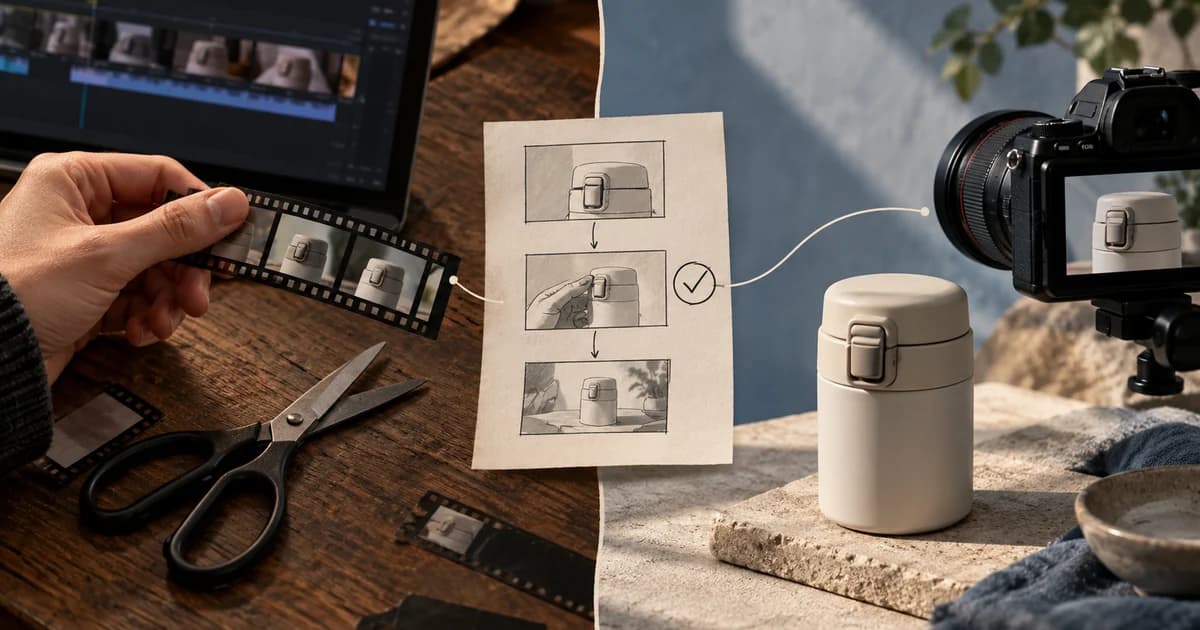
An edit is not automatically free, and a reshoot is not automatically billable. First classify the work. Then classify why it became necessary.
The approved UGC script says “Start your free trial.” Three days after the creator delivers, the campaign changes and the brand asks for “Book a demo.” The editable project and usable B-roll still exist, so the new version may need only a voiceover pickup and a short re-edit.
That sounds smaller than a reshoot. It is also probably new scope if the accepted order bought one CTA.
Now reverse the facts. The approved shot list required a sharp close-up of the product latch, but the only take is out of focus. Fixing it requires a new three-second pickup. That is technically a reshoot, yet it may be a scope-compliance correction rather than a new charge.
This is the central rule for UGC revisions versus reshoots: the production method does not decide who pays. Use two separate questions:
- What work is actually required—an edit, a pickup, a partial or full reshoot, or no production work at all?
- Why is it required—nonconforming delivery, an ambiguous brief, or a client change after approval?
Then check the accepted order, the applicable platform or provider terms, the approval stage, the files that still exist, the revision allowance, and the request deadline. This is an operational decision framework, not a universal legal entitlement.
Classify the Change on Two Axes
Teams often start with the wrong argument: “It is only a small edit” or “It requires a reshoot.” Those statements describe effort, not responsibility.
| Work required | Creator or provider missed an accepted requirement | Brief or approval is ambiguous | Client requests something new |
|---|---|---|---|
| Existing-footage edit | Usually a correction, subject to the order’s rules | Clarify which requirement controls before editing | Often a new version or deliverable to price |
| Voiceover or single-shot pickup | Can still be an included correction | Pause until wording, setting, product use, or approver is resolved | Usually new production if the original delivery conformed |
| Partial or full reshoot | May be required to cure nonconforming work | Responsibility is unresolved until the record is reconstructed | New production unless the accepted scope already included it |
| Rights-only change | Not a production revision | Check which license or order language controls | Handle separately from editing or shooting |
Current provider policies show why the distinction matters. Insense’s creator guidance says a reshoot may be necessary when content misses stated brief requirements, while content outside the original agreement may be accepted, repriced, or declined. The undated public UGC SHOP terms, checked September 8, 2026, go further: corrections caused by noncompliance with the approved brief or incomplete work do not consume the creator’s included revision round, while post-approval changes may add cost and time.
Neither policy is universal law. They are concrete examples of the same useful separation: new capture can be corrective, while a tiny edit can be additional scope.
Use observable facts, not adjectives
“Make it more premium,” “the hook feels weak,” and “we need a cleaner version” are not classifications. Replace them with inspectable facts:
- Which accepted requirement is allegedly unmet?
- Where is it written, and when was it approved?
- Does the delivered file actually conflict with it?
- Can the requested result be built from existing footage, audio, and project files?
- Does the request add a deliverable, claim, person, location, format, CTA, or usage term?
A low-performing ad is not automatically nonconforming work. A buyer’s changed preference is not automatically a creator error. Conversely, “the brand approved the script” does not excuse a delivery that mispronounces the brand name or omits a required demonstration.
Find the Agreement—and the Approval It Changed
The controlling record is rarely “the latest brief” in a shared folder. Start with the version that became part of the order.
Check five layers in this order:
- Accepted order, statement of work, or campaign record. Identify the purchased deliverables, duration, aspect ratios, talent, location, CTA, raw-file obligations, revision unit, and fee.
- Incorporated platform or provider terms. Confirm which version applied when the order was accepted and which commercial relationship it governs.
- Approval history. Separate concept, script, shot list, raw footage, base edit, captions, and final approval. Approval of one stage is not approval of every later choice.
- The change trail. Preserve the exact request, requester, timestamp, attachments, and the reason given.
- The change mechanism. Find the required platform button, support route, price-change request, or written variation. A casual “sure” may not update the order.
This version work is not bureaucracy. Public pages can describe different entitlements. Billo’s brand terms, effective June 1, 2026 make the accepted order details part of the contract and limit standard revisions to the agreed scope rather than new requirements or material changes. Twirl’s customer terms, updated June 30, 2023, describe one free revision, rising to two or three with larger credit purchases. Its current pricing page displays two, two, and three included rounds across three offers, while its August 11, 2025 revision policy lists a £60 variation for significant off-brief changes. Those pages do not reveal which package and terms governed a particular order. The safe move is to retrieve the accepted checkout or offer—not to let the newest marketing page rewrite the past.
The same principle applies to approvals. A script approval can establish that the spoken claim was agreed. It does not prove that a disputed set, wardrobe, framing choice, or final edit was approved unless those items were part of that approval.
Check What Footage and Files Actually Exist
“Use the existing footage” is only useful after someone inventories it. Keep these assets separate:
| Asset | What it may allow | What it does not guarantee |
|---|---|---|
| Final captioned export | Trims, crops, or a limited cutdown | Clean audio, removable text, or alternate takes |
| Clean export | New overlays, captions, or some CTA treatments | Individual source clips or an editable timeline |
| Raw clips | A new assembly if the required action was captured | The project file, licensed music, graphics, or every recorded take |
| Editable project | Text, timing, graphics, and sequence changes | A missing product action, person, location, or spoken line |
| New product, talent, or location | A genuinely new shoot | That the new production is included or approved |
The label “raw” is especially unreliable. Twirl’s raw-footage help page says its credits cover final UGC rather than individual raw clips; what it calls a “raw” version is a finished video without text overlays and music. A clean export can be useful, but it is not the same asset as all camera originals.
Availability is also time-sensitive. Twirl warns in its revision policy that creators may delete content or no longer have raw files after auto-approval. Record the inventory when the first delivery arrives: filenames, duration, resolution, clean versions, raw clips, project files, separate audio, and any stated retention period.
Read the Allowance and the Clock Separately
There is no defensible universal rule that every UGC package includes one, two, or three free revisions. Public policies use different numbers, units, exceptions, and clocks.
| Provider policy snapshot | Allowance or scope rule | Review or request clock | Why the unit matters |
|---|---|---|---|
| Billo, June 2, 2026 | Up to two requests per content item for each request type; reshoots address raw content that misses the original brief, while edit requests go to post-production | Creator guidance expects the revised video to be uploaded within 48 hours; platform auto-approval rules vary by account | A reshoot request and a post-production edit request are different stages |
| Insense | Up to three revision requests, aligned with the original brief | The platform’s stated process and chat record matter | Extra content is not converted into an included revision merely by calling it feedback |
| Influee, last updated September 2025 | Revisions can continue until content fits the Content Brief; that does not mean unlimited new concepts | The terms state 14 days for client review and seven days for a revision | The “unlimited” promise is bounded by the original brief |
| Collabstr, updated August 20, 2025 | In-scope revisions are allowed; beyond-scope requests may require a new order | 72 hours after submission before automatic approval | A late message is not necessarily the same platform remedy as an on-time revision request |
| JoinBrands, updated June 17, 2026 | One, two, three, or ten revisions per job depending on the plan described | Content Ready guidance gives brands ten days to approve or reject | “Per job” is the unit; a plan allowance is not a ruling about defective work |
| UGC SHOP, undated | One complimentary editing round; brief-mismatch or incomplete-work corrections are treated separately in the creator terms | Consolidated feedback is requested within three to five business days | Whether an error fix consumes a round can matter more than the headline number |
Treat this table as a comparison of named relationships, not an industry survey. Check the live order before acting. A plan may change, a custom brief may override a default, and a platform may distinguish a draft from a formal delivery. For example, Fiverr’s order guide says a shared draft does not count as a delivery or revision, while formal delivery starts the standard three-day review clock; Gigs requiring shipping have a 14-day auto-completion period.
The practical rule is simple: preserve both the allowance and the clock trigger. “Two rounds” is incomplete without the unit. “Seventy-two hours” is incomplete without the event that started it.
Six Change Requests, Six Conditional Decisions
The following cases are fictional teaching examples. The prices in Case 5 are illustrative inputs, not market rates.
1. The caption says “4 minutes” instead of “40 minutes”
Record: The approved script and voiceover say 40 minutes. The final caption says 4 minutes. The editable caption layer exists.
Decision: Existing-footage edit caused by a creator or editor export error. Treat it as a scope-compliance correction under terms that require the delivered version to match the approved script. Whether it consumes a named round still depends on the order.
Response:
The “4 minutes” caption in v1 is my export error; the approved script and audio say “40 minutes.” I’ll correct the caption under the scope-compliance correction and return v2 through the order channel. No additional creative fee is proposed. Please confirm whether the platform records this correction separately from the included revision round.
2. The required close-up is unusably soft
Record: The approved shot list requires the product latch to be shown clearly. The only close-up is out of focus, and no alternate take exists.
Decision: A three-second pickup is technically a reshoot, but the cause is nonconformance. Do not price a whole new concept. Replace the required shot and keep the original setting, product, framing purpose, and surrounding edit.
Response:
The required latch close-up cannot be repaired in the edit because there is no sharp alternate take. I’ll capture a replacement pickup for that approved shot rather than reshooting the full video. This is a correction to the existing requirement; please confirm the product and deadline are unchanged.
3. A new approver wants a “more premium” studio
Record: The script was approved. The brief contains a bright kitchen reference and a separate dark studio reference. After delivery, a new stakeholder asks for a dark luxury set and says the kitchen was never acceptable.
Decision: A new shoot may be required, but responsibility is not yet classifiable. The record does not show which visual direction controlled. Do not promise a free reshoot or issue a change fee before resolving the contradictory references and approval authority.
Response:
The script approval is clear, but the visual record contains both kitchen and dark-studio references. Please identify the approved setting requirement—or the approval that replaced it—and confirm who has final creative authority. Once that is resolved, I can classify the request as a correction or a new production change and provide the corresponding scope and schedule.
4. The product was used up before new instructions arrived
Record: A single-use sachet was consumed in the approved demonstration. After filming, the brand sends a different application sequence. No replacement unit is on hand.
Decision: Separate three questions. Was the sequence genuinely new, or was it already available and missed? Who supplies the replacement? Who pays shipping? If the creator ignored a clear pre-shoot instruction, the creative work may be corrective. If the sequence first appeared after filming, the new production may be a client change. Product and shipping costs do not automatically follow the creative-fee answer.
Response:
The sachet used for the approved demo has been consumed, and the revised sequence was sent after filming. Please share the instructions and packaging information available before the shoot. A replacement unit will be needed either way. Once the record is clear, we can confirm the creative-work treatment, who supplies and pays for the replacement and shipping, and a delivery date tied to arrival.
5. The approved CTA changes with the campaign
Record: The accepted 20–30-second video contains the approved CTA, “Start your free trial.” The campaign changes to “Book a demo.” Usable B-roll, a clean export, and the editable project exist; the new spoken line does not.
Decision: This is a client scope change if the order bought one CTA. Offer distinct outputs rather than one vague “reshoot fee.”
| Fictional option | Output | Illustrative subtotal |
|---|---|---|
| A | Remove the old spoken CTA and use the new CTA as text over existing B-roll | $35 |
| B | Record a voiceover pickup and replace the CTA over existing B-roll | $60 voiceover + $40 edit = $100 |
| C | Recreate the on-camera setup, capture the new line, and replace the ending | $85 setup + $55 capture + $40 edit = $180 |
The outputs are not equivalent. The $80 difference between Options B and C is not a measured saving or a quality claim; it reflects different fictional production inputs.
Response:
The approved script and v1 use “Start your free trial.” “Book a demo” is a new CTA for this campaign, rather than a correction to that version. Because usable B-roll and the editable project are available, I can provide one 20–30-second replacement with a voiceover pickup for a $100 subtotal before applicable tax. This excludes a new on-camera scene and any additional cutdown. Please approve the scope, tax treatment, and revised delivery date through the agreed order channel before production starts.
6. One email asks for a cutdown, a new person, and longer usage
Record: The accepted order covers one 30-second indoor video with one creator. After final approval, the brand asks for a 15-second cutdown from the same footage, an outdoor demonstration with a second person, and a longer usage period.
Decision: Split the email into three line items:
- 15-second cutdown: existing-footage edit; check whether the package already included it, otherwise quote an additional deliverable.
- Second person outdoors: new talent, location, permissions, and production; quote separately if it was not in the accepted scope.
- Longer usage: rights-only change; check the existing license and handle it separately from production. It may require no new file at all.
Response:
Your request contains three separate changes: a 15-second cutdown from existing footage, a new outdoor scene with another person, and an extension of usage. I’ll first check whether the cutdown and longer usage are already covered by the accepted order. Any additional editing, new production, and rights change will be listed separately with the applicable approval and fee basis. The new scene cannot be created from the footage already delivered. Please confirm which items you want quoted; this message does not itself approve additional work or reverse acceptance of the existing final.
Approve the Change Before Production Starts Again
A proposed fee is not an approved change. Use the change-control worksheet and six completed decision records to document the result. Turn the request into a compact decision record before anyone opens the project or sets up the camera.
| Decision-record field | What to write |
|---|---|
| Original scope | Order, brief, and version identifiers; purchased deliverables and exclusions |
| Approval stage | Concept, script, shot list, raw, base edit, captions, or final |
| Exact change | The old requirement and the requested replacement |
| Work required | Existing-footage edit, pickup, reshoot, new deliverable, or rights-only |
| Cause | Nonconformance, ambiguity, client scope change, or unresolved |
| Asset inventory | Final, clean export, raw clips, project, audio, product, talent, and location |
| Allowance and clock | Remaining unit, formal request route, trigger timestamp, and deadline |
| Commercial treatment | Included correction, proposed extra, product/shipping, tax status, and exclusions |
| Approval | Authorized person, platform channel, accepted subtotal, and accepted due date |
| Acceptance check | Observable conditions that make the changed version complete |
For the CTA example, a completed record would say: one replacement 20–30-second version; voiceover pickup plus existing B-roll; $100 subtotal; tax confirmation required before billing; no new on-camera scene or cutdown; authorized approval through the order channel; old CTA absent from audio and captions; new CTA consistent across both.
Use the platform’s actual change mechanism. Insense’s price-change workflow, for example, updates the deal only after the creator accepts the price-change request. Billo, by contrast, says reshoot and edit requests must use its designated request field rather than chat. “Keep it in writing” is not enough when the applicable platform defines which writing changes the order or stops a timer.
A reusable response can follow this structure:
Version [ID] meets [accepted requirement]. The new request changes [specific item]. The result requires [existing-footage edit / pickup / reshoot / new deliverable] because [asset fact]. Under [order or policy reference], I classify it as [included correction / unresolved pending clarification / additional scope]. I can deliver [defined output] for [subtotal and tax status], excluding [explicit exclusions], by [date tied to approval or product arrival]. Please approve through [required channel] before additional work starts.
So, Who Pays?
The defensible answer is conditional:
- The creator or provider generally absorbs the correction when a clear, accepted requirement was missed and the applicable agreement includes scope-compliance corrections—even when the fix requires a pickup or reshoot.
- The brand generally pays for additional work when the delivered content met the accepted brief and the brand adds or replaces a requirement, deliverable, person, location, format, or CTA.
- Nobody should restart production yet when the brief, reference files, approval authority, or timing of instructions is genuinely ambiguous. Reconstruct the record first, then agree how the cost is handled.
- The applicable platform process controls its own remedy. A missed review window, wrong request channel, custom order, or plan-specific allowance can change what the platform will recognize without deciding every possible legal claim between the parties.
Do not ask “edit or reshoot?” as if it settles the invoice. Ask what changed, why it changed, what evidence controls, what assets remain, and what the accepted agreement says happens next. That turns a subjective revision argument into a change order both sides can inspect.
Sources
- For Brands: How to request edits and reshoots — Billo, June 2, 2026.
- For Creators: Working on Reshoot Requests — Billo, May 29, 2026.
- Terms of Service for Brands — Billo, effective June 1, 2026.
- Reshooting content and brand revisions — Insense, page checked September 8, 2026.
- The content I received is not good/did not follow the brief. What should I do? — Insense, page checked September 8, 2026.
- How to change the price of a collaboration — Insense, page checked September 8, 2026.
- Terms of Service — Influee, last updated September 2025.
- Managing Content Submissions & Revisions — Collabstr, updated August 20, 2025.
- Brands: Finding the Perfect Subscription Plan to Suit Your Needs — JoinBrands, updated June 17, 2026.
- Brands: A Guide to Job Status and Timers — JoinBrands, updated June 10, 2026.
- Terms & Conditions — UGC SHOP, undated public terms checked September 8, 2026.
- Terms & Conditions — Twirl, updated June 30, 2023.
- Revision Request Policy — Twirl, August 11, 2025.
- Pricing — Twirl, page checked September 8, 2026.
- Can Creators Submit The Raw Footage As Individual Clips? — Twirl, August 1, 2024.
- Managing your orders: A freelancer’s guide to the Fiverr order process — Fiverr, page checked September 8, 2026.