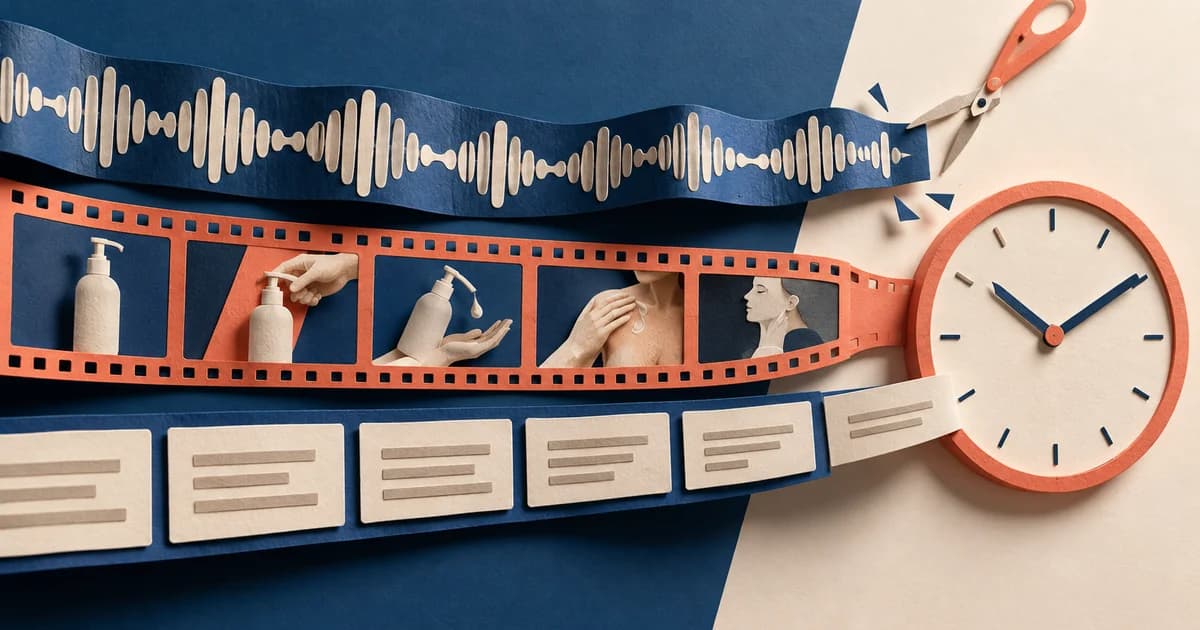
A voiceover can finish in eight seconds while the video still runs long. The product may not have finished moving. A price condition may not have stayed on screen long enough to read. The call to action may arrive before the proof.
That is the central mistake in many short scripts: timing the words while treating the video as decoration.
A workable 15-second script needs one dominant communication job and three coordinated tracks:
- Voiceover or dialogue: what the viewer hears.
- On-screen text: what must remain visible, including prices, limits, and disclosures.
- Shot or product action: what must happen on camera for the claim to be believable.
The four scripts below use the same fictional product brief so the strategic difference is easy to see. They are original teaching examples, not real campaigns or performance-tested formulas. Their voiceovers were rendered with the same offline synthetic voice and measured. Their visual windows are proposed production targets, not observed footage or a substitute for a human read, prop rehearsal, small-screen check, and final export measurement.
Choose one job before you start compressing
“Demo,” “testimonial,” “offer,” and “objection” are not four magic formulas. They are four different answers to the question: What must this ad accomplish before it ends? One ad can contain elements of several jobs, but a 15-second cut usually needs one of them to dominate.
| Communication job | The question it answers | What the video must communicate beyond voiceover | Poor fit when… |
|---|---|---|---|
| Demo | What does the product do? | The actual action, state change, or interface result | The result is invisible, takes days, or needs too many sequential steps |
| Testimonial-style | What was the person’s relevant experience? | A genuine, permissioned source—or an unmistakably fictional dramatization | No real account exists, the edit changes its meaning, or the claim needs more context |
| Offer | What exactly can the viewer get? | Price, material conditions, eligibility, geography, and a matching destination | Qualifications overwhelm the offer or change too frequently to keep the ad accurate |
| Objection-response | Can you answer one specific concern? | The question, the proof, and the limit of that proof | The answer needs a compatibility matrix, safety explanation, or evidence you cannot show |
A 15-second brief is also not a universal platform law. Current TikTok documents differ by product: Auction In-Feed specifications allow much longer Non-Spark uploads, while TopView specifications list 5–60 seconds and recommend 9–15 for certain assets. Google similarly distinguishes a 7–15-second standard non-skippable format from other video campaign subtypes and YouTube TV lengths, which include 6-, 15-, 30-, and 60-second options. Treat 15 seconds as the selected placement and production target, then recheck that placement’s current requirements before delivery.
Write the script in three tracks, not one paragraph
A conventional AV script puts audio beside visuals. StudioBinder’s AV script guide describes the familiar two-column format. For a short performance ad, it is useful to separate the visual side again: one column for on-screen text and one for the shot or action. That forces the team to answer two different questions:
- What information has to be readable?
- What action has to be seen rather than merely claimed?
Parallel tracks can share clock time, but they do not create free attention. A person can hear “two positions” while the hand changes the stand and the same words appear on screen. Those events overlap mathematically. They may still compete perceptually.
A 2018 qualitative study commissioned by the UK Advertising Standards Authority asked 138 television viewers about superimposed text. It found that legibility problems were cumulative: text duration, size, contrast, background movement, creative distraction, and competing text could all matter. That study is not a US mobile-viewing benchmark, but it supports a practical production point: adding a text layer does not make its reading time disappear. See the Define Research report.
A real transcript also does not reveal the full AV timeline. For example, an Australian Government 15-second Bulk Billing advertisement reports a 0:15 duration and publishes a transcript containing the service proposition, CTA, and government authorization. That verifies the player duration and spoken copy on the page. It does not tell us, without inspecting the media, when each visual appeared or how long the CTA remained readable.
The useful rule is therefore:
Measure the final timeline from the earliest required start to the latest required end. Do not add simultaneous tracks together—but do add actions that must happen in sequence.
The controlled fictional brief
All four examples use Phone Stand A, a fictional foldable desktop phone stand. It opens into two positions. Its lower opening leaves room to connect the shown phone and shown cable. The fictional price is $18 plus $4 shipping and applicable sales tax, available only in the contiguous United States. The CTA is to check product details and compatibility.
Those facts deliberately do not establish universal device compatibility, charging performance, durability, ergonomic benefits, scarcity, a discount, free shipping, or a real product page. There is no real customer account. Holding the brief steady lets us compare the communication job without quietly changing the product or evidence.
For the production check, the complete voiceovers were generated with eSpeak 1.48.15, an offline en-us synthetic voice requested at 165 words per minute. Exact WAV durations were measured with media-probe tooling. These are voice-track measurements only; they do not establish human delivery, action timing, text comprehension, edit rhythm, or platform acceptance.
| Script | Words | Measured synthetic VO | What the measurement does not prove |
|---|---|---|---|
| Demo | 18 | 8.178 s | That unfolding, placement, two-position proof, and CTA fit |
| Fictional testimonial-style | 21 | 8.507 s | That a real customer said it or that the label is readable |
| Offer | 22 | 10.747 s | That the price and conditions receive enough visual hold |
| Objection-response | 21 | 8.406 s | That the cable action is clear or representative of other devices |
Notice that the 22-word offer took more than two seconds longer than the 21-word objection in the same synthetic setup. Word count is useful for screening drafts, but it is not a measured duration until the actual words are performed.
1. Demo script: let the action carry the claim
A demo is strongest when the viewer can verify the product’s central action. Do not spend the opening on a logo animation and then narrate a feature the camera never proves.
Complete voiceover:
Unfold Phone Stand A. Set your phone down. Choose between two positions. Check the product details and compatibility.
| Proposed window | Voiceover | On-screen text | Shot or action |
|---|---|---|---|
| 0–3 s | Unfold Phone Stand A. | Phone Stand A · Fictional product |
Start on the folded stand. Complete one clean unfolding motion without hiding the hinge under the hand. |
| 3–6 s | Set your phone down. | Set your phone down |
Place the same phone on the opened stand. Hold long enough to see that it is seated. |
| 6–11 s | Choose between two positions. | Two positions |
Show position one, then change to position two from a consistent angle so the edit does not imply two different products. |
| 11–15 s | Check the product details and compatibility. | Product details + compatibility |
Keep the stand in use while the CTA appears. Do not cover the product with the CTA block. |
The measured synthetic voiceover is 8.178 seconds. That leaves clock time in a 15-second container, but not automatically enough action time. The stand has to open before the phone can be placed; the second position cannot be shown until the phone is seated. Those dependencies are sequential.
Cut rule: remove decorative setup first. If the second-position change still cannot be shown clearly, remove the “two positions” claim, overlay, and action together. Do not retain the claim over footage that proves only one position. When two positions are the main buying reason, keep the proof and choose a longer format instead.
2. Testimonial-style script: never manufacture the customer
The following example is an obviously fictional role-play, not a customer quote, review, or proof of satisfaction. Its persistent visual label is part of the concept, not a legal footnote to hide at the end.
Complete fictional dialogue:
Fictional example. I want my phone propped up at my desk. I can choose between two positions. Check the product details.
| Proposed window | Voice or dialogue | On-screen text | Shot or action |
|---|---|---|---|
| 0–2 s | Fictional example. | FICTIONAL EXAMPLE — NOT A CUSTOMER TESTIMONIAL |
Show the role performer or their hands with the product. Do not add a name, star rating, customer title, or review card. |
| 2–6 s | I want my phone propped up at my desk. | Keep the fictional-example label visible; optional dialogue captions below it | Place the phone on the stand as a present-tense dramatization of the need. Do not imply months of prior use. |
| 6–11 s | I can choose between two positions. | Persistent label + Two positions |
Show both positions. Do not add invented outcomes such as less pain, better focus, or improved productivity. |
| 11–15 s | Check the product details. | Persistent label + Check product details |
Hold the real product state and CTA. The fictional label remains through the end. |
The synthetic dialogue measures 8.507 seconds. Its real constraint is not only pace; the viewer must understand that the scene is a teaching dramatization rather than social proof.
For a genuine testimonial, replace this dialogue with a permissioned account drawn from what the person actually said and experienced. The FTC’s Endorsement Guides FAQ says endorsements must reflect honest opinions and cannot make claims the marketer could not legally make. It also explains that a disclosure placed only in a TikTok or YouTube description can be missed, and that a representation made both visually and audibly is more likely to need disclosure in both modes.
The FTC’s Consumer Reviews and Testimonials Rule Q&A adds two useful production boundaries. A business should not supply testimonial text without a reasonable basis for believing it is truthful about the person’s experience. An obviously fictional dramatization is not itself a testimonial, although actors presented as testimonialists can still create a deceptive impression. A public review featured in advertising also becomes testimonial material. Public visibility does not make its source or meaning irrelevant, and usage rights remain a separate production check. The FTC describes these pages as staff guidance, not a safe harbor; the facts and context still matter.
Cut rule: shorten an optional setup phrase before cutting the fictional label, a material-connection disclosure, or a qualification that makes the account true. For a real testimonial, never combine fragments into a stronger experience the customer did not describe.
3. Offer script: make the conditions part of the offer
An offer ad is not automatically a discount ad. Its job is to make the transaction understandable enough that the CTA does not contradict the destination.
Complete voiceover:
Phone Stand A. Eighteen dollars, plus four dollars shipping and applicable sales tax. Contiguous United States only. See product details and compatibility.
| Proposed window | Voiceover | On-screen text | Shot or action |
|---|---|---|---|
| 0–2 s | Phone Stand A. | Phone Stand A · Fictional offer |
Begin unfolding the stand in the actual scene rather than spending two seconds on a separate title card. |
| 2–8 s | Eighteen dollars, plus four dollars shipping and applicable sales tax. | $22 before applicable sales tax$18 stand + $4 shippingContiguous U.S. only |
Place the phone while the price block settles into one stable reading area. Do not rotate through extra promotion messages. |
| 8–11 s | Contiguous United States only. | Keep the full price and territory block visible | Show the stand in use. Avoid introducing another feature headline while the viewer is reading conditions. |
| 11–15 s | See product details and compatibility. | Price block remains + Product details + compatibility |
Hold the product state and CTA together. Keep the conditions unobscured. |
The arithmetic is simple and complete: $18 + $4 = $22 before applicable sales tax. No tax-inclusive total can be calculated without the applicable rate and transaction facts. The synthetic voiceover measures 10.747 seconds, the longest of the four reads.
The production risk is trying to “save time” by deleting information that changes the transaction. Current TikTok ad-format policy requires the ad, caption, CTA, promoted product, and landing page to be consistent. Even outside TikTok, that is a useful operational test: if the landing page adds shipping, geography, or eligibility conditions that materially change the spoken offer, the short script is not complete merely because the price line sounds cleaner.
Cut rule: remove a decorative product move or redundant spoken repetition before removing shipping, tax treatment, territory, or eligibility. If the conditions cannot remain readable without dominating the screen, use the 15-second cut as a simpler product introduction and move the full offer to a longer, accurately qualified format.
4. Objection-response script: prove the limited answer
An objection ad should not name a concern and then leap to a universal promise. The response must stay as narrow as the evidence on screen.
Complete voiceover:
Can the cable reach? With this phone and cable, yes. The opening leaves room to plug in. Check the compatibility details.
| Proposed window | Voiceover | On-screen text | Shot or action |
|---|---|---|---|
| 0–3 s | Can the cable reach? | Cable access? |
Start with the phone already on the stand. Show the lower opening and the unplugged cable in the same frame. |
| 3–8 s | With this phone and cable, yes. | Shown phone + shown cable only |
Align and insert the connector without hiding the critical moment under a hand or jump cut. |
| 8–11 s | The opening leaves room to plug in. | Keep Shown phone + shown cable only visible |
Hold the opening, connected cable, and phone together. Do not add a charging-speed claim or battery animation. |
| 11–15 s | Check the compatibility details. | Check compatibility |
Keep the bounded proof on screen while the CTA appears. Do not montage untested devices. |
The synthetic voiceover measures 8.406 seconds. The physical action is the likely pacing risk: the connector must be visible before, during, and after insertion. Speed-ramping or cutting around the insertion may make the film shorter while removing the proof.
Cut rule: the explanatory sentence “The opening leaves room to plug in” is the first spoken line to remove because the shot can carry that meaning. The remaining 14-word version keeps the question, bounded answer, and CTA. If the plug-in action itself is not clear in the available time, do not broaden the copy; use a longer demo or send the viewer to a compatibility page.
Timing pass: why an eight-second read can still create a 15.8-second ad
Consider an overloaded version of the demo. The following action durations are illustrative assumptions, not observed rehearsal data:
| Sequential dependency | Assumed duration | Cumulative end |
|---|---|---|
| Unfold the stand | 3.2 s | 3.2 s |
| Place the phone | 3.8 s | 7.0 s |
| Change to the second position | 3.0 s | 10.0 s |
| Hold the critical view | 1.8 s | 11.8 s |
| Hold the final product state and CTA | 4.0 s | 15.8 s |
The estimated path is 3.2 + 3.8 + 3.0 + 1.8 + 4.0 = 15.8 seconds, so it misses a 15-second target by 0.8 seconds. The demo voiceover’s measured synthetic duration of 8.178 seconds does not fix that dependency chain.
Suppose the second position is useful but not essential to this particular cut. Remove the three-second position change and its associated claim and overlay. The revised voiceover is:
Unfold Phone Stand A. Set your phone down. Check the product details and compatibility.
That 14-word synthetic read measures 6.142 seconds, 2.036 seconds shorter than the original synthetic read. The revised assumed action path is 3.2 + 3.8 + 1.8 + 4.0 = 12.8 seconds, leaving 2.2 seconds of arithmetic room against the target.
Do not add the three-second action saving and the 2.036-second audio saving and claim a 5.036-second improvement. The voice and action can overlap. The final reduction depends on which track previously ended last. The correct lesson is to remove a claim-and-proof pair, rebuild the shared timeline, and measure again.
Apply the same logic to the other structures:
- Testimonial-style: shorten optional context, not the fictional label, real disclosure, or words that preserve the source account’s meaning.
- Offer: cut decorative motion or repeated price language, not a condition that changes the transaction.
- Objection: cut a redundant explanation before cutting the bounded proof or hiding the product action.
Download the four-script CSV and timing notes. Listen to the synthetic teaching reads: Demo, Fictional testimonial-style, Offer, Objection-response, Revised demo. These are rough machine reads, not final voiceovers.
Before you call the script filmable
A completed AV table is a preproduction document, not a 15-second certificate. Run these checks with the actual product, performer, edit, and placement:
- Claim check: connect every spoken and written claim to a visible action, verified fact, or substantiation record.
- Human read: record the final words in the intended tone. Measure from the first audible sound to the end of the required performance, including deliberate pauses.
- Action rehearsal: film or time the actual unfold, placement, position change, plug-in, and CTA hold. Record failed attempts rather than choosing only the fastest lucky take.
- Reading check: review the creative at delivery size with platform UI and captions present. TikTok’s current specifications note that safe zones can change with caption length and add-ons; the preview can also differ by device.
- Disclosure check: evaluate a testimonial cut on its own. A disclosure in a longer source video or description does not automatically disclose the relationship in the 15-second version.
- Destination and CTA check: make sure the CTA describes a real action. TikTok policy explicitly gives “Swipe up to learn more” as an invalid instruction where swiping simply advances to the next video.
- Final export check: measure the encoded file, not the edit decision list or script estimate. Confirm the selected placement’s duration, aspect ratio, audio, safe-zone, and file requirements on the delivery date.
A sound-off comprehension review can be valuable, but it does not mean the uploaded file may be silent. TikTok’s April 2026 ad-format policy, for example, says covered ads must contain audio and must not rely primarily on static images. Creative accessibility, audience comprehension, and platform acceptance are related checks, not interchangeable ones.
When 15 seconds is the wrong answer
Use a longer format when the evidence cannot be compressed without becoming misleading or visually unintelligible. A product whose outcome develops over weeks needs more than a fast montage. A customer story may need the condition that explains why the experience was positive. A financial or subscription offer may need qualifications that cannot be treated as miniature end-card text. A compatibility objection may require several devices rather than one bounded demonstration.
A short testimonial can also be a teaser rather than the whole account. One production write-up from BULLET describes creating a longer testimonial film and a 15-second teaser. That is a practitioner’s production pattern, not proof that the shorter cut performs better. The useful idea is structural: let the short asset earn attention for the complete, permissioned story instead of rewriting the whole story into an overconfident sentence.
Fifteen seconds is enough when one clear job, one bounded proof, and one honest next step can share the screen. It is too short when the only way to fit is to talk faster, hide a condition, fake a customer, or cut around the very action that makes the claim true.
Sources
- Ultimate AV Script Template to Write Better Ads — StudioBinder, April 4, 2025.
- TikTok Auction In-Feed Ads — TikTok for Business, last updated June 2026.
- Ad format and functionality — TikTok for Business, last updated April 2026.
- TopView ad specifications — TikTok for Business, last updated June 2026.
- Non-skippable in-stream ads — Google Ads Help, checked September 8, 2026.
- About video ad formats — Google Ads Help, checked September 8, 2026.
- About YouTube TV ad formats — Google Ads Help, checked September 8, 2026.
- FTC’s Endorsement Guides: What People Are Asking — Federal Trade Commission; Guides revised in 2023, page checked September 8, 2026.
- The Consumer Reviews and Testimonials Rule: Questions and Answers — Federal Trade Commission; rule effective October 21, 2024, page checked September 8, 2026.
- Superimposed text in TV advertising — Final Report — Define Research for the Advertising Standards Authority, November 2018.
- Bulk Billing for all Australians Campaign — 15 second advertisement — Australian Government Department of Health, Disability and Ageing, January 23, 2026.
- How can I get the most out of a testimonial video? — BULLET, May 2, 2018.