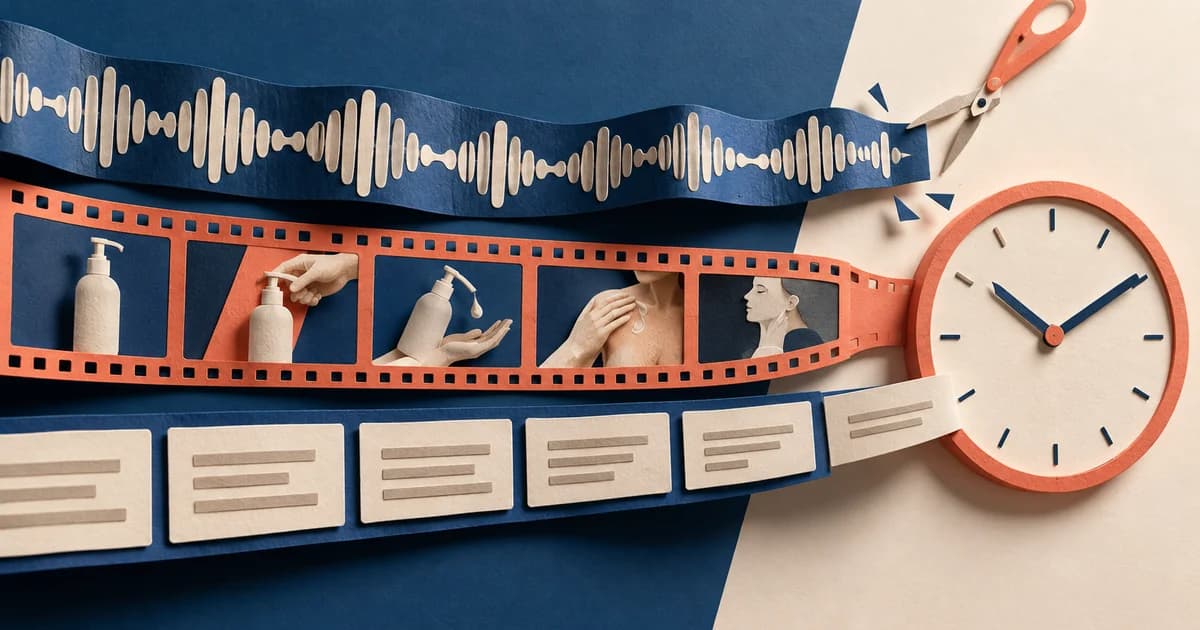
You can write 50 hooks for one product and still have only one ad angle.
“Coffee still hot at 3 p.m.”, “Your afternoon coffee, still warm,” and “Stop reheating your coffee” may look like three creative ideas. But if all three ask the buyer to choose the product for the same reason—keeping a drink warm until later—they are one angle expressed three ways.
That distinction matters because creative teams often respond to fatigue by rewriting openings, swapping creators, or changing scenes while leaving the persuasion premise untouched. Those variations can still be useful. They are just not the same thing as finding a new reason to buy.
For this article, an ad angle is a proposed reason to choose the same product in a particular situation. That is a deliberately narrow working definition, not an industry-standard taxonomy. Practitioners use “angle” at different levels: some include emotions, personas, proof devices, formats, or storytelling styles. Adheart, for example, defines an angle as the perspective from which a product is presented, while Motion separates an angle from the hook that expresses it.
The practical test is simpler: what changed in the buyer’s decision?
Angle, hook, feature, proof: keep the jobs separate
A useful creative brief can keep these terms in different columns even when a single line of copy performs more than one job.
| Term | Working meaning in this article | Example |
|---|---|---|
| Feature | A documented property of the product | Vacuum-insulated stainless-steel bottle |
| Benefit | A consequence the user may get from that property | A drink stays warm for a later break |
| Angle | The reason to choose the product in a specific situation | “I prepare coffee now and want it warm when my break starts” |
| Hook | The opening that earns attention and can express the angle | “Your 3 p.m. coffee doesn’t have to start at 2:55” |
| Proof | Evidence that supports the claim | Product specification, demonstration, test, review, comparison |
| Objection | A reason the buyer may hesitate | “Will this be annoying to clean?” |
| Offer | The commercial terms around the product | Price, bundle, discount, guarantee |
| Execution | The actual creative treatment | Desk photo, creator demo, print ad, animation |
| Format | The delivery container | Static, video, carousel, email, display ad |
A testimonial, for example, is usually proof, not automatically a new angle. A discount is an offer, not a new product benefit. A new UGC creator can be a new execution while the underlying buying reason stays identical.
This is not just a vocabulary argument. A 1990 Journal of Consumer Research paper explicitly distinguished cosmetic variation—changing elements such as color, layout, or presentation while keeping the substantive message—from substantive variation, where the product arguments change. Its experiments concerned attitudes under particular repetition and relevance conditions, not modern conversion campaigns, but the distinction is still a useful warning against counting every visual change as a new persuasion premise. Read the paper.
Real ads show why the distinction gets messy
Consider two professional WD-40 print campaigns archived by Ads of the World. In the 2011 set, “Genius” and “Swearing” use different jokes and imagery, but our reading of both is the same immediate purchase premise: I need to free a stuck or rusty part. The hook changed; the reason to buy did not. In the same campaign family, “Liberty” broadens the message toward keeping WD-40 around for multiple workshop jobs. That is not completely unrelated to the stuck-part use case; it is a broader parent premise that contains it. See the 2011 WD-40 campaign record.
Now look at IKEA’s 2026 FRAKTA “Point-Of-You” work. The agency describes the bag across picnics, laundry, parties, beach days, and last-minute packing. Those scenes make the product feel relevant in more moments. But a picnic scene and a laundry scene are not automatically two distinct buying motives. The underlying reason may still be “I need a cheap, capacious thing to carry this load.” A new occasion can reveal a new competitor or constraint—but you have to identify that changed decision before counting a new angle. See the agency’s FRAKTA campaign description.
None of these public records tells us which angle converted better. They are examples of message structure, not “winning ads.”
A controlled exercise: 12 candidate angles for one insulated bottle
To make the method concrete, we will freeze the product instead of quietly adding features whenever an idea needs them.
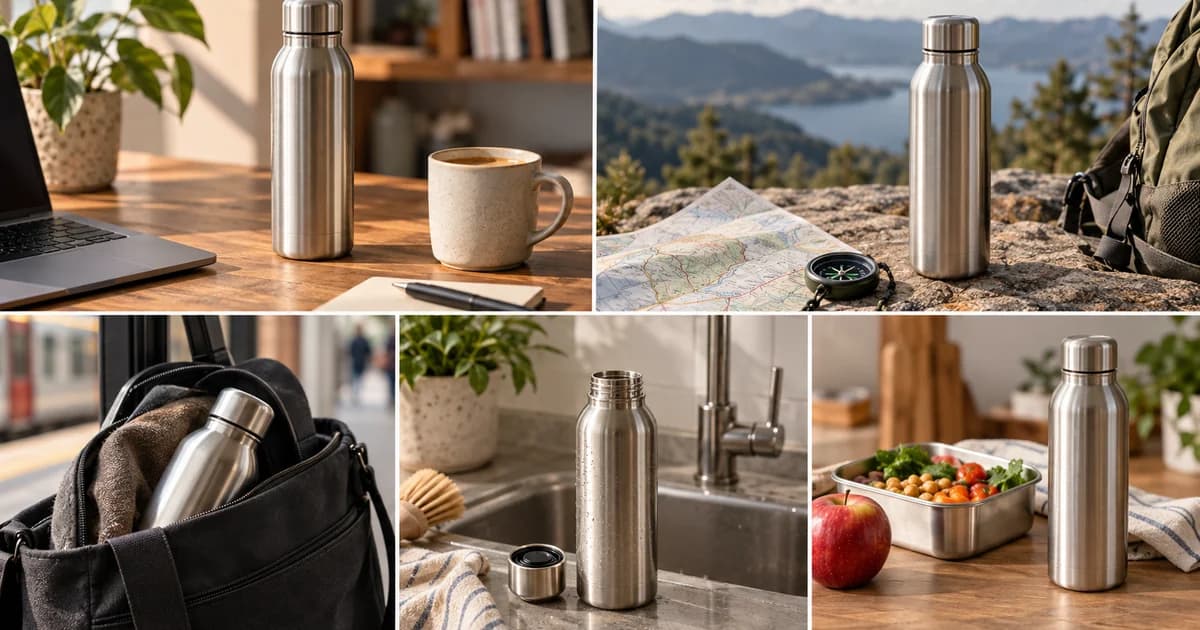
The reference product is the US Thermos 16oz Stainless King Beverage Bottle, item SK2000MDB4. On September 8, 2026, the manufacturer listed it at $29.99, with 16 oz / 475 ml capacity, double-wall vacuum insulation, a built-in serving cup, a twist-and-pour stopper, and manufacturer claims of up to 18 hours hot and 24 hours cold. Thermos also describes the lid as leak-proof when fully closed. These are manufacturer claims, not measurements performed for this article. Thermos product page.
The care guide matters just as much as the feature list. It instructs users to pour into the lid-cup rather than drink directly from the container or stopper; says the product is not recommended for use by children; and warns against carbonated drinks and dry ice. It also gives specific washing and gasket-care instructions. Thermos Care and Use Guide.
The copy below is original teaching copy, not a Thermos campaign and not tested advertising. The point is to see which ideas survive once the product truth, alternative, objection, and proof requirement are written down.
| # | Candidate buying reason | Illustrative copy | Proof needed before publishing | Decision |
|---|---|---|---|---|
| 1 | Keep a prepared hot drink warm until a later break | “Make coffee at 8. Drink it warm when your break finally arrives.” | Manufacturer retention claim; do not imply our own test or guarantee taste | Keep — thermal continuity |
| 2 | Keep cold water cold until later | “Cold water for the break you won’t get for another six hours.” | Manufacturer cold-retention claim; actual use conditions if made more specific | Merge with #1 |
| 3 | Close the drink before putting it in a bag | “Close it, pack it, then get on with your commute.” | Correct closure instructions and leak-proof claim; no absolute “nothing can leak” promise | Keep — closed transport |
| 4 | Fit a specific cup holder or bag pocket | “The bottle that actually fits your center console.” | Exact dimensions of the user’s compartment and the exact bottle; “fits most” is not “fits yours” | Hold |
| 5 | Avoid packing a separate drinking cup | “Your bottle already brought the cup.” | Built-in serving cup and correct pour method | Keep — fewer separate items |
| 6 | Replace some bought coffees with coffee from home | “Skip some coffee-shop runs. Bring the one you made.” | Real replacement behavior and honest cost inputs; the bottle alone does not create savings | Keep, conditional — purchase substitution |
| 7 | Have your preferred drink available where you take a break | “Your break room has coffee. It just isn’t your coffee.” | Evidence that the context exists for the intended audience; no taste or health superiority claim | Keep, conditional — preferred-drink access |
| 8 | Make cleaning easy | “A bottle that won’t become another cleaning project.” | Comparative cleaning evidence; current manual shows real care steps | Merge into objection/proof |
| 9 | Avoid another disposable cup | “Bring one reusable container instead of taking another cup.” | Defined comparison and environmental substantiation if claiming impact beyond the action itself | Hold |
| 10 | Buy something that needs replacing less often | “Buy the bottle you won’t be replacing next season.” | Comparative durability/replacement data; warranty length alone is not lifetime performance | Hold |
| 11 | Enjoy carrying something that looks good | “A bottle you don’t mind leaving on the desk.” | Mostly subjective; stronger evidence needed for any social-status claim | Hold |
| 12 | Give a useful gift that fits someone’s routine | “A gift they might actually take to work tomorrow.” | Recipient fit plus any packaging, engraving, delivery, or return claims actually offered | Hold |
The useful outcome is not “we found twelve angles.” It is that the audit leaves five distinct angle families, plus one merged thermal variation, one objection layer, and five ideas that need better evidence or a stronger reason to exist.
That is what good angle development often looks like: generate broadly, then delete aggressively.
The five angle families that survive
1. Thermal continuity
The purchase reason is not “vacuum insulation.” That is the feature. The reason is: I prepare a drink now and want its temperature preserved until a later moment.
That gives you many hooks without pretending each one is a new angle:
- “Your second meeting shouldn’t decide your coffee temperature.”
- “Made at 8. Still there for the 2 p.m. break.”
- “Cold water for later, not just for the walk out the door.”
Hot and cold can deserve different executions because the scenes, season, and objections change. But unless the buyer’s decision changes, they remain one broader temperature-continuity family.
2. Closed transport
Now remove temperature from the premise entirely: I need to close my drink before it goes into my bag.
That is a different job. The competitor is not “a bottle that loses heat faster”; it may be an open mug or another container the buyer does not trust for transport.
The proof should focus on how the product closes and what the manufacturer actually claims. Do not jump from “leak-proof when fully closed” to “your laptop is guaranteed safe.” The first is a product claim. The second is a much broader outcome.
3. Fewer separate items
The built-in serving cup supports a small but distinct convenience premise: I do not want to pack a bottle and a separate cup.
That sounds modest—and that is fine. Angles do not need to sound revolutionary. They need to matter in a real decision.
The execution could show a bag-packing checklist or a break routine. But the product’s own use guide should shape the scene: this bottle is designed to pour into the lid-cup, not to be shown as a direct-sip bottle.
4. Purchase substitution
Savings is not “a money angle” just because the headline contains a dollar sign. You need a real alternative purchase that stops happening.
Here is a deliberately hypothetical calculation:
- All-in acquisition cost: $36
- Bought drink replaced: $4.00
- Home-prepared drink: $0.70
- Incremental cleaning cost: $0.10
- Net difference per replaced purchase: $3.20
Break-even is ceil(36 / 3.20) = 12 replaced purchases.
If the bottle is carried 20 times and actually replaces 20 purchases, the hypothetical net is 20 × 3.20 − 36 = $28. If it is carried 20 times but replaces only five purchases, the net is 5 × 3.20 − 36 = -$20.
Carry days are not replaced purchases. That denominator is the difference between an economic angle and decorative savings copy.
The $36, $4.00, $0.70, and $0.10 figures are teaching inputs, not market averages or observed customer data. The Thermos page’s current $29.99 item price is also not the same thing as a real shopper’s all-in acquisition cost.
5. Preferred-drink access
Suppose the break-room coffee is free. The savings angle disappears—but another reason may remain: I want the drink I prepared, not simply whatever drink is available there.
This is a useful semantic test. Remove the word “warm.” If the reason still matters, it is not just the thermal angle. Set both options to the same price. If it still matters, it is not just savings.
But this angle is conditional on a real context. A Reddit thread or a handful of reviews can surface situations worth investigating; they cannot establish a representative customer segment or prove an ad will work. Treat anecdotes as hypothesis inputs, not market-size data.
How to tell whether two ideas are actually different angles
When two concepts feel different, normalize them before you count them.
Write each one as:
In [context], I choose this product over [alternative] because [purchase reason], despite [objection].
Then run four checks.
1. Remove the hook. If two clever openings reduce to the same sentence, you probably have one angle with multiple hooks.
2. Remove the visual. If “office,” “beach,” and “gym” all reduce to “I need to carry my stuff,” you may have occasion variation rather than three motives. Ask whether each occasion introduces a different alternative, constraint, or desired outcome.
3. Neutralize one variable. Set price equal. Remove the temperature benefit. Remove the persona label. If the reason collapses, you have found what the angle actually depends on.
4. Ask what proof would falsify it. A real angle should be vulnerable to facts. “Fits my cup holder” fails if the dimensions do not fit. “Saves me money” fails if purchases are not replaced. “Easier to clean” fails if you cannot support the comparison.
This is a semantic editorial check, not an empirical similarity score. Two people can reasonably disagree about borderline cases. The discipline is making the disagreement explicit instead of silently inflating the angle count.
Start with product truth, then move outward
If you want more angles, do not begin with a list of emotions. Begin with five inputs:
- Product truth: What is documented or directly observable?
- Context: When and where does the buyer use it?
- Alternative: What are they doing, buying, carrying, or tolerating instead?
- Consequence: What changes if they switch?
- Proof: What would you need to support the claim you want to make?
That sequence prevents a common failure mode: starting with “sustainability,” “status,” “busy moms,” or “save money,” then forcing the product to support whatever the creative team already wanted to say.
It also reveals where research belongs. Reviews can suggest awkward cleaning routines, commute constraints, or moments when the desired drink is unavailable. Product manuals can invalidate an execution before you shoot it. Customer interviews can tell you whether the alternative you invented is real. Support tickets can expose objections. Price histories can make or break a savings premise.
The angle comes from the relationship between those inputs, not from the label you put on the brainstorm board.
A clear angle is still only a hypothesis about performance
Once you have a truthful, distinct premise, you have improved the quality of the hypothesis. You have not proved it will sell better.
That final distinction matters for both measurement and compliance. In the US, the FTC’s advertising substantiation policy says advertisers should have a reasonable basis for objective express and implied claims before they disseminate them. The required support depends on the nature of the claim and what the ad communicates. FTC Policy Statement Regarding Advertising Substantiation.
Commercial testing is a separate question. If you compare one polished video for Angle A with one weak static for Angle B, you are not learning only about the angle. If you change the landing page too, you are testing a message-plus-page bundle. If the platform allocates delivery unevenly, that is not automatically a clean randomized angle experiment.
So keep three questions separate:
- Is the claim true enough to publish? → substantiation/product validation.
- Is the premise meaningfully different? → semantic/editorial QA.
- Does it perform better for this audience, offer, and campaign? → campaign validation.
That separation is the real value of an angle system. It lets you produce more creative without pretending that every new headline is a new idea—or that every plausible idea is already a winner.
Sources
- Thermos Brand — “16oz Stainless King™ Beverage Bottle”. Product page; checked September 8, 2026.
- Thermos L.L.C. — “Care and Use Guide: Vacuum Insulated Stainless Steel Beverage Bottle”. PDF; checked September 8, 2026.
- Ads of the World / O’Leary and Partners — “WD-40: Genius, Swearing, Liberty, Duvet”. US print campaign, January 2011; checked September 8, 2026.
- NoA Åkestam Holst — “IKEA – FRAKTA Point-Of-You”. 2026 campaign page; checked September 8, 2026.
- David W. Schumann, Richard E. Petty, D. Scott Clemons — “Predicting the Effectiveness of Different Strategies of Advertising Variation: A Test of the Repetition-Variation Hypotheses”. Journal of Consumer Research, September 1990.
- Federal Trade Commission — “FTC Policy Statement Regarding Advertising Substantiation”. November 23, 1984; checked September 8, 2026.
- Adheart Team — “What is an ad angle: breaking it down with examples”. September 11, 2025; checked September 8, 2026.
- Motion — “What is Creative Strategy? 7 Steps & Examples for DTC”. Checked September 8, 2026.