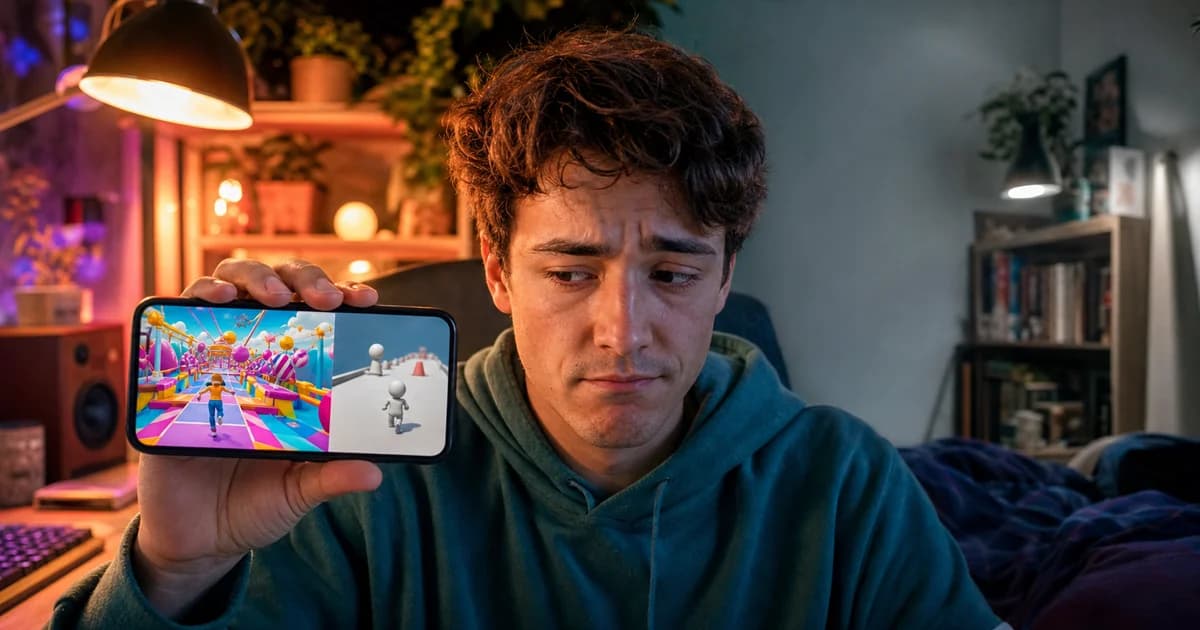
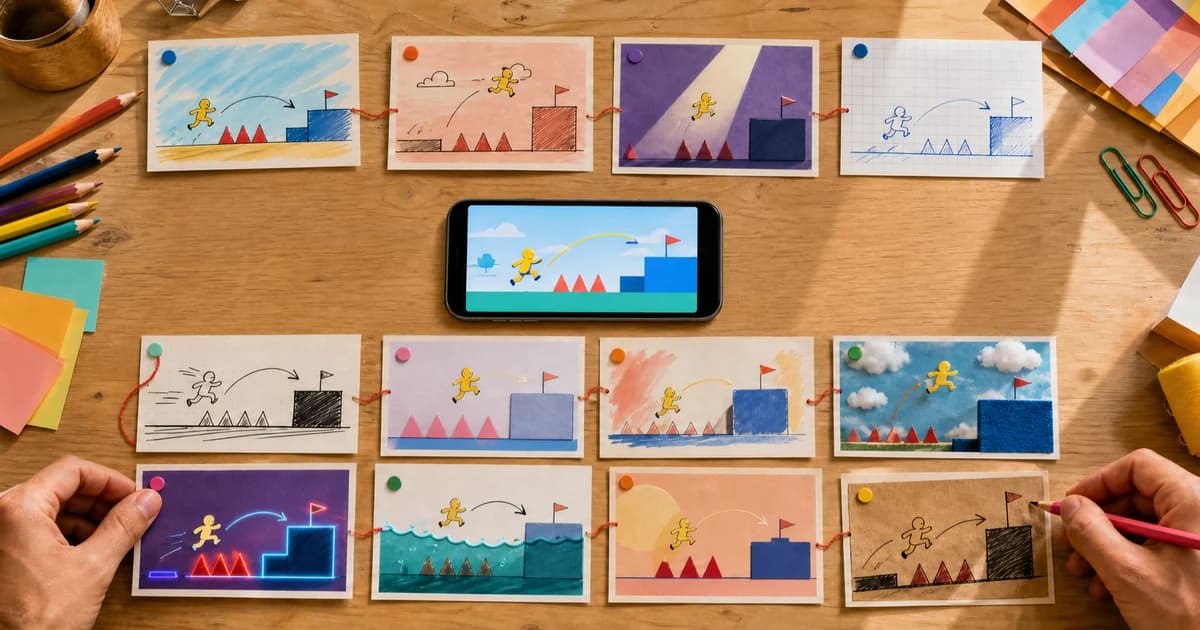
You've tested 47 video creatives this quarter. Your best performer hit an IPM of 12 in the first week, then flatlined. CPI keeps climbing. Your UA budget is burning through the same audience segments, and the algorithm keeps serving the same top-of-funnel users who watch three seconds and scroll past.
Now imagine one of those users sees your ad and actually plays your game (taps a tile, watches gems cascade, feels the dopamine hit of a combo chain) all before they ever visit the store. That user doesn't need convincing. They've already had the experience. They just need a download button.
That's the core argument for playable ads in gaming. Not theory. Data.
The Numbers Behind the Shift
Liftoff's 2025 Mobile Ad Creative Index, built on 4.7 trillion impressions and 1.1 billion installs, puts hard numbers behind what UA teams are seeing anecdotally. Playable ads are 20 times more likely to drive installs than banner ads. For top-spending gaming advertisers, impression-to-install rates are 8x higher with playables versus non-playable formats. For smaller advertisers, that gap widens to 16x.
The spend follows the performance. In 2024, top games allocated 35% more budget to playable ads compared to other formats, and interactive ad spend grew 20% year-over-year among top apps. Meanwhile, Moloco reported that one of its top US gaming advertisers achieved a 49% lift in IPM and 25% improvement in ROAS with playables. EJAW, a playable ad studio, reports even higher numbers in their own campaigns, up to 319% higher conversion rates versus video ads and CPI ranges of $0.70–$1.50 compared to $1.00–$2.50 for video, though these are self-reported figures from a company selling the format.
The signal is clear across independent and self-reported data alike: playable ads convert better. But the how matters enormously, and it changes with every genre.
Hyper-Casual: The Two-Second Rule
A user scrolling through a social feed gives your ad roughly two seconds of attention. In hyper-casual, that's all you need, because your entire game is one mechanic.
Supersonic's data from their hyper-casual publishing pipeline illustrates this precisely. For Mad Dogs, a side-view action game, they stripped the playable ad down to a single mechanic with a bare background, simplified the environment, and changed the camera to a full side view. The result: 87% engagement rate, 27%+ conversion rate, IPM over 64. For Stacky Dash, increasing color contrast and adjusting the tile design dropped time-to-engage from 4 seconds to 3 seconds, and engagement rate jumped from 72.6% to 82%.
The pattern is consistent across their portfolio. Emoji Puzzle reached #2 on Android after they shortened play duration and swapped emoji assets, pushing CTR from 75% to 86%. For Wheel Scale, reducing required swipes from 8 to 5 lifted CTR, CVR, and IPM simultaneously, landing at a 7.7% conversion rate.
The design principles for hyper-casual playables are ruthless in their simplicity:
- One mechanic only. Tap, swipe, or drag. If you need to explain it, it's too complex.
- First interaction within 2 seconds. No logo screens, no tutorials, no "tap to start." The game is already happening.
- 8–12 seconds total. Not 15. Not 20. Hyper-casual playables that run longer see engagement drop, not rise.
- Fail state = CTA opportunity. When the player loses (and the playable should be designed so they eventually do lose), the end card appears immediately. "Think you can do better? Download now."
The first 3 seconds are where hyper-casual playables are won or lost. Everything else is just momentum toward the store.
Puzzle Games: The Almost-Win
Match-3 and merge games have a structural advantage in playable advertising that no other genre can match: the core mechanic is instantly satisfying to perform. Swapping two gems and watching a cascade of matches is inherently rewarding, even to someone who has never played your game. The challenge for puzzle playable ads isn't demonstrating the mechanic. It's knowing when to stop.
The most effective pattern is what the industry calls the frustration hook. You present one level. The board is pre-set so the first few moves create impressive cascades. Colors pop, combos chain, the score multiplier climbs. The player feels clever. Then, with two or three moves left, the board tightens. The obvious match isn't there. Time runs out, or moves run out, and the end card drops: "So close! Keep playing."
Dream Games proved this at scale with Royal Match. Their playable ad campaigns drove a 21% install conversion rate, roughly double the industry average for video ads. The game has accumulated over 300 million installs and $3 billion in lifetime revenue, with paid UA and playable creatives forming the backbone of their acquisition strategy.
What makes puzzle playables different from hyper-casual is pacing. A hyper-casual playable should feel frantic. A puzzle playable should feel deliberate. Give the player time to look at the board. Let them think. The satisfaction comes from choosing the right move, not from reflexes. Extend the duration to 12–18 seconds to let the "almost won" feeling build, because a player who felt smart for 15 seconds and then lost is far more motivated to download than one who tapped randomly for 8.
Idle and Clicker: Compressing Time
Here's the paradox: the core appeal of an idle game is watching numbers grow over hours and days. A playable ad gives you 15 seconds. How do you compress a 72-hour progression loop into a quarter of a minute?
You don't. You fake the speed.
The most effective idle game playables abandon the literal idle mechanic entirely. Instead, they focus on the active moments: the tap that triggers a merge, the upgrade that doubles your output, the prestige reset that multiplies everything. The playable becomes a highlight reel of dopamine spikes, stripped of all the waiting that sits between them.
Here's what works:
| Element | Implementation |
|---|---|
| Numbers | Start at hundreds, climb to millions within 10 seconds. The scale is the hook. |
| Upgrades | Show 3–4 upgrade taps, each with a visible multiplier effect on the game world. |
| Visual progression | Environment transforms with each upgrade: a hut becomes a castle, a sapling becomes a forest. |
| End state | Freeze at a tantalizing moment: "You've unlocked 4 of 200 levels. What happens next?" |
The curiosity hook replaces the fail-state hook used in other genres. Idle game players aren't competitive. They're curious. They want to see what happens at the next tier. The playable should end at a cliffhanger, not a game over. If your game has a particularly dramatic visual transformation at a certain stage (a base building game where the map expands, a clicker where the character evolves), that's your end frame.
Be aware that this genre consistently underperforms in playable format compared to casual and puzzle genres. The A/B testing investment here is especially important. Test playable against video and rewarded video, because for some idle games, a well-cut 30-second video still wins.
RPG and Mid-Core: Let the Data Speak
Mid-core is where playable ad skepticism is strongest. The games are complex. The UI is dense. The onboarding takes 10 minutes. How do you compress that into 15–20 seconds?
Two case studies answer that question definitively.
Idle Heroes (DH Games) partnered with PlayTurbo to create playable ads that isolated individual gameplay elements rather than trying to represent the full game. The Mindworks creative team broke the RPG down into separate playable concepts: one for battle mechanics, one for hero team formation, one for tower climbing, one for equipment and skins. Each playable highlighted one element. The results were staggering:
- The battle + team building playable lifted CVR by 289% and IVR by 173%
- An optimized version focusing on skins and visual effects achieved IVR increase of 1,153%
- A variant that removed the character selection step (jumping straight to action) drove CTR up by 319%
Legend of Slime (LoadComplete), a Korean idle RPG with 18 million+ downloads, took a different approach. Their PlayTurbo playable ads streamlined core battles to be faster and flashier than the actual game, with exaggerated power surges, animated character reactions, and defeated enemies turning into cartoonish skeletons. The result: 30–40% increase in both D1 and D7 ROAS, launched in August 2023.
The lesson from both: don't try to represent your whole game. Pick one moment (a hero selection screen, a single boss fight, an equipment upgrade reveal) and make that moment as visually rich and immediately satisfying as possible. RPG players expect polish. They expect particle effects, flashy skill animations, and satisfying number pops. Give them that in 15–20 seconds, and the end card writes itself: "Choose your class. Begin your journey."
Runner and Arcade: The Score Challenge
Endless runners and arcade games sit in a sweet spot for playable ads: the mechanic is simple enough for instant understanding (swipe to dodge, tap to jump) but competitive enough to trigger replay instinct. The play here isn't frustration or curiosity. It's challenge.
Show the player a score counter. Let them dodge 5–6 obstacles with increasing speed. When they inevitably collide, flash their score against a "Top Players" leaderboard where they landed somewhere in the middle. The CTA: "Beat your score."
Key design details:
- Speed ramp matters. Start at 60% of your game's actual speed. Accelerate to 120% by the end. The playable should feel slightly faster than the real game to create urgency.
- Show a near-miss. Program at least one obstacle that passes within pixels of the player's character. Near-misses trigger adrenaline more than comfortable dodges.
- 10–15 seconds total. Runners feel stale after 15 seconds in an ad context. End it before the novelty fades.
- Visible score counter. Even if your game doesn't have a traditional score, add one to the playable. Numbers going up creates investment.
Runner playables benefit from the same production approach as hyper-casual: simple, fast, one mechanic. The difference is the emotional hook: competitive pride instead of casual fun. If your game type supports it, adding a "challenge a friend" CTA can outperform generic download CTAs by creating social proof alongside competition.
The Fake Gameplay Trap
In 2020, the UK's Advertising Standards Authority banned ads for Playrix's Homescapes and Gardenscapes. The ads showed pin-pull puzzle mechanics (drag a pin to direct water or lava) that had almost nothing to do with the actual match-3 gameplay. The ASA ruled the ads breached CAP Code rules on misleading advertising (rule 3.1), qualification (rule 3.9), and exaggeration (rule 3.11). The ads were pulled.
But the practice didn't stop. In August 2022, Google Play updated its policies to explicitly ban ads showing content that doesn't accurately reflect the game. Violations can result in app suspension or removal. Despite this, enforcement remains inconsistent. If even a minor minigame somewhere in the app vaguely resembles the ad, it often slips through review.
Here's why you should care beyond regulatory risk. Data from Segwise paints a stark picture of what fake ads do to your funnel:
| Metric | Authentic Ads | Fake Ads |
|---|---|---|
| Day-1 Retention | 32% | 14% |
| Day-7 Retention | 11% | 1.5% |
| Lifetime Value (per user) | $0.25 | $0.05 |
Day-1 retention drops by more than half. Day-7 retention collapses to nearly nothing. And the LTV gap is 5x. You might drive cheap installs with a fake ad, but you're filling your funnel with users who feel deceived on first open, and deceived users don't spend.
The breakdown holds across genres. According to the same data, fake ads versus authentic ads retention runs 12% vs 25% in casual, 18% vs 35% in mid-core, and 22% vs 40% in hardcore. Meanwhile, 58% of users now report being unlikely to try playable ads in the future due to past misleading experiences, and 49% say they rarely or never interact with them anymore. The format's long-term credibility is at stake.
Playable ads solve this problem by design. When a player plays your actual game mechanic in the ad, there's no mismatch at install. The expectation is set correctly. That's why playable ads consistently drive higher retention than video. Not just higher install rates, but better installs.
Seasonal and Event Creative Strategies
Q4 is the most expensive and most lucrative period in mobile gaming advertising. Moloco's 2024 seasonality analysis shows CPMs climb 70–100% from the start to the end of Q4, with the sharpest spike around Black Friday and Cyber Monday.
But here's the opportunity: the Christmas-to-New Year window is where efficiency peaks. In the US, ROAS during that period runs +32% above Q4 baseline on iOS and +15% on Android, even as downloads surge more than 40% above Q4 start. In Japan, the same window sees CPI drop while ROAS rises. iOS ROAS jumps +36% and Android +60% versus early Q4.
For playable ads, this means two things. First, launch seasonal creatives at least 2 weeks before key events to give ad network algorithms time to learn and optimize. A Halloween-themed playable dropped on October 30th won't have time to find its audience. Second, reskin your best-performing playable rather than building from scratch. If your match-3 playable converts at 8%, a version with pumpkin-themed gems and a spooky background will likely outperform a completely new creative. The mechanic stays proven; only the visual layer changes.
Hookin's template builder makes this particularly efficient. Because game code and visual assets are separated, you can swap backgrounds, color palettes, and particle effects through the chat editor without touching the game logic. One base playable becomes five seasonal variants in an afternoon.
Best Practices for Gaming Playable Ads
- Match your hook to your genre. Hyper-casual = fail state. Puzzle = frustration. Idle = curiosity. RPG = visual spectacle. Runner = challenge. Don't use a frustration hook on a runner. Don't use a score challenge on a match-3.
- Kill the tutorial. If your playable needs instructions, the mechanic is too complex for the format. Reduce to one action. If the real game has 4 mechanics, pick the most visually rewarding one. The others don't exist in the ad.
- Test swipe count, not just creative concepts. Supersonic's Wheel Scale data showed that reducing swipes from 8 to 5 lifted every metric. The number of interactions in a playable is a tunable variable. Treat it like one.
- End in mid-gameplay for urgency, in victory for satisfaction. AppAgent's 2025 data shows that 40% of high-performing playables end mid-gameplay (creating urgency to continue), while 85.9% of those that do complete end in a player win. Pick the pattern that fits your genre, then A/B test the other.
- Front-load the payoff. The first cascade, the first power-up, the first kill should happen within 3 seconds. Players who don't get a reward signal in the first few seconds disengage.
- Export to every network. AppLovin handles 59% of playable ad traffic. AdMob handles 38%. Unity Ads handles the remaining 2%. If you're only on one network, you're missing most of the auction. Each network has different specs. AppLovin requires MRAID 2.0, Google Ads needs a ZIP with ad.size meta tag, Unity needs MRAID 3.0. A platform like Hookin handles all of this with one-click export to 10 ad networks.
- Watch file size. Most networks enforce strict size limits. An unoptimized 3D playable can easily blow past 5MB. Compress textures, inline assets, and strip unused code before export.
- Measure beyond IPM. IPM tells you the ad converts. Day-7 retention tells you the install is valuable. Always pair acquisition metrics with retention data to catch misleading creative that drives installs but tanks LTV.
When Playable Ads Don't Work
Playable ads aren't a universal solution, and being honest about their limitations will save you budget and frustration.
Narrative-heavy games are hard to adapt. If your game's value proposition is a branching storyline, rich dialogue, or cinematic cutscenes, compressing that into 15 seconds of interaction is nearly impossible. A visual novel or story-driven RPG might be better served by a 30-second video trailer that sets the narrative mood. You can create a playable that features a single dialogue choice leading to a dramatic consequence, but it requires exceptional writing in a tiny space.
Production cost is real. AppAgent's 2025 data puts external playable ad production at $3,000–$5,000 per creative with 2–4 week turnaround times. For studios running lean UA teams, that's a significant investment per variant. In-house teams can reduce this to $600–$1,000 per creative after initial setup, but that requires dedicated playable ad talent. Platforms like Hookin bring this cost down further. AI-powered generation from a text prompt means you're iterating in minutes, not weeks.
Not every network supports them equally. While AppLovin and AdMob dominate playable traffic (97% combined), smaller or regional networks may have limited playable support, broken preview environments, or QA processes that reject valid HTML5 creatives. If your UA strategy depends on a specific network that handles playables poorly, video might be the safer bet.
Iteration velocity matters more than format. A mediocre playable won't outperform a brilliantly edited video ad. The format advantage only materializes when you can produce, test, and iterate quickly. If your pipeline means one new playable per month, video's faster iteration cycle might deliver more cumulative learning. The studios seeing the biggest gains from playables are the ones testing 5–8 variants monthly.
Some audiences don't engage. Older demographics and certain geographic markets show lower playable ad interaction rates. If your game targets 45+ users in markets where interactive ad formats are less established, test carefully before shifting budget away from video.
From Data to Installs
The Liftoff data is directionally clear: playable ads outperform non-interactive formats in gaming by a wide margin, and the gap is widening. Top studios spend 35% more on playables because the numbers justify it: 8x to 16x higher impression-to-install rates, better retention, and stronger ROAS.
But the format only works when the creative matches the genre. A hyper-casual playable that runs 20 seconds is too long. An RPG playable that shows three mechanics is too complex. A puzzle playable that lets you win easily is too generous. Every genre has its own rules, and the best-performing studios have learned them through iteration, not intuition.
If you're building playable ads from scratch, you're solving ad network compliance, MRAID integration, end card design, CTA routing, file size optimization, and multi-platform export before you even get to creative testing. That's months of engineering for infrastructure that doesn't differentiate your ad. It just makes it run.
Hookin handles the infrastructure. Describe your game in plain text, and the AI generates a playable ad with the game mechanic, end card, CTA button, loading screen, and audio handling built in. Edit through chat: "make the gems bigger," "speed up the cascade," "add a Halloween background." Then export to Meta, Google, AppLovin, Unity, and 6 more networks with one click. You focus on finding the winning mechanic. The pipeline is already built.