A viral phone video can make a billboard look like a glass tank, a room with a giant cat, or a hole punched through a building. Before you approve a similar idea, ask a less glamorous question: Where was the camera standing?
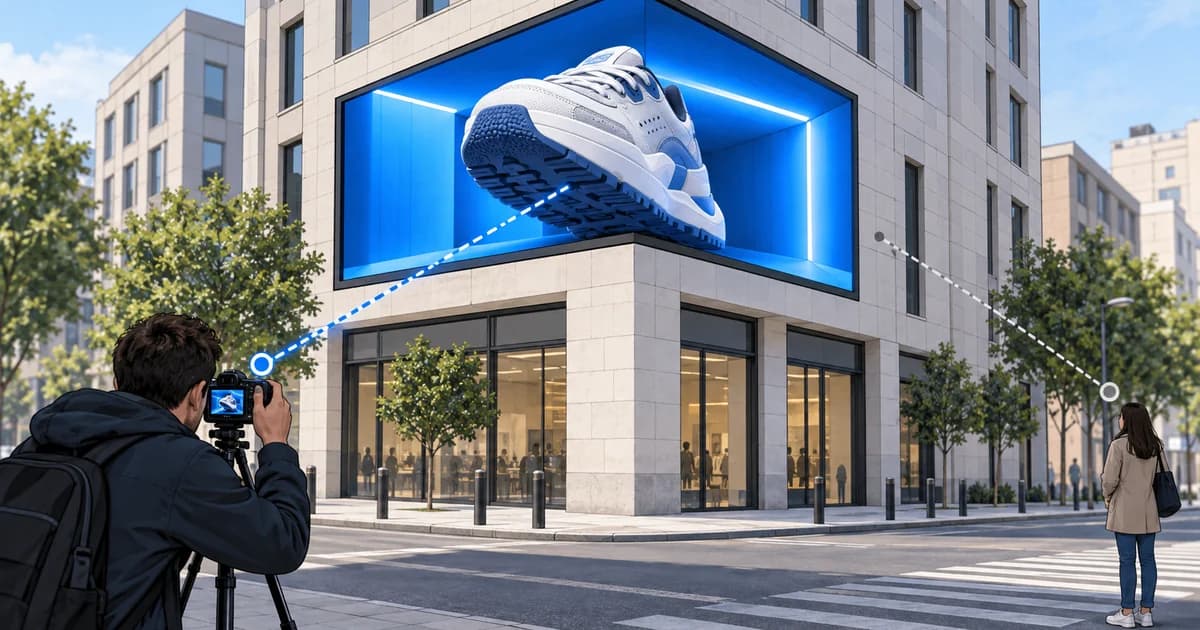
In many well-documented “naked-eye 3D” executions, the billboard is a real LED display and the content is CGI, but the apparent depth is an optical construction made for a chosen viewing zone. Move far enough to the left or right and the screen does not stop existing; the virtual room simply begins to skew, flatten, or separate from the architecture around it. The effect is closer to a stage set painted for one seat than to a hologram visible equally from every direction.
That distinction changes the brief. You are not buying “a 3D video” in isolation. You are buying content mapped to a particular screen, street, audience path, and camera position—plus a less spectacular version that still communicates when people stand elsewhere.
Four different things get called a 3D billboard
The phrase is loose enough to hide materially different productions. Classify the job before comparing examples, schedules, or bids.
| What people call it | What physically exists | Where the depth comes from | What changes with viewpoint |
|---|---|---|---|
| Anamorphic or forced-perspective billboard | A flat, curved, or corner LED display playing rendered content | The image is intentionally distorted for a reference eye so room lines, scale, shadows, and occlusion imply depth | The illusion is strongest in a designed viewing zone and degrades away from it |
| Real-time anamorphic experience | The same kind of real display, connected to a live renderer, data source, camera, or game | A calibrated 3D scene is rendered live instead of exported only as a fixed movie | Geometry still depends on the screen and reference viewpoint, even though the content can change |
| Physical or kinetic 3D billboard | A sign with relief, props, moving modules, or another genuinely three-dimensional surface | Objects or display parts occupy physical depth | Different viewpoints reveal real sides and parallax, although the creative may still favor one view |
| Faux OOH, FOOH, or CGI social video | A finished video that blends a real-world plate with computer-generated advertising | Compositing makes an imagined installation look present in the filmed scene | There may be no public screen or physical placement to visit at all |
“CGI” therefore does not mean “fake billboard.” A real installed screen normally plays digital content, and that content may be entirely computer-generated. The decisive question is whether a documented physical display carried it. By contrast, a FOOH production can be designed only for social distribution; Groove Jones’ own explanation describes FOOH as digitally created advertising that imitates installations and is commonly blended into real footage (Groove Jones, 2024).
The optical term underneath many screen-based examples is anamorphosis: a distorted projection that becomes recognizable from a particular vantage point or through a special viewing method (University of Arizona Optics Outreach). On a billboard, the “special viewing method” is usually much simpler than it sounds: stand in the intended place and look toward the screen.
Why the sweet spot works
Imagine a virtual cube floating in front of a flat display. A designer places a virtual camera where the target viewer is expected to stand. Every visible cube point is projected along a sightline from that camera until it lands on the physical screen plane. Those landing points become the distorted image delivered to the billboard.
From the design eye, each screen point sits directly behind the virtual point it represents, so the two appear aligned. From another eye, the same fixed pixel lies on a different sightline. The viewer now sees the pre-warp made for somebody else.

Open the interactive viewpoint demo and move the viewer slider. It uses a simplified flat screen, one virtual cube, and one eye height. A real production needs the actual pixel map, screen curvature or corner angle, installation height, plaza geometry, likely viewing distances, and audience paths. Production studios describe comparable workflows: Groove Jones says it designs for the actual location and optimal viewing point, while Coper describes capturing screen dimensions, curvature, installation angle, and the key viewer position before placing the scene camera (Groove Jones; Coper, July 31, 2025). These are provider accounts, not neutral performance studies, but they document the geometry their teams use.
A curved or corner screen gives the artist more useful boundaries. The bend can become the corner of a virtual room, tank, shelf, or street. It does not make the display a multi-angle hologram. The render still has to persuade a person standing somewhere specific that the digital edges and the physical edges belong to the same space.
Six 3D billboard examples—and what each one actually teaches
The cases below are documented by a screen operator, producer, official project channel, award archive, or record body. That establishes the installation or production account. It does not establish sales lift, attention, recall, or return on media spend.

1. WAVE at COEX K-POP Square: use the building as the container
D’strict’s official project video identifies WAVE as public media art using anamorphic illusion at Seoul’s COEX K-POP Square in April 2020 (d’strict official project video). The physical object is a large digital façade; the water and transparent-looking enclosure are rendered content.
The useful lesson is not “put water on a screen.” It is that an illusion becomes easier to read when the real display architecture supplies a credible container. Screen edges can act like tank edges, while the corner establishes two apparent planes. The viewer has a familiar spatial model before the animated subject has to do any work.
For a brief, translate that into a question: What could this exact screen plausibly become? A corner may become a room, freezer, shipping crate, elevator, aquarium, or open storefront. A random object floating over a generic black background wastes the physical clue you already paid for.
2. The Shinjuku giant cat: calibrate the room, then let the subject break it
Cross Shinjuku Vision’s operator says the giant cat appeared in July 2021 and that the display’s naked-eye 3D image is intended to be viewed from the plaza in front of Shinjuku Station’s east exit (Cross Shinjuku Vision). The producer, Omnibus Japan, is even more explicit: the cat’s white room was calculated to look three-dimensional from that square. Its ears and tail move outside the room boundary, reinforcing the perception of depth. The page describes the display as an 8-meter by 19-meter curved screen (Omnibus Japan).
This example combines two cues:
- A stable reference space. The room gives the eye floor, wall, ceiling, and frame relationships to interpret.
- A controlled frame break. The cat crosses the apparent room boundary, so the brain reads foreground and background rather than a flat character layer.
The order matters. If everything is outside the frame from the opening second, there is no established boundary to violate. First show the box; then break the box.
3. Vodafone Lions at Piccadilly Lights: animate travel through depth
Ocean Outdoor’s July 2021 case page describes a Vodafone British & Irish Lions execution on London’s Piccadilly Lights. It says the forced-perspective scene moved digital avatars from deep inside the composition toward the viewer, with the screen’s curvature used as a stage (Ocean Outdoor, July 20, 2021).
That is a stronger depth demonstration than making a subject bob slightly in place. A readable sequence gives the audience multiple scale and occlusion states: far back, approaching the frame, crossing it, and holding in the foreground. The movement itself becomes evidence for the constructed space.
For a product, this could mean a shoe moving from a deep shelf to the ledge, a vehicle entering from a virtual street and stopping at the frame, or a package traveling from a warehouse bay into the foreground. The path should be legible without sound and without relying on a single freeze-frame captured for social.
4. Samsung Gaming Hub at Piccadilly Lights: live content still needs fixed geometry
A later Piccadilly Lights case adds a different production layer. Ocean Outdoor says Samsung Gaming Hub ran a 30-minute Rocket League challenge in December 2023 that combined live-stream video, interactive elements, and live-rendered anamorphic scenes (Ocean Outdoor).
The creative was not limited to one pre-rendered film, but the display did not become viewpoint-independent. A live renderer still needs a calibrated virtual camera and screen model. This is useful when evaluating bids: “real time” describes how the image is generated or updated, not how many viewing angles receive a perfect illusion.
It also expands the QA plan. In addition to reviewing the visual at the sweet spot, the team must test data loss, latency, fallback scenes, unexpected player behavior, and what remains on screen if the live component fails. A beautiful hero render is not an operational plan.
5. Spirit Halloween in Times Square: previsualize the street, not only the canvas
Groove Jones’ October 2022 case study documents a Spirit Halloween forced-perspective execution on a corner display in Times Square. The scene made Jack the Reaper appear to punch through the façade and reach beyond it. The producer says it recreated the Times Square location in virtual reality so the team could review the work as though standing on Broadway and confirm the intended angles (Groove Jones, October 25, 2022).
The transferable lesson is location previsualization. Reviewing a rectangular movie on a laptop misses the relationship among the screen, nearby buildings, street width, viewer elevation, and corner seam. Even a simple 3D blockout of the intersection can expose a bad assumption before final rendering.
Ask for three review views, not one:
- the designated hero position;
- a common approach from the left or right;
- a practical social-capture position that does not obstruct traffic or require an implausible lens.
The hero view proves the illusion. The other two reveal whether the campaign still looks intentional when the illusion weakens.
6. Coca-Cola’s 2017 robotic Times Square sign: sometimes the depth is physical
Coca-Cola’s Times Square installation is a useful counterexample because its surface actually moved. Guinness World Records records a 210.22-square-meter robotic billboard achieved on August 8, 2017, made with 1,715 moving and 245 static LED cubes; each moving cube could extend up to 1.52 meters (Guinness World Records). The One Show archive likewise describes independently computerized LED modules extending and retracting to create physical dimension (The One Club for Creativity).
This is not merely an anamorphic room rendered on a fixed surface. It introduces mechanical motion, weather response, safety, noise, service access, and content-to-hardware choreography. A buyer comparing it with a conventional corner-screen animation is comparing different engineering categories, not two creative treatments of the same media unit.
What changes when you leave the hero viewing zone
An off-axis view is not automatically a failure. Outdoor media is seen in motion and from imperfect positions. The useful question is what degrades first—and whether the underlying ad survives.
| Element | At the intended view | Away from it | Practical response |
|---|---|---|---|
| Virtual room edges | They align with the screen frame and imply a believable box | Walls can look too wide, shallow, or slanted | Keep the architecture simple and test common approach paths |
| Object proportions | Scale and foreshortening read as a coherent object | The object may stretch, compress, or appear attached to the panel | Avoid putting critical product detail at the most distorted extreme |
| Frame-breaking moment | Foreground overlap creates a strong pop-out cue | The extension can read as a long or bent shape | Make the break brief, bold, and recover to a stable view |
| Corner seam | It disappears into the virtual architecture | It becomes an obvious physical fold | Design the seam as a real corner, not an inconvenience to hide |
| Logo and offer | Stable copy can remain readable | Copy placed on a moving or extruding object can skew badly | Put essential text on a calmer plane and hold it long enough to read |
| Story comprehension | Depth reinforces an already clear action | The spectacle weakens | Make the action understandable as a normal 2D composition too |
This is the core editorial test: Does the ad remain an ad when it stops being a perfect illusion? A passerby should not need to discover a painted X on the pavement before learning the brand, object, and action.
How to verify that a viral “billboard” was actually installed
A polished clip is evidence that a video exists. It is not, by itself, evidence that a public screen displayed the content. Use an evidence ladder.
1. Find the media owner or venue
Look for a page naming the screen, address, operator, and booking or technical context. The Cross Shinjuku operator page, for example, identifies the display and its location. A map pin is stronger than a caption that says only “Tokyo.”
2. Find a production or campaign page with matching specifics
The strongest case pages name the brand, date, screen, agency or producer, and mechanism. Matching details across an operator page and a producer page reduce the chance that you are looking at a speculative render or repost.
3. Ask for field evidence from more than one position
Request a wide establishing view, the intended hero view, and an off-axis view. Include the whole screen and recognizable surroundings rather than only a tightly cropped phone frame. Real pedestrians, changing occlusion, reflections, exposure shifts, and repeated playback can be useful context, but no single visual clue is conclusive after compositing.
4. Separate proof of placement from proof of performance
A proof-of-play report, operator archive, or field video can support the claim that content ran. It cannot, without additional measurement, establish attention, brand lift, sales, or profitability. Do not turn “the screen existed” or “the clip went viral” into an effectiveness claim.
Use precise labels in decks and case studies:
- Real LED display playing anamorphic CGI
- Real-time anamorphic display on a documented screen
- Physical or kinetic 3D installation
- FOOH / CGI social video; no physical placement verified
- Concept render; installation status unknown
Those labels do not diminish the craft. They tell the buyer what was produced.
A filled 3D billboard brief for one fictional campaign
The following teaching case is fictional. It shows the level of specificity that should exist before a studio starts polishing the hero shot.
Campaign: Northline Cold Brew — “The shortcut”
Media unit: Two-panel corner LED display. Fictional working size: 16 meters across the front face, 7 meters on the return, 9 meters high. Final production must replace these placeholders with the media owner’s pixel map and survey.
Primary viewing zone: A six-meter-wide pedestrian area centered 24 meters from the corner. Reference eye height: 1.65 meters.
Secondary views: A left-side approach beginning 35 meters away and a closer right-side crossing where the corner effect will be weak.
Ten-second action:
- 0.0–2.0 seconds: A quiet virtual convenience-store cooler establishes back wall, side wall, floor, and corner.
- 2.0–5.0 seconds: A cold-brew can rolls from the back shelf toward the screen edge, growing in scale and passing behind one shelf divider.
- 5.0–6.5 seconds: The can crosses the apparent frame by a controlled amount; condensation particles stay within the display so they do not become visual noise off-axis.
- 6.5–10.0 seconds: The can returns to a stable ledge. The room darkens slightly and the copy holds on the back wall.
Weak copy: “EXPERIENCE THE FUTURE OF REFRESHMENT.” It is generic, long, and competes with the frame-breaking moment.
Improved copy: “COLD BREW. STRAIGHT AHEAD.” It echoes the movement, uses ordinary language, and can sit on a stable plane. The fictional brand lockup remains visible for the final 3.5 seconds.
Required review renders: Hero point at normal eye height; hero point with a phone-equivalent vertical crop; left approach; right crossing; bright daylight simulation; dark scene with display black levels raised; one frame with all safe areas and the physical corner marked.
Field check: Photograph the blank screen from each approved review position before final render. After launch, record one full loop from the same positions with the entire façade visible. Compare the delivered file, the screen playback, and the social edit separately.
This brief does not promise that the effect will be equally convincing across the plaza. It identifies where the effect should be strongest and protects the message elsewhere.
The review checklist that prevents a one-angle surprise
Before approving final delivery, require answers to these questions:
- Is the reference viewing point marked on a real map with distance and eye height?
- Did the team receive the final screen pixel map, physical dimensions, curvature or corner angle, and content-safe areas?
- Does the virtual camera match that geometry rather than a generic 16:9 canvas?
- Have you reviewed the hero point and at least two common off-axis positions?
- Does the first second establish the virtual space before the main frame break?
- Is the brand or offer readable on a stable plane without pausing a social video?
- Does the action remain understandable when the 3D illusion weakens?
- Are seams, bezels, adjacent screens, building edges, and likely obstructions represented in the preview?
- Is there a fallback or holding state for playback, data, or live-render failure?
- Will field documentation show the whole installed screen from multiple positions rather than only the flattering hero crop?
The most useful approval question is not “Does it look 3D?” It is: From where, for whom, and what still works when they are not standing there?
A 3D billboard is a viewpoint plan
The best-known examples do not defeat perspective. They choreograph it. WAVE turns a real façade into a plausible container. The Shinjuku cat establishes a room and then crosses its boundary. Vodafone uses travel through depth. Samsung adds live rendering without removing geometric constraints. Spirit Halloween reviews the actual street in virtual form. Coca-Cola’s robotic sign demonstrates the separate category of genuine moving depth.
Treat the viral hero clip as one deliverable, not the whole product. Ask for the physical screen evidence, the design-eye map, the off-axis reviews, the stable brand frame, and the field capture plan. Then the campaign can earn its spectacular angle without becoming unintelligible everywhere else.
Sources
- “Anamorphic Art” — University of Arizona, Wyant College of Optical Sciences Outreach.
- “Public Media Art ‘WAVE’ Full ver.” — d’strict, April 2020.
- Cross Shinjuku Vision / Space official website — Cross Space Co., Ltd.
- “Giant 3D Cat at the east exit of Shinjuku Train Station” — Omnibus Japan.
- “Vodafone brings the Lions to life in 3D Piccadilly Lights activation” — Ocean Outdoor, July 20, 2021.
- “Samsung Gaming Hub” — Ocean Outdoor, December 2023.
- “Times Square OOH Animated 3D Billboard for Spirit Halloween” — Groove Jones, October 25, 2022.
- “Anamorphic and Forced Perspective 3D Billboards for OOH Marketing” — Groove Jones.
- “Anamorphic 3D Billboards and LED Advertising: Technology, Examples, and Pricing” — Coper, July 31, 2025.
- “Faux OOH Advertising – How CGI Videos and Social are Redefining OOH” — Groove Jones, November 17, 2024.
- “Largest 3D robotic billboard” — Guinness World Records, record achieved August 8, 2017.
- “Coca-Cola Times Square Billboard” — The One Club for Creativity, 2018 awards archive.