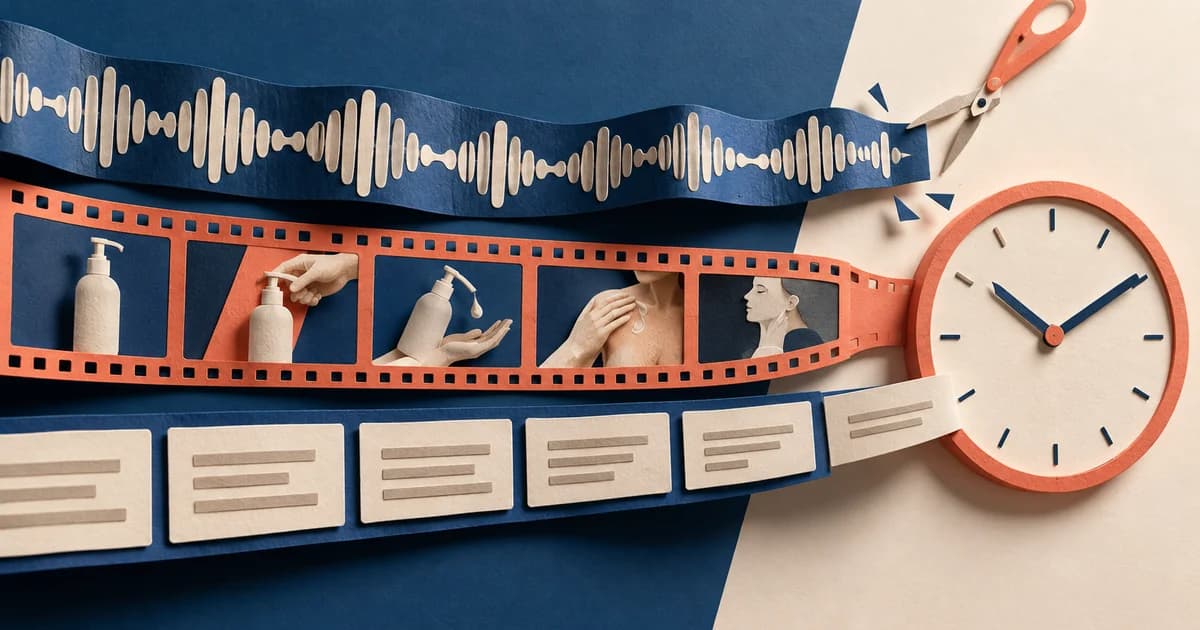
A folder of competitor ads can tell you what other brands are saying. Turning it into a useful brief takes another step: identify the buyer question behind the message, decide what your own product can truthfully prove, and choose an original way to show it.
Use a five-stage process: record the observation, separate repeated messages, identify the customer tension, write your proposition, and specify the proof and production choice. The worked example below follows training-apparel archive records through to a filled creative brief called “Fit Before the Set.”
The examples use third-party ad archives and current destination pages. They show how to develop a brief from observable messages; they do not establish which ads were profitable or reproduce a live Meta Ad Library walkthrough.
Start with evidence status, not inspiration
An ad repository can show communications that an advertiser made observable. It does not automatically reveal why the advertiser made them, how much was spent, whether delivery was continuous, or whether the ad was profitable.
Meta’s 2019 product announcement said the expanded Ad Library would bring in all active ads run by Pages, while spend information and seven-year storage were described for ads related to politics or issues. That announcement is useful historical context, not proof of every control or field in the 2026 commercial-ad interface. In a February 2026 election update, Meta again said US ads about elections, politics, or social issues are stored in the public library for seven years. The category-specific wording matters: do not transfer political-ad transparency fields or retention rules to ordinary commercial ads without current support. Meta’s 2019 Ad Library announcement · Meta’s 2026 US election update
Use this evidence ladder:
| What you have | What it supports | What it does not support by itself |
|---|---|---|
| An archive page with accessible copy | The archive displayed that wording when you inspected it | Verified live Meta provenance, delivery country, spend, or results |
| An archive provider’s “active,” date, duration, or relaunch label | The provider displayed that label at the observation time | Live Meta status, uninterrupted delivery, budget, profitability, or a “winner” designation |
| Repeated accessible copy across records | A repeated written message worth grouping | The same video, one campaign, one audience, or causal effectiveness |
| A static image you opened | The visible composition and claims in that image | Motion, audio, frames outside the image, or video proof |
| A current outbound link that resolves | The page and visitor task reached on the observation date | The historical destination for every impression or geography |
| No matching result in one search | That search produced no visible match under those conditions | That the advertiser has no ads or the approach is absent from the market |
The last distinction is operationally important. A Mozilla Foundation and CheckFirst stress test captured 100 ads on each studied platform during December 2023–January 2024, then tried to find the same ads 24 hours later by advertiser or keyword. The researchers found 83% of the captured Instagram ads and 65% of the captured Facebook ads. Those figures are not a current US error rate, but they demonstrate why one failed search is not proof of nonexistence. Full Disclosure report, pp. 13 and 32–33
Build a bounded archive sample
Three archived ad pages can look like three different creative ideas. In the worked sample for this article, inspection supported a smaller and more useful count: two advertisers, two written message families, one confirmed visual execution, and two current destination paths. Two Gymshark archive pages repeated the same accessible copy, call to action, and destination, but their videos did not play. Counting them as two fully inspected creatives would have exaggerated the evidence.
Evidence boundary: The completed example below uses public third-party archive pages from Crush and AdScan, not a directly inspected live Meta Ad Library corpus. The numerical identifiers are reported only as archive record IDs; they were not matched to live Meta records. No source video was played or transcribed. Destination observations describe where the archive pages’ outbound links resolved on September 9, 2026, not necessarily what every historical viewer saw. The same worksheet can be used during a live Meta Ad Library session, but this article does not claim to document the current interface or its buttons.
A useful sample begins with a written admission rule. The rule for the worked example was:
On September 8, 2026, inspect public English-language archive records related to women’s training apparel. Admit a record to the main comparison only when its advertiser label, accessible copy or call to action, and either an inspectable static or a followable destination path can be recorded. Treat served market, live Meta identity, and inaccessible media as unknown. Recheck admitted pages and current destinations on September 9, 2026.
This is a convenience sample from third-party archives. It is not representative of the category, and its delivery market is unknown. The main comparison contains three records from two advertiser labels. A Wayfair Professional record is included separately as a destination counterexample, not as training-apparel evidence. Three additional archive records remain in the downloadable sheet as exclusions or access cases.
That separation prevents a common research failure: changing the category after seeing the results, then speaking as if the final pile came from one coherent search. A keyword false positive, a different market, or a record with inaccessible media can still teach an access lesson, but it should not quietly enlarge the comparison set.
Save a reproducible observation packet
A screenshot without context is a weak handoff. It can omit the source surface, query, market selection, Page identity, date, media-access level, and destination. Save enough information for another strategist to understand what was observed and what remains unknown.
| Field group | What to record |
|---|---|
| Source and identity | Source surface, advertiser or Page label, durable URL, archive record ID, and a separately verified Meta Library ID only when the live record itself is opened and matched |
| Research context | Observation date, market or country shown, category, query or Page route, and any visible status, date, or media controls |
| Displayed metadata | Status and dates exactly as displayed, with the provider or platform named; preserve ambiguous date formats instead of interpreting them silently |
| Creative access | Copy, headline, offer, CTA, and whether you inspected a playable video, static image, thumbnail only, transcript only, or inaccessible media |
| Destination | Outbound URL, redirects, resolved URL, observation date, page type, and the task the visitor is asked to complete |
| Coding | Buyer situation, hook, promised value, proof, objection, offer, visual device, and CTA |
| Duplicate control | Capture group, record group, message family, visual-execution family, and destination group |
| Unknowns | Spend, impressions, targeting, conversions, CPA, ROAS, profitability, and any undisclosed performance field |
| Interpretation and reuse | Editorial hypothesis in a separate field; source and reuse limits, because public visibility is not permission to republish the asset |
The downloadable filled competitor observation sheet contains seven records with those distinctions, including the inaccessible videos and unmatched live-Meta fields.
Count messages separately from records
Duplicate control should happen before pattern analysis. Use five units:
- Capture: one screenshot, export, or observation event.
- Record: one distinct archive or library entry.
- Message family: records with materially the same proposition and primary wording.
- Visual execution: a distinct piece of media you actually inspected.
- Destination: the resolved page or visitor task observed after the CTA.
The comparable training-apparel subset produced this calculation:
| Unit | Count | Basis |
|---|---|---|
| Third-party archive records | 3 | One Crush record for Violate The Dress Code and two AdScan records for Gymshark |
| Advertiser labels | 2 | Violate The Dress Code and Gymshark; live Page identities were not verified |
| Written message families | 2 | The two Gymshark records repeated the same accessible title, primary copy, CTA, and destination |
| Confirmed visual executions | 1 | Only the Violate static was inspected; neither Gymshark video played |
| Current destination paths | 2 | One product detail page and one collection page, resolved on September 9, 2026 |
| Verified live Meta records | 0 | None of the archive identifiers was matched to an inspectable Meta record |
The equation is not “three records equals three creatives.” It is:
3 records → 2 advertiser labels → 2 written messages → 1 inspected visual execution → 2 current destination paths.
The two Gymshark records may contain different videos. Their visual relationship is unknown. Collapsing them into one written message family is justified; declaring them the same creative is not.
Read the archived record and current destination separately
A creative record and the page reached from it serve different parts of the decision. Code them separately before judging continuity.
| Archive record | What was actually observed | Current destination observation | Defensible interpretation | Important unknown |
|---|---|---|---|---|
Violate The Dress Code — Crush archive record 709616978876410 |
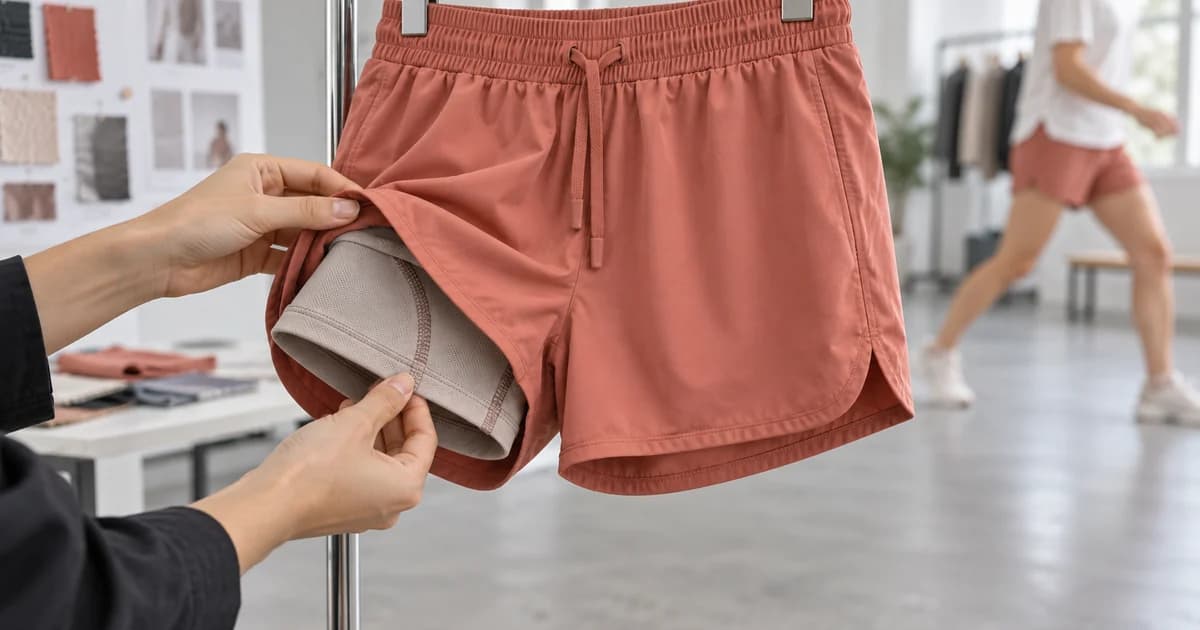
Accessible copy described lightweight training shorts with a built-in liner, breathability, and flexibility. A static model image and “Shop Now” were inspected. Archive record | On September 9, the archive’s outbound link resolved to the Gym Crush Shorts Coral product page, where product title, sizing and liner descriptions were visible. Current product page | The inspected static combines product appearance with feature claims. It does not itself show how the liner behaves during a defined movement. | Served market, live Meta identity, other variants, performance, and whether the current page matches the historical destination |
Gymshark — AdScan archive records 7552214 and 7168315 |
Both pages displayed the same “hybrid” positioning, supporting copy, and “Shop Now” CTA. Each page exposed a video element, but no video playback or transcript was available. Record 7552214 · record 7168315 | On September 9, each accessible “Visit Site” path resolved to Gymshark’s women’s Hybrid Training collection. Current collection | The written message frames a range around multiple training situations. Nothing can be concluded about the videos’ opening, demonstration, audio, editing, or proof. | Served market, live identity, visual relationship between the records, historical destination, and performance |
Wayfair Professional — Crush archive record 1031540632561443 |
Project-support copy appeared with an inspected furnished-bedroom static and a “Sign Up” CTA. Archive record | On September 9, the outbound link resolved to a professional-membership form describing member benefits and asking for an email, not to a bed product page. Current destination | The pictured room can represent the result of a professional project while the visitor task is membership. Object-level matching would misread the communication path. | Historical page behavior, delivery market, live Meta identity, and campaign results |
Use three continuity checks:
- Semantic continuity: Does the destination continue the subject and promise?
- Task continuity: Does it ask the visitor to do the thing implied by the CTA?
- Evidence continuity: Does it contain the information needed to support the important claim?
A product ad and product page may pass semantic and task continuity while still offering weak support for an objective performance claim. Conversely, the Wayfair room image can align with a membership task because the message concerns completing professional projects, not buying the pictured bed.
Always date the destination observation. A current redirect is evidence about today’s path, not a reconstruction of every historical impression. When a link fails, mark it unresolved rather than substituting the brand homepage.
Extract a tension, not a competitor formula
The admitted records do not establish a winning formula. They support a narrower observation: the accessible Violate static presents the product and feature claims, while the repeated Gymshark wording presents a broader hybrid-use identity. The Gymshark videos were unavailable, so this sample cannot show whether they contained movement demonstrations.
The correct opportunity statement is therefore not “competitors never prove fit.” It is:
Within the one inspected static, the liner claim was not accompanied by a condition-controlled movement demonstration. That may be a useful decision gap to investigate, but the sample cannot establish category absence or performance advantage.
Customer evidence can sharpen the question without turning it into a market statistic. In one self-selected r/XXRunning discussion, the original poster objected to bulky liners, while other participants said they specifically buy lined shorts or that fit determines whether the feature works for them. The thread is anecdotal and running-specific, but it exposes a practical tension: “built-in liner” is not automatically a benefit or drawback for every person. Liners in shorts—am I missing something?
That leaves three evidence layers:
- Observed in the admitted records: feature language and multi-use positioning.
- Not observed in the one inspected static: a transparent demonstration of construction and fit under declared movement conditions.
- Customer tension to validate: whether construction, size, and use conditions make a liner helpful or irritating for the intended buyer.
The third layer needs stronger product and customer evidence before it becomes a campaign claim: permissioned interviews, support and return reasons, reviews with usable context, and substantiation from the actual product. Absence from this sample is not an untapped market.
Worked example: “Fit Before the Set”
The following is a completed teaching example for a fictional product, T1 training shorts by HB48 Concept Brand. It does not reuse the observed brands’ wording, imagery, composition, colors, or unsupported product claims.

Observation-to-decision trace
| Step | Completed decision |
|---|---|
| Observation | One inspected static combined product appearance with feature claims. Two Gymshark archive records repeated broader hybrid-use wording, but their videos were not inspected. |
| Evidence boundary | The sample cannot reveal the better-performing ad, prove a category pattern, show what the inaccessible videos contained, or validate an unmet market need. |
| Customer tension | Liner preference appears conditional on construction, fit, body, and use rather than universally positive or negative. |
| Hypothesis | A creative package that shows construction, declared size, and specific movements may help the intended buyer form a more accurate fit expectation than a feature-only package. |
| Original execution choice | Make the buyer’s fit decision the job of the ad: reveal the fictional product’s inside and outside, then show a small set of declared movements with size and conditions visible. |
| Falsification | Revise or reject the idea if the product cannot support the demonstration, viewers interpret it as a universal guarantee, or the information does not help the intended customer decide. |
Filled creative brief
| Brief field | Decision |
|---|---|
| Product context | Fictional T1 lined training short; one verified product version and one color for the initial production. |
| Audience task | Decide whether the shown internal construction and fit are relevant to the buyer’s training context before purchase. |
| Original proposition | See how this specific short is built and how the shown sizes move before you decide. This promises decision clarity, not universal comfort or performance. |
| Proof required before production | Manufacturer specifications; a verified production-equivalent sample; model measurements and worn sizes; permissioned models; uninterrupted raw footage for each declared movement; and a product page carrying the same conditions. |
| Visual treatment | Open with an original inside/outside construction reveal. Move to a consistent waist-height, full-body view for a squat, short lateral step, and treadmill stride. Keep product version, worn size, and model measurements legible. Design the sequence to work without audio. |
| On-creative action and destination | Use “View fit details” as the message-level action. Link to the T1 product page containing construction, sizing, movement conditions, and returns information. The concept does not depend on a particular native platform-button label. |
| Production constraints | One half-day shoot, three permissioned size examples, two approximately 30-second original executions, and 9:16 plus 4:5 compositions. These are project assumptions, not platform requirements. |
| Claim boundaries | No “zero ride-up,” “works for every workout,” “perfect fit,” or competitor comparison without product-specific substantiation. |
| Rejected weak concept | A competitor-like beauty pose with a universal anti-ride-up claim. It repeats a surface treatment and asks the product to prove more than the evidence supports. |
| Decision now | Advance to product-proof feasibility and customer-task validation, not media launch. |
The originality is not a synonym swap. The brief changes the communication job. The observed material presents features and a broad use identity; the fictional concept helps a buyer inspect conditions. That decision also changes production: the team needs verified samples, declared sizes, consistent framing, raw evidence, and a destination that preserves the conditions.
The full observation-to-brief worksheet contains this completed example plus a reusable version.
Define what would change your mind
A useful brief contains rejection conditions before results arrive. Separate product truth, viewer understanding, business outcome, and quality.
| Gate | Question | Completed measure definition | Revise or stop when… |
|---|---|---|---|
| Product-proof gate | Can the sold product support the proposition under the declared conditions? | Approved specifications, production-equivalent sample review, raw movement footage, and documented model sizes | The behavior is inconsistent, the sample differs from the sold product, or the footage cannot support the wording |
| Comprehension gate | Do intended viewers understand the limits of the promise? | Correct interpretation among valid research participants of the shown size, conditions, and absence of a universal guarantee | A meaningful share reads the creative as “comfortable for everyone” or another unsupported promise |
| Communication-package test | Does the decision-help package improve the chosen outcome relative to an internally produced feature-focused package? | Distinct purchasers divided by eligible assigned users, with assignment and attribution rules documented before analysis | Results are materially worse, inconclusive at the predeclared decision threshold, or the cells are not comparable |
| Quality guardrail | Does expectation quality remain acceptable? | Relevant returns divided by eligible orders whose return window has matured, plus coded expectation complaints | Fit-related returns or expectation complaints exceed the business’s predefined tolerance |
This is a package test, not proof that one line or camera angle caused the outcome. Keep product, offer, destination, eligibility, and run window as comparable as the setup permits. Document the assignment unit. Optimized delivery is not automatically random assignment; when the allocation is observational, describe it that way.
Do not import an industry CTR benchmark, runtime, sample size, or return-rate threshold. Set decision inputs from your baseline, economics, measurement system, minimum meaningful difference, and risk tolerance before reading results. Price, inventory, brand trust, color, audience mix, delivery, and page friction remain alternative explanations until the design addresses them.
Apply the worksheet during a live Meta Ad Library session
The archived example teaches the evidence structure. When you have direct Meta Ad Library access, start a new dataset rather than relabeling archive rows.
- Name the source surface correctly. Use
Meta Ad Libraryonly for a record you opened there. Keep archive provider and live-library URLs in separate fields. - Record the context visible in your session. Save the observation date, Page or query route, selected market or country, ad category, and any status, date, or media settings the interface actually shows. Do not borrow defaults from a tutorial.
- Verify identity at the record level. Preserve the advertiser or Page identity and durable record link. Fill a Meta Library ID only after the matching live record is open; an archive number is not enough.
- Describe media access literally. “Video played with audio,” “video played muted,” “thumbnail only,” and “video unavailable” are different evidence states. A thumbnail is not a storyboard.
- Follow the current click separately. Record the outbound path, redirects, final URL, page type, visitor task, and observation time. Do not claim that today’s page was the historical destination.
- Change one search dimension at a time. When a market, query, date, category, status, or media control changes, save a new context row. Do not merge results from different settings without labeling the datasets.
- Deduplicate after capture. Count records, written messages, inspected visual executions, and destinations separately. Preserve uncertainty when videos or variants cannot be compared.
- Treat absence as a search result. Check Page identity, query ambiguity, selected market, date context, and category before concluding anything—and still phrase the result as “not observed in this sample.”
The workflow is intentionally independent of a particular button layout. Platform interfaces change; the evidence contract remains useful.
Turn observation into a decision, not a copy
A disciplined competitor study can be summarized in ten actions:
- Write the bounded sample contract.
- Preserve the source surface and identity.
- Record only the copy and media you actually inspected.
- Date and separate the current destination path.
- Deduplicate records into message and execution families.
- Keep explicit content separate from editorial interpretation.
- State what performance and market facts remain unknown.
- Add product proof and customer evidence from your own context.
- Change the proposition, proof burden, production treatment, or destination task.
- Define the evidence that would make you revise or reject the brief.
Archived ad records are not a substitute for direct live-library observation. They can still support a rigorous teaching example when their provenance and limits remain visible. Used this way, competitor research does not tell you which ad “won.” It shows what was communicated, what was not established, and which original customer decision your own creative is prepared to serve and prove.
Sources
- A Better Way to Learn About Ads on Facebook — Meta, March 28, 2019; historical product announcement.
- How Meta Is Preparing for the 2026 US Midterm Elections — Meta, originally published February 19, 2026; category-specific US political-ad statement.
- Full Disclosure: Stress Testing Tech Platforms’ Ad Repositories — Mozilla Foundation, April 16, 2024.
- Full Disclosure report PDF — Mozilla Foundation and CheckFirst; data collection December 2023–January 2024.
- Violate The Dress Code archive record
709616978876410— Crush; rechecked September 9, 2026. - Gym Crush Shorts Coral — Violate The Dress Code; rechecked September 9, 2026.
- Gymshark archive record
7552214and archive record7168315— AdScan.ai; rechecked September 9, 2026. - Women’s Hybrid Gym Clothing — Gymshark; rechecked September 9, 2026.
- Wayfair Professional archive record
1031540632561443— Crush; rechecked September 9, 2026. - Wayfair Professional membership destination — Wayfair; rechecked September 9, 2026.
- Liners in shorts—am I missing something? — Reddit / r/XXRunning; rechecked September 9, 2026.