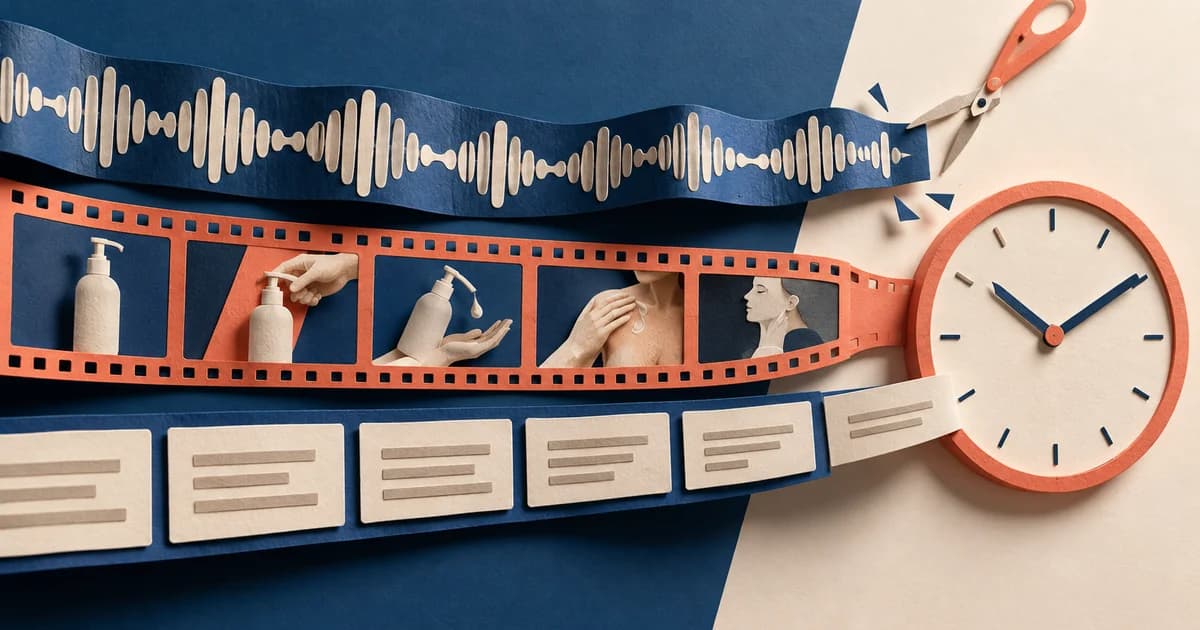
An overlong audio ad rarely contains one catastrophic sentence. More often, several reasonable-sounding sentences are doing duplicate work: two setups, two product descriptions, two readings of the destination, and two calls to action.
The useful edit is to lock the offer, cut duplicated jobs, write the spoken form, then measure the finished audio. Word count helps you find excess; the final recording determines whether the spot fits.
The worked example below cuts a fictional herb-kit ad from 121 to 53 words while preserving the price, discount code, deadline, pickup restriction, availability, and checkout instruction. With the same synthetic voice, the supplied reads take 44.56 and 21.97 seconds. The nine edits show what was removed and why; a human performance still needs its own timing and comprehension check.
The complete 121-to-53-word audio ad edit
Both teaching reads use eSpeak 1.48.15 with the same synthetic US-English voice and settings, without music or effects. The WAV files measured 44.562404 and 21.974422 seconds. These timings describe these files; they do not establish human comprehension, platform acceptance, or campaign performance.
For this comparison, “word” means a space-separated written token. That simple count is useful for tracing the edit, but the later pronunciation section shows why it is not a duration formula.
Original script: 121 words
Before you start thinking about what to make for dinner tonight, take a moment to imagine how nice it might be to have a little more green in your kitchen. Morrow Garden has something to tell you about: our herb kit, with basil, mint, and parsley. It is a kit that includes three herbs: basil, mint, and parsley, all together in one kit. The price is twenty-four dollars before tax with code GROW. Order by October thirty-first, twenty twenty-six. This offer is for local pickup only and is available while supplies last. To place your order, visit Morrow Garden dot example and use code GROW at checkout. That is Morrow Garden dot example. And follow Morrow Garden for more kitchen inspiration.
Play the long synthetic MP3 or open the source WAV.
Revised script: 53 words
Your next meal could use a little green. Get the Morrow Garden herb kit, with basil, mint, and parsley, for twenty-four dollars before tax with code GROW. Order by October thirty-first, twenty twenty-six. Local pickup only, while supplies last. To order your kit, visit Morrow Garden dot example and enter GROW at checkout.
Play the revised synthetic MP3 or open the source WAV.
| Version | Written words | Measured WAV duration | Measured MP3 duration | What the measurement establishes |
|---|---|---|---|---|
| Original | 121 | 44.562404 s | 44.591020 s | This exact dry synthetic render is longer than 30 seconds. |
| Revised | 53 | 21.974422 s | 22.021224 s | This exact dry synthetic render is shorter than 30 seconds. |
The edit removed 68 written words, and the matched WAV duration fell by 22.587982 seconds. The WAV-to-WAV comparison is the reporting basis because the two MP3 copies show slightly different encoded durations. The result leaves about eight seconds inside a 30-second slot, but that space belongs to the eventual performance and mix—not automatically to more copy.
The filled nine-edit decision sheet and measurement ledger are included with the audio.
Nine edits that shortened the read without shrinking the offer
A useful cut list identifies both sides of the decision: what disappeared, and what information survived. The nine edits below account for the full 68-word reduction.
| # | Actual edit | Net words removed | Why the edit works | Information protected |
|---|---|---|---|---|
| 1 | The 30-word dinner-and-kitchen preamble became “Your next meal could use a little green.” | 22 | It reaches the same meal-and-green image directly. | A relevant scene remains. |
| 2 | “Morrow Garden has something to tell you about: our herb kit” became “Get the Morrow Garden herb kit.” | 5 | It deletes the announcement that an announcement is coming. | Brand, product, and action remain. |
| 3 | The second complete basil, mint, and parsley sentence was deleted. | 17 | It repeated the product contents already stated immediately before it. | All three herbs still appear once. |
| 4 | “The price is twenty-four dollars…” became “…for twenty-four dollars…” inside the product sentence. | 2 | The carrier phrase did not add price information. | Price, tax basis, and code condition stay together. |
| 5 | “This offer is for local pickup only” became “Local pickup only.” | 4 | The condition can stand on its own. | The restrictive word “only” remains. |
| 6 | “And is available while supplies last” became “While supplies last.” | 3 | The availability carrier phrase was unnecessary. | The inventory limitation remains. |
| 7 | “To place your order…” became “To order your kit…,” and “use code” became “enter GROW.” | 1 | The change is small, but it names the object and checkout action more directly. | Destination, code, and redemption step remain. |
| 8 | The second complete reading of the URL was deleted. | 6 | It repeated the same destination without adding a new instruction. | The destination is still spoken once. |
| 9 | “And follow Morrow Garden for more kitchen inspiration” was deleted. | 8 | It introduced a second behavior after the purchase instruction. | One next action remains: order the kit. |
The edit is not a contest to remove every repeated word. Two repetitions remain because they perform different jobs. GROW first qualifies the price, then tells the listener what to enter at checkout. Morrow Garden identifies the product and also appears inside the spoken destination.
One conspicuous line was not shortened at all: “Order by October thirty-first, twenty twenty-six.” The year belongs to the locked fictional offer. Removing it would not be a cleaner expression of the same condition; it would change the condition.
Edit 8 is also reversible. If first-time listeners later fail to recover the destination, a second URL reading may earn its way back. The decision sheet marks it as a conditional cut rather than pretending repetition is always waste.
Lock the offer before editing the sentences
Writers often receive one block of copy in which creative setup, approved claims, offer mechanics, and required qualifications look equally editable. Separate them first. Otherwise, a polished rewrite can quietly become a different offer.
For Morrow Garden, the locked sheet is:
| Offer element | Locked value | A shorter line that would change it |
|---|---|---|
| Product | Herb kit with basil, mint, and parsley | “Herb kit” removes what is included. |
| Price basis | $24 before tax with code GROW | “For $24” makes the code-dependent price sound unconditional. |
| Redemption | Enter GROW at checkout | Merely mentioning the code does not explain how to use it. |
| Deadline | October 31, 2026 | Dropping the year changes the stated deadline. |
| Fulfillment | Local pickup only | “Local pickup available” no longer excludes delivery or shipping. |
| Availability | While supplies last | “Limited time” replaces an inventory condition with a time condition. |
| Next action | Order at Morrow Garden dot example | “Follow us” competes with the transaction. |
This is an invariant check: the revised wording can move, combine, or disappear only if the locked value is still recoverable from the final script.
Not every locked phrase is a legal disclosure. Some conditions come from the commercial brief, some from substantiation or brand review, and some may be legally required. The writer should not guess which category applies and then delete the phrase to solve a timing problem.
For US digital advertising, the FTC’s 2013 Dot Com Disclosures guide says audio claims should use audio disclosures presented at a volume and cadence people can hear and understand. It also recommends clear language and syntax rather than legalese. The FTC’s 2023 revised Endorsement Guides add that, in the endorsement context, an audible disclosure should use sufficient volume, speed, and cadence for ordinary consumers to hear and understand it.
Those sources do not prescribe one universal retail script or decide which Morrow Garden conditions are legally mandatory. They support a narrower editing rule: do not make a necessary qualification inaudible, incomprehensible, or materially different just to hit the clock.
Cut copy by function, not by adjective count
“Delete adjectives” is too crude. Some modifiers are empty; others carry the offer. “Amazing” and “incredible” may be expendable generic praise. “Local pickup only” and “three-herb kit” are compact information.
Label each phrase by the job it performs:
- Scene: creates a relevant mental picture.
- Identity: names the advertiser and product.
- Offer: states what the listener receives and on what terms.
- Qualification: limits or explains a claim.
- Action: tells the listener what to do next.
- Production: reserves a pause, sound effect, sonic logo, or music-only beat.
Then compare phrases with the same label. Two passages that deliver the same scene, product list, or destination are candidates for consolidation. Similar-looking passages with different jobs may both be necessary.
The Morrow Garden stock line shows the difference between tightening and deleting. “This offer is for local pickup only and is available while supplies last” becomes “Local pickup only, while supplies last.” The syntax loses seven words across edits 5 and 6, but both limitations survive. By contrast, changing the line to “Pickup available for a limited time” would alter both conditions while sounding smoother.
The production label matters because a script can gain duration without gaining words. A pause after the deadline, a one-second sonic logo, or an isolated product sound may occupy exclusive time. A music bed running under the voice normally overlaps the voice span and should not be added a second time in the duration budget.
Start with the placement limit, not a magic word count
A platform’s maximum file duration and its script-length recommendation are different kinds of information. The first is a delivery constraint. The second is planning guidance.
| Placement or workflow | Current duration rule | Provider guidance that affects the script | Writer’s consequence |
|---|---|---|---|
| Spotify music ads and streaming-ad-insertion podcast ads via Ads Manager or Direct IO | Maximum 30 seconds | Spotify recommends no more than 65 words for a 30-second ad. Selected-market Direct music campaigns can use long-form ads up to 60 seconds, skippable after 30. | Treat 65 as a warning line, not proof that the final file fits. |
| AudioGO uploaded audio | 30 seconds or less | The upload-spec page accepts MP3, WMA, AAC, OGG, or WAV; it does not convert a word count into duration. | Measure the encoded file you will submit. |
| AudioGO podcast creative | Placement-specific network guidance | Target 70 words for :30 at a casual, conversational pace; no time-compressed audio or sped legal copy; no “click” or “tap” CTA. | A podcast version may need different pacing and a different ending. |
These requirements and recommendations were rechecked on September 9, 2026 in Spotify’s US audio ad specifications, AudioGO’s upload specifications, and AudioGO’s podcast creative guidelines.
The Morrow Garden revision sits below both 65 and 70 written words, but that fact did not establish its runtime. The audio file did. Likewise, a 70-word human read with deliberate pauses may fit, while a shorter script full of spelled-out codes, unfamiliar names, and legal qualifications may not.
Write the version the performer will actually say
A text counter sees symbols. A performer sees pronunciation decisions.
| Written item | Spoken direction in this example | Why it matters |
|---|---|---|
| Morrow | “MOR-oh” | An unfamiliar fictional brand needs one approved pronunciation. |
| GROW | The word “grow,” not four letters | Spelling both appearances as G-R-O-W replaces two spoken words with eight letter names. |
| $24 | “Twenty-four dollars” | A compact symbol expands when spoken. |
| 10/31/2026 | “October thirty-first, twenty twenty-six” | Date formatting changes the spoken sequence. |
| morrowgarden.example | “Morrow Garden dot example” | One typed string becomes four spoken units in the performance script. |
The revised display script contains 53 space-separated words. Split its three hyphenated forms and it contains 56 planning units. Spell both instances of GROW as four letters and the count becomes 62. None of those counts is a duration; they show why the written document must be converted into an explicit spoken script before recording.
Now budget the non-overlapping timeline:
final duration = intro-only time + voice-read span + other exclusive holds + tail-only time
A music bed underneath the voice is already inside the voice span. A one-second sonic intro plus a one-second tail, however, leave 28 seconds for speech in a 30-second file. Planning 56 units into that span gives:
56 ÷ 28 × 60 = 120 planning units per minute
That is a scheduling calculation, not a recommended speaking rate and not a measured human read.
Why “just read it faster” is not an editing method
A 1999 laboratory study, Effects of Advertisement Speech Rates on Feature Recognition, and Product and Speaker Ratings, illustrates why a single ideal rate is hard to defend.
Experiment I assigned 98 US undergraduates to a simulated automobile ad read at 212, 113, or 56 words per minute. The fast group rated the car more favorably than the medium group, while the slow group recognized more listed features than the fast and medium groups. Experiment II used 30 different students and only the fast and medium recordings; after a ten-minute interpolated task, the medium group produced higher car ratings and feature recognition than the fast group.
The study is narrow and old: one fictional, list-like car ad; classroom listening; student samples; one nonprofessional female reader; and no music or sound effects. It does not set a modern streaming-ad speed limit. Its useful lesson is smaller: a pace that changes an immediate overall impression may not help people retain specific offer details, and the result can change with the measurement and delay.
When a script is long, edit the message before asking the performer to carry the entire solution in pace.
Keep one next decision, then adapt the route to the placement
The Morrow Garden edit removes “follow us” because ordering and following are different decisions. That does not mean an audio ad can mention only one interface.
Spotify’s current podcast specification says a spoken CTA can reflect the campaign action with language such as visiting a URL or tapping the companion banner, and it requires different CTA scripts when a campaign includes both streaming and dynamic ad insertion. AudioGO’s podcast guideline takes a different route for its network: it prohibits “click” and “tap” language because the actual podcast ad does not include a clickable display component.
The practical rule is: choose one next decision, then name only the routes the selected placement supports. “Order at the site or tap the banner to order” can still describe one decision through two valid paths. “Order now and follow us for ideas” asks for two different outcomes.
Review the ending after the placement is selected. Do not copy a music-streaming CTA unchanged into a podcast version and assume the listener has the same companion experience.
Test the final ad in three separate passes
A correct edit can still fail in production. Run these checks on the actual campaign version rather than treating a clean document as finished audio.
1. Offer-preservation check
Compare the revision with the locked sheet. For Morrow Garden, verify the kit contents, $24 before tax, code GROW, checkout use, October 31, 2026 deadline, local-pickup-only condition, stock limitation, destination, and order action.
Do this before recording. It catches a semantic change while the fix is still a copy edit.
2. Final-file timing check
Measure the exact encoded master that will be trafficked—not the document, an earlier take, or an isolated voice stem. Record the duration without rounding a 30.04-second file down to “30.” Note the version, voice, pronunciation sheet, music, sound effects, exclusive intro and tail, and export settings.
For modular audio, inspect assembled versions as well as isolated clips. A Million Ads’ post-production QA guidance separates checking clips on their own from testing combinations for flow, music and sound-effect interaction, pronunciation, and timing. Its arrangement checklist recommends listening to the shortest, longest, and default versions. These are provider workflow recommendations, not evidence that a campaign will perform better.
3. First-listen comprehension check
Give the final audio to people who have not seen the script. Begin with open questions:
- What is being offered?
- What does it cost, and is anything required to receive that price?
- When does the offer end?
- How is the product fulfilled, and is there an availability condition?
- What should the listener do next?
Record “not recalled” separately from a wrong answer. When comparing versions, avoid always playing the long version first to the same person; the first exposure teaches the offer and can make the second appear easier to understand.
This is a comprehension check, not a sales-lift study. It can reveal that the destination, condition, or action was missed. It cannot prove that the shorter ad will generate more orders.
When the clean version still runs long
Sometimes every remaining phrase has a job and the natural final read still exceeds the slot. That is not a cue to swallow the URL, accelerate the qualification, or make the performer sprint.
Change a larger input instead:
- simplify the offer itself;
- choose one product rather than a catalog;
- use a longer eligible placement;
- remove a production-only beat after confirming it is not central to the concept;
- use a shorter approved destination;
- create placement-specific endings; or
- obtain approval to change a material condition instead of deleting it quietly.
The stop rule is straightforward: when the truthful, understandable offer cannot fit at a credible pace, the brief or placement is over capacity. Show which information consumes the slot, which language is genuinely redundant, and which larger decision must change.
That is the difference between a shorter script and a smaller promise.
Sources
- Audio ad specs & requirements — Spotify Advertising; publication date not stated; checked September 9, 2026.
- What are your audio ad specs? — AudioGO; publication date not stated; checked September 9, 2026.
- What are the Podcast Ad Creative Guidelines? — AudioGO; publication date not stated; checked September 9, 2026.
- .com Disclosures: How to Make Effective Disclosures in Digital Advertising — Federal Trade Commission; March 2013; checked September 9, 2026.
- Guides Concerning the Use of Endorsements and Testimonials in Advertising — Final Rule — Federal Trade Commission; 2023; checked September 9, 2026.
- Effects of Advertisement Speech Rates on Feature Recognition, and Product and Speaker Ratings — Skinner, Robinson, Robinson, Sterling, and Goodman; International Journal of Listening; 1999; checked September 9, 2026.
- Post-Production Quality Assurance — A Million Ads; publication date not stated; checked September 9, 2026.
- Stage 4: Arrangement & Quality Control — The Final Polish — A Million Ads; publication date not stated; checked September 9, 2026.