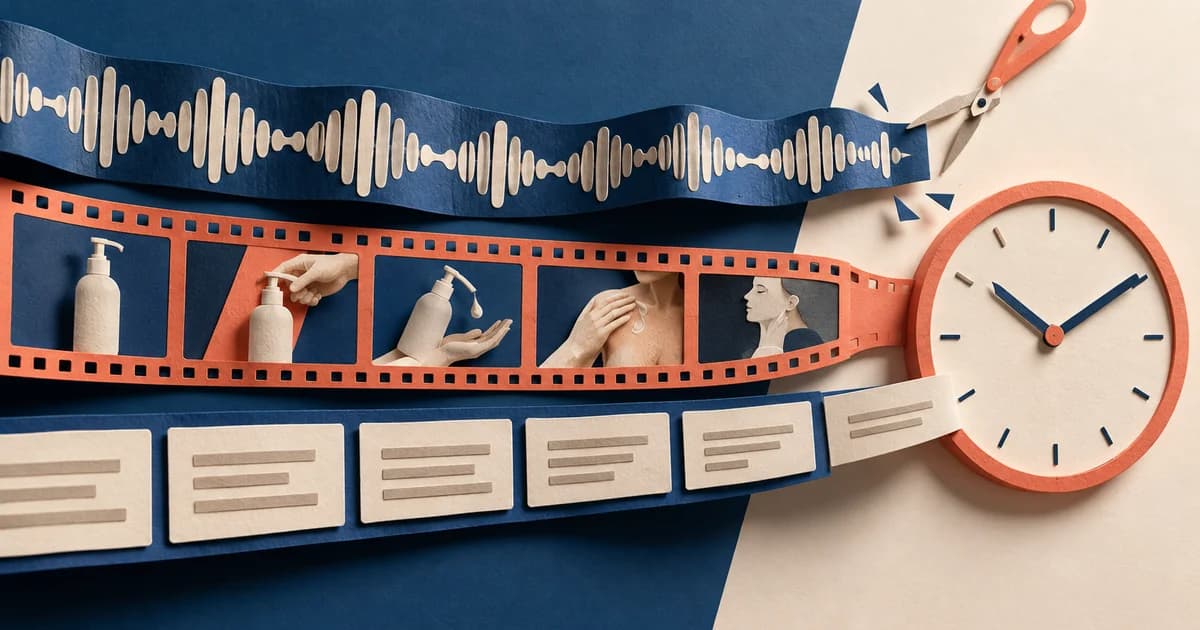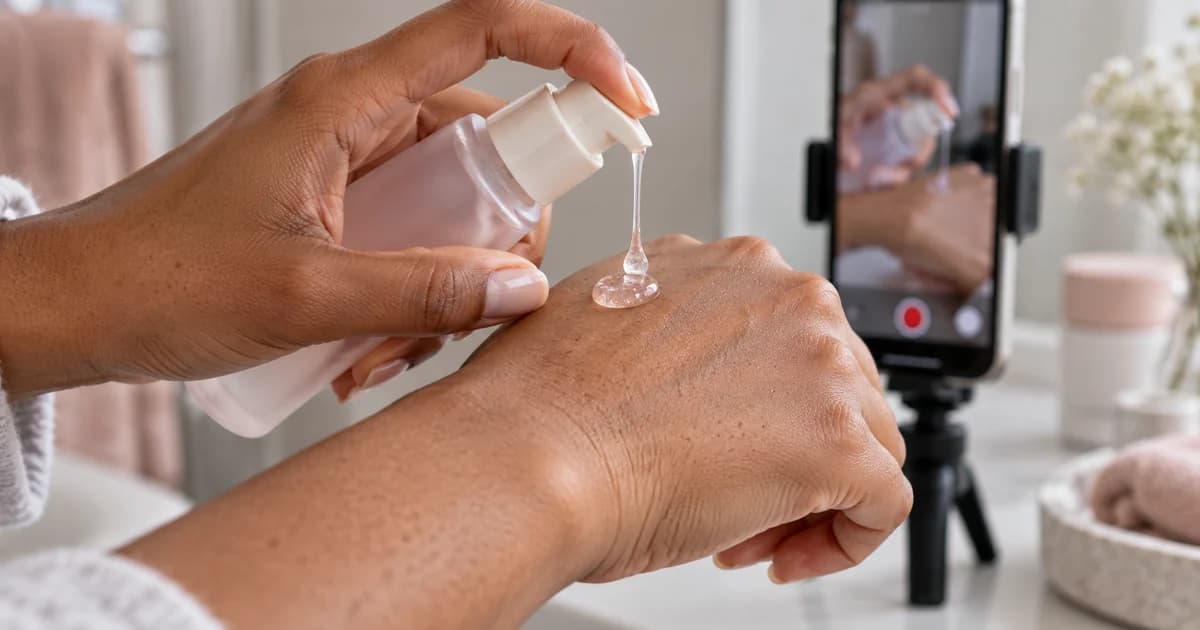
A creator holds up a serum and says it is “so good.” The bottle is visible, the bathroom looks believable, and the praise sounds spontaneous. Yet the shopper still does not know whether the pump is controllable, the texture is runny, the tint covers anything, the base pills under makeup, or the mascara actually comes off the way the label says.
That is the useful dividing line for beauty UGC: a testimonial reports an opinion; a demonstration answers a visible product question. The strongest shot is not necessarily the prettiest one. It is the shot that lets a buyer observe a relevant action under conditions clear enough to interpret.
Use this planning sequence:
- Name one shopper uncertainty.
- Film the action that could answer it.
- Control the conditions that could change the impression.
- Describe only what the clip can establish.
- State what remains unknown instead of filling the gap with generic praise.
A short beauty video can show dispensing, spread, placement, immediate coverage, layering behavior, removal steps, or finish under specified light. It cannot, by itself, establish treatment efficacy, a four-week outcome, all-day wear, or the result a typical customer will achieve.
Four beauty ad patterns to critique
“Ad example” can refer to four different things: a playable original, a vendor’s timecoded description, a still frame, or a paid-ad record. Those are not interchangeable. Only inspected motion supports your own account of a sequence. A still does not reveal application order; a transcript does not reveal lighting; a paid-ad record does not prove that the media loaded or that the ad worked.
The examples below come from public paid-social libraries, but the action sequences are source-reported rather than independently replayed here. They are useful as patterns to critique—not as proof of campaign performance.
| Public record | Source-reported sequence | Shopper question it addresses | What the sequence still does not prove |
|---|---|---|---|
| Tarte Shape Tape coverage demo | Motion describes lip liner placed below the eyes, two swipes of concealer, then brush blending from 00:00 to 00:21. | “Can I see this concealer cover a high-contrast mark?” | A drawn mark is not a natural dark circle, acne lesion, or treatment outcome. Unknown amount, lighting, retouching, and wear time limit the conclusion. |
| Tarte concealer-only face routine | Motion describes darker and lighter concealer placements followed by blending into a finished face. | “Where do the shades go, and in what order are they blended?” | The routine demonstrates placement and technique, not long wear, shade universality, or superiority to foundation. |
| Tarte tubing-mascara removal | Motion describes one-eye application followed later by water removal between 00:16 and 00:26. | “What does the removal action look like?” | A final swipe does not reveal water temperature, saturation time, hidden preparation, rubbing force, or residue. Narrated “better for lashes” and all-day claims are separate from the visible action. |
| Dermalogica water-cream application | Motion describes product explanation, facial application from 00:28 to 00:48, then a side comparison. | “How does the texture handle, and what is the immediate finish?” | Shine or a side difference under unknown light does not establish collagen preservation, long-term hydration, or typical results. |
Sources: Motion’s Tarte Cosmetics paid-social library and Motion’s Yapper-format library. Motion labels these as active Meta ads and supplies the timecodes and analyses; it is a creative-intelligence vendor, not an independent efficacy study.
Paid provenance is a separate question. A TikTok Creative Center Top Ads record for a DG Beauty eyeshadow post identifies an Italy cosmetics ad, a landing page, and an #adv caption, These record details establish paid-status context; the sequence analysis above relies on the explicitly attributed Motion descriptions. TikTok also explains that Spark Ads can turn authorized organic posts into ads while attributing boosted engagement to the original post. Likes on a creator-looking post therefore do not establish an organic-only history—or why the creative succeeded.
The practical lesson is simple: borrow the demonstration task, not an unverified outcome. The following six original teaching examples turn that principle into shootable briefs.
Six beauty UGC demonstrations worth filming
The products and measurements in these six treatments are fictional teaching inputs. Replace them with permissioned products, current label instructions, actual capture notes, and real footage before making a product-specific statement.

1. Dispensing: show what one press actually delivers
Shopper question: Is the package controllable, or does it dispense more product than I need?
Frame the nozzle, receiving dish, and full finger press in one locked close-up. Film the first prime separately; do not present it as a normal dose. Then show transfer from the dish to the tool and from the tool to a marked 5 × 5 cm application area.
A simple mass balance prevents misleading shorthand. In this fictional example, the dish moves from 12.00 g to 12.12 g, so 0.12 g was dispensed. After pickup, it weighs 12.03 g, so 0.09 g left the dish. If the tool retained 0.02 g, the estimated deposit is 0.07 g—not 0.12 g. Across 25 cm², that is 2.8 mg/cm².
Use: “Here is one full press, transferred over this marked area.”
Avoid: “This is exactly how much reaches your skin.”
Also capture packaging use when it is the uncertainty. The current Skinfix Triple Lipid-Peptide Cream instructions specify 1–2 pumps and show a three-step refill process; the refill fits the regular 1.7 oz package, not the mini or XL. That is a better basis for a packaging demo than a generic jar-opening montage.
2. Texture and spread: keep amount and area together
Shopper question: Is the formula fluid, dense, tacky, or easy to distribute over the intended area?
Use two views for two different jobs. A side-lit macro can reveal ridges, stringing, and slip. A second locked comparison view should hold light, angle, exposure, distance, product mass, area, tool, passes, and elapsed time constant. Do not splice a dramatic side-lit texture shot into a coverage comparison and imply both were captured identically.
Area matters as much as amount. The same fictional 0.10 g spread over 16 cm² equals 6.25 mg/cm²; over 25 cm² it equals 4.00 mg/cm². The first nominal loading is 56.25% greater. A thicker-looking film may therefore reflect a smaller application area rather than a different product behavior.
Use: “This is how 0.10 g spreads over a marked 25 cm² area in 15 seconds.”
Avoid: “A little goes a long way,” unless “little,” area, and application method are defined.
3. Shade and coverage: identify the starting point
Shopper question: What does this shade look like here, and what visible mark remains after a defined application?
For a safe teaching setup, use a permissioned forearm and a deliberately drawn cosmetic mark—not an invented blemish, diagnosis, or fabricated customer before-and-after. Include the shade name, reference card, bare baseline, one continuous application, and a ten-second final hold. In the fictional brief, apply 0.05 g to a 5 × 5 cm area and blend for 15 seconds with the named tool.
Lock white balance and exposure before the baseline. Keep the camera perpendicular to the surface. Show the result both close enough to inspect edges and far enough to see the whole marked area. Do not auto-brighten only the “after,” smooth texture, or switch to a more flattering focal distance.
Use: “Coverage over a deliberately drawn cosmetic mark, filmed under this lighting.”
Avoid: “Erases dark circles,” “covers every blemish,” or “one swipe for everyone.”
A surrogate mark can make contrast visible, as in the source-reported Tarte example. It does not become evidence about a natural skin concern merely because it appears near the eye.
4. Layering: film the exact stack, including the wait
Shopper question: What happens when these exact products are layered in this order?
Record the base product, amount, area, application tool, passes, wait interval, second product, and final hold. For a fictional base-plus-tint example: apply 0.10 g of base over 25 cm² for 12 seconds, wait 60 seconds, apply 0.05 g of tint for 12 seconds, then hold for 10 seconds. The uninterrupted master lasts 94 seconds. A two-second edit of the wait is acceptable only when an elapsed-time card preserves the real interval.
Do not write one universal wait into every brief. The Skinfix instructions say to apply makeup while the moisturizer still feels wet for extra dewiness. A Milk Makeup article about its Hydro Grip Gel Tint workflow says to let the primer dry for 60 seconds, then use the back of the hand or a palette to control tint amount. Different product stacks and desired finishes create different demonstrations.
Hidden cleanup is another confound. In a 2024 study of skincare pilling, 528 women in Guangzhou applied fixed quantities over marked areas, but any observed pills were gently removed before the next layer. That method detail prevents a reader from treating later appearance as proof that foundation visibly dissolved existing pills.
Use: “This recorded stack, amount, order, and interval produced this immediate appearance.”
Avoid: “Never pills under makeup.”
5. Removal: the preparation is part of the result
Shopper question: What preparation, contact, motion, and residue are involved in removal?
Start before the satisfying wipe. Show the water or remover, contact time, pressure direction, number of passes, surface afterward, pad or fingertips, and remaining residue. For a fictional swatch: apply 0.05 g over 25 cm², use 0.50 g remover, allow 28 seconds of preparation/contact, perform a two-second swipe, and hold on the result for four seconds. The process is 34 seconds, not “removed in two seconds.”
Exact formula matters. Maybelline’s current US directions say Sky Tubes tubing mascara should be saturated with warm water before the tubes are gently swiped down with two fingers. Its separate Sky High Washable Mascara is removed with gentle makeup remover or micellar water. A brand-family name does not justify filming one removal method for another formula.
Use: “After warm-water saturation, the tubes moved with this downward swipe; residue is shown here.”
Avoid: “Falls off instantly with water,” when the preparation was cut.
6. Immediate finish: show the look—and the time limit
Shopper question: What does the product look like immediately after a specified application under this light?
Film baseline, continuous application, an immediate hold, and a second hold at 60 seconds. In the fictional brief, apply 0.10 g over 25 cm² with the same camera, distance, angle, white balance, exposure, and light output throughout. Add a separate moving-light beauty shot only after the controlled comparison, and label it as a different view.
Lighting must fit the question. A 2021 clinical-photography paper explains that cross-polarized light reduces glare and specular reflection, while standard white light better preserves some surface texture and morphology. The paper concerns clinical documentation, not advertising performance, but the optical tradeoff is directly useful: polarization may clarify color while hiding the sheen a finish demo is meant to show. Capture both when both questions matter.
Use: “Immediate finish at 0 and 60 seconds under this lighting.”
Avoid: “Hydrates all day,” “repairs the barrier,” “preserves collagen,” or “typical four-week result.” A short shine or smoothness clip does not contain that evidence.
How filming choices can change the apparent result
A demonstration is only as interpretable as its capture conditions. “No filter” is not enough; the camera can still change exposure, white balance, focus, sharpening, tone mapping, and local brightness automatically.
| Variable | How it can alter the impression | Practical control |
|---|---|---|
| Lighting direction and diffusion | Side light exaggerates ridges and flakes; frontal diffusion can flatten them. Specular light can make a finish look wetter. | Keep a locked comparison light, then capture any beauty-light view separately and label it. |
| Exposure and white balance | A brighter or warmer after shot can make tone and glow appear changed. | Lock both before the baseline; include a neutral reference card in setup footage. |
| Filters, beauty mode, and retouching | Smoothing can remove texture; local edits can change redness, shadow, and edge contrast. | Disable them, retain the unedited master, and log every crop or grade. |
| Distance, lens, and angle | Moving closer changes texture visibility; a new angle changes reflection and apparent contour. | Mark tripod and subject positions; match crop from one master where possible. |
| Product amount, area, and tool | A heavier loading or smaller area can imitate better coverage or richer texture. | Weigh or otherwise define the amount, mark the area, and name the tool and passes. |
| Time | Wet application, dry-down, oxidation, transfer, and residue can look different seconds later. | Put actual elapsed time on screen; do not compress it into an outcome claim. |
| Editing and cleanup | Cuts can hide extra coats, removed pills, repeated wipes, or a changed light. | Keep an uninterrupted evidence take and a change log; disclose speed changes and hidden intervals. |
The goal is not to make every UGC ad look clinical. It is to protect the answer to the chosen question. A glossy moving highlight may be the right beauty shot for finish; it is the wrong sole comparison for coverage. A macro texture shot may be informative; it should not replace the wider frame that proves the same area and amount were used.
The informal UGC look does not make a claim trustworthy
For US-facing work, build disclosure and claim review into the capture plan—not onto the caption after editing.
The FTC’s Endorsement Guides FAQ says endorsements must be honest and not misleading, and unexpected material connections should be disclosed clearly and conspicuously. For video, a visual endorsement calls for at least a visual disclosure, an audible endorsement calls for at least an audible disclosure, and an endorsement made both ways calls for both. A description alone can be missed, and a platform disclosure tool is not automatically sufficient.
The same FAQ warns that standard brand-created content becomes misleading when it falsely communicates that a creator used a product or had an experience. The FTC’s Consumer Reviews and Testimonials Rule Q&A likewise distinguishes an obvious fictional dramatization from an actor presented as a real testimonialist. So fictional teaching demonstrations should look and read like demonstrations—not fabricated customer stories.
Visuals also contribute to the claim. The FTC’s Health Products Compliance Guidance instructs marketers to assess the ad’s overall net impression, including images, not just isolated wording. A generic “results may vary” line does not, by itself, neutralize a stronger transformation message; the Endorsement Guides FAQ says such phrases generally do not change the interpretation of a testimonial claiming specific results.
Finally, the FDA’s cosmetic-versus-drug guidance draws the line by intended use. Cleansing, beautifying, and altering appearance fit the cosmetic definition; claims to treat disease or affect body structure or function can create drug implications, including through advertising and online promotional language. That is why “looks smoother under this light” and “repairs skin structure” are not interchangeable copy choices.
This is a production framework, not a legal opinion. Route product-specific efficacy, therapeutic, comparative, and typical-results claims through the brand’s substantiation and legal review.
Send creators a capture brief, not six lines of praise
A useful brief can fit on one page, but it must preserve the evidence. For every shot, specify:
- the shopper question and exact SKU, formula, shade, size, and batch when relevant;
- label instructions, amount, application area, tool, number of passes, wait time, and removal preparation;
- camera, lens or phone mode, distance, angle, light placement, white balance, exposure, focus, and any polarization;
- the required baseline, continuous action, result hold, residue view, and elapsed-time card;
- prohibited changes: beauty mode, smoothing, hidden touch-up, undisclosed speed changes, or selective exposure shifts;
- the creator’s real material connection and where the disclosure appears in image and sound;
- permission and reuse scope; and
- delivery of the edited cut, uninterrupted master, capture notes, failed takes relevant to interpretation, and an edit/change log.
Keep two outputs when aesthetics and comparison pull in different directions: a controlled evidence take that answers the question and a beauty take that makes the product attractive. Never cut between them as though the conditions were identical.
The downloadable beauty UGC demonstration shot planner and capture-notes worksheet turn these fields into production-ready records. They also force one final sentence before filming: “This clip can show ___, but it cannot establish ___.”
Choose the product question before choosing the creator line
Generic praise is easy to record because it asks nothing of the footage. A useful beauty UGC demonstration is harder: it defines the amount, action, surface, timing, light, and limit clearly enough that the viewer can judge one product behavior.
Start with the uncertainty. Does the pump control the dose? How does this measured amount spread? What remains after one defined layer? Does this exact stack pill? What preparation precedes removal? What is the immediate finish under a named light?
Then film the answer—and stop the claim where the camera stops seeing.
Sources
- FTC’s Endorsement Guides: What People Are Asking, Federal Trade Commission, guidance reflecting the 2023 revised Guides; checked September 8, 2026.
- Health Products Compliance Guidance, Federal Trade Commission, 2022; checked September 8, 2026.
- The Consumer Reviews and Testimonials Rule: Questions and Answers, Federal Trade Commission; rule effective October 21, 2024; checked September 8, 2026.
- Is It a Cosmetic, a Drug, or Both? (Or Is It Soap?), US Food and Drug Administration; checked September 8, 2026.
- How Tarte Cosmetics Advertises on Meta, Motion paid-social library; checked September 8, 2026.
- What Is the Yapper Ad Format?, Motion creative-format library; checked September 8, 2026.
- DG Beauty TikTok Top Ads Record 7623699338883301394, TikTok Creative Center; checked September 8, 2026.
- About Spark Ads, TikTok for Business, updated June 2026; checked September 8, 2026.
- Triple Lipid-Peptide Cream, Skinfix US product instructions; checked September 8, 2026.
- What Is a Skin Tint? All About Hydro Grip Gel Tint, Milk Makeup, July 30, 2025; checked September 8, 2026.
- Understanding the Causes of Skincare Product Pilling, Skin Research and Technology, published August 2, 2024; checked September 8, 2026.
- Lash Sensational Sky Tubes Tubing Mascara, Maybelline New York US product instructions; checked September 8, 2026.
- Lash Sensational Sky High Washable Mascara, Maybelline New York US product instructions; checked September 8, 2026.
- Standardized Clinical Photography Considerations in Patients Across Skin Tones, British Journal of Dermatology, 2021; checked September 8, 2026.