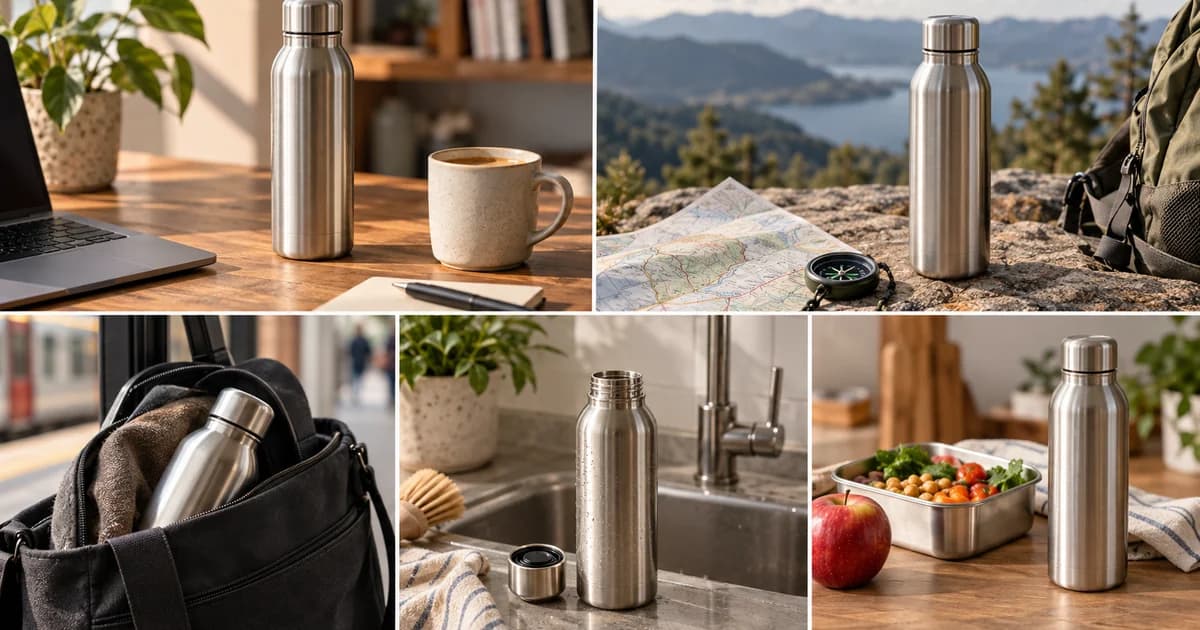
Imagine two Black Friday offers for a $60 bottle: 20% off, or 10% off plus a free sleeve with a $16 retail price. The second looks gentler. In the model below, after product, packing, shipping, payment, return, and $12 of allocated advertising costs, 20% off leaves $9.16 of contribution while the smaller discount plus gift leaves $5.59.
The lesson is not that gifts are bad or discounts are good. A headline percentage reveals little about an offer’s total cost.
A margin-constrained brand needs to make three decisions in order:
- Choose a benefit the buyer can actually use. A complementary product, included service, or delivered price can be more meaningful than a vague “VIP” perk.
- Price the entire mechanism. Include the gift’s landed cost, extra packing, carrier charges, payment fees, returns, labor, future credits, and any sales the offer may replace.
- Write the ad as benefit, condition, and next step. The audience should understand what they receive, what qualifies, and what to do without decoding a footnote.
Campaigns show alternatives. Olight offered engraving on selected models and colors, with a product-page preview flow. In 2025, Fangamer combined shipping benefits with tiered gift codes, while Ossou used future-order credit with spend bands and a short redemption window. These records show mechanics, not effectiveness. Olight’s engraving guide, Fangamer’s 2025 terms, Ossou’s 2025 terms.
Start With the Offer, Not the Percentage
Before writing an ad, define the no-offer basket you are comparing against.
A $68 bottle-and-brush bundle should usually be compared with the contribution from selling that same bottle and brush separately—not with a bottle-only order. A free brush should be compared with a bottle-only order when the brush would not otherwise sell, but with a bottle-plus-brush order when the promotion displaces a paid attachment. A two-bottle threshold should be compared with an undiscounted two-bottle purchase, not a one-bottle order.
Then map the mechanism to its hidden inputs:
| Offer mechanism | Customer-facing benefit | Merchant inputs that can change the decision | What the ad must make clear |
|---|---|---|---|
| Complementary bundle | A useful set at one price | Component cost, displaced full-price sales, partial returns | Included items, separate-price basis, shipping, return allocation |
| Gift with purchase | An extra product at $0 | Gift COGS, packing, parcel size, gift inventory, returns | Qualifying SKU or spend, quantity limit, automatic or code, return treatment |
| Quantity or spend threshold | A fixed saving after a reachable basket | Cheapest qualifying basket, discount operator, partial returns | What counts, before or after discounts, cap, exclusions |
| Free shipping | A lower delivered price | Carrier cost, zones, dimensional weight, address eligibility | Merchandise threshold, geography, standard versus express |
| Personalization | A product made more giftable | Labor, queue capacity, remake risk, recovery value on return | Eligible variants, customization step, handling time |
| Future credit | Value on a later order | Earning rate, redemption rate, minimum future basket, displaced repeat sales | Not a discount today, issue timing, minimum, expiry and exclusions |
| Early access | More time or earlier inventory access | Account friction, support load, whether access is genuinely different | Start times, account requirement, price, whether stock is reserved |
| Gift-ready service | Convenience | Materials, labor, package size, peak capacity | How to select it, order limit, handling or delivery limits |
None is automatically margin-safe. A large discount can be rational for high-margin or excess inventory; a no-discount offer can be expensive if it creates another shipment, larger packaging, or lower recovery value on returns. Ask which benefit creates the best trade-off for this buyer, basket, and operation—not simply how to avoid 50% off.
Eight Black Friday Ad Ideas, With the Conditions Attached
The eight treatments below are original, fictional examples for Field Bottle, a simple U.S. catalog with a $60 insulated bottle, a $12 cleaning brush, and a $16 sleeve. They are alternatives, not a stackable promotion set.
Unless a concept says otherwise, the specimen window is November 27, 2026 at 12:00 a.m. ET through November 30, 2026 at 11:59 p.m. ET; it applies to the contiguous United States, taxes are extra where applicable, standard shipping is $5, and it cannot be combined with another promotion. The illustrative voluntary-return policy allows eligible merchandise to be returned within 30 days of delivery; original shipping is not refunded and return shipping is covered.
1. Sell the Useful Pair, Not a Mystery Bundle
Ad: A bottle-and-brush set for $68. Choose your bottle color and get the brush with it.
Condition: One bottle + one brush. $72 if purchased separately. $5 standard shipping. No code needed.
CTA: Choose the set.
Use this only when the products solve one job; a random slow-moving add-on can feel like inventory disposal. The model leaves $24.88 after allocated advertising versus $28.77 for the same items sold separately, a $3.89 sacrifice. Comparing it with a bottle-only order and calling the higher order value a win would be misleading. For partial returns, allocate the $68 price in advance—$56.67 to the bottle and $11.33 to the brush here—rather than inventing a later clawback.
2. Include a Complementary Gift
Ad: Buy a $60 bottle. Get the cleaning brush free.
Condition: One brush per order with a full-price bottle. Added automatically. $5 standard shipping.
CTA: Choose your bottle.
A gift’s retail value is not its merchant cost. Price the unit, packing, parcel change, returns, and any add-on sale it displaces; show the gift as a separate $0 cart line. LEGO’s surviving U.S. terms ran November 29–December 2, 2024 and paired The Endurance (10335) with Shackleton’s Lifeboat while supplies lasted. They listed a $24.99 approximate retail value, limited the gift to one per household, and required it back with a qualifying return. Membership appeared in a separate paragraph for Insiders discounts, not in the gift paragraph; the page does not reveal LEGO’s unit cost. LEGO’s 2024 U.S. offer terms.
For Field Bottle, the brush adds $3 landed COGS, $0.50 pick-and-pack, and $0.20 return allowance. Contribution is $17.11, or $3.70 below the bottle-only control. If it displaces a paid brush purchase, the sacrifice is $11.66. State the return rule near the offer; this fictional version lets the customer keep the brush and does not deduct its $12 retail price.
3. Make the Threshold Reachable
Ad: Two bottles for $110, plus $5 standard shipping.
Condition: Save $10 when bottle merchandise totals $100 or more before this offer. Accessories, shipping, and tax do not qualify. One $10 saving per order.
CTA: Choose two colors.
The catalog must make the threshold reachable. At $60 each, two bottles are the first eligible basket: $120 before the saving and $110 after it. Three bottles still receive only one $10 saving. The model leaves $46.36 versus $56.07 at full price; only incremental two-bottle purchases could offset that sacrifice, and the calculation does not prove them. For partial returns, allocate $55 to each bottle and use the same rule in checkout, support, and refund logic.
4. Advertise the Delivered Price
Ad: Bottle + brush: $72 with standard shipping included.
Condition: Free standard shipping on $72+ in merchandise after discounts. Contiguous U.S. only. Taxes do not count toward the threshold. No express upgrade included.
CTA: Build the $72 set.
Translate “free shipping” into the delivered basket. The merchant still pays the carrier: this example leaves $23.91 versus $28.77 for the same basket with a $5 customer charge, a $4.86 sacrifice after the lower card fee. Check the packed parcel, not only product weight. FedEx explains that it can charge based on actual or dimensional weight, whichever is greater, and uses length × width × height ÷ 139 for U.S. dimensional-weight calculations. In a simple illustration, expanding a 12 × 6 × 6-inch box to 12 × 12 × 6 inches changes calculated dimensional weight from about 3.1 to 6.2 pounds. That does not prove the shipping bill doubles; zone, service, rounding, and contract rates still matter. FedEx dimensional-weight guidance.
5. Offer Personalization With a Real Capacity Limit
Ad: Make the $60 bottle theirs. Add initials at no extra charge.
Condition: Complimentary initials on Black or Sand bottles. Preview and approve before checkout. Allow two extra business days for handling. $5 standard shipping.
CTA: Preview initials.
Olight’s 2024 Black Friday page showed the operational part that weak personalization ads often omit: choose an eligible model, select Customize on the product page, preview the design, and complete the order. The offer applied to selected models and colors rather than every product. The broader event ran from November 15 at 8:00 p.m. EST through December 3 at 11:59 p.m. EST, but the source does not establish a separate engraving-only start time. Olight’s personalization flow, Olight’s event guide.
Field Bottle allows three uppercase letters in one fixed font and position. Six minutes at $30 per hour adds $3 labor and leaves $17.81 in the base model, before equipment setup. A 2% remake branch on $31 of product, engraving, packing, and carrier cost adds $0.62 per order. Use capacity estimates to close the offer or extend handling time—not to manufacture scarcity.
6. Make Future Credit Honest About the Future
Ad: Buy a $60 bottle now. Earn $10 toward a later order after the 30-day return window.
Condition: One credit per customer on a kept, full-price bottle. Issued by email after the return window closes. Use on a future $30+ merchandise order before credit. Not a discount today.
CTA: See the credit terms.
Future credit looks inexpensive because nothing comes off today’s cart. Here, 95% of orders qualify after returns and 40% of those customers redeem, so the nominal reserve is 0.95 × 0.40 × $10 = $3.80 and first-order contribution is $17.01. On the smallest reachable future basket—two $16 sleeves—the customer pays $22 plus $5 shipping, and the second order leaves only $0.62. If that $32 purchase would have happened anyway, the credit reduces its contribution by $9.71. Model incremental redemptions and displaced paid repeats, not redemption alone.
Real terms can be much tighter. Ossou’s 2025 Black Friday offer used tiered next-order credits based on cumulative net purchases, excluded taxes, shipping, other credits, and gift cards, withheld credit for returned merchandise, issued codes by a stated date, and gave the code a 15-day life. That is a documented mechanism, not a recommendation to copy the deadline. Ossou’s 2025 credit terms.
7. Sell Access Only When Access Is Meaningful
Ad: Account holders can shop Black and Sand bottles a day early.
Condition: Free account. Early access starts November 26, 2026 at 12:00 a.m. ET; public access starts November 27 at 12:00 a.m. ET. Same $60 price. $5 standard shipping. No stock reserved.
CTA: Create an account for access.
Field Bottle assigns only $0.50 of incremental operations to early access, leaving $20.31, but low cost does not create customer value. Walmart’s 2025 online event began November 25 at 12:00 a.m. ET, with Walmart+ access five hours earlier. That sat alongside price deals; it does not show that access replaces discounts. Walmart’s 2025 announcement.
State what opens early, account cost, price, and whether stock is reserved. Do not relabel the same public catalog “VIP access.”
8. Remove a Gifting Task
Ad: A $60 bottle, wrapped and ready to give.
Condition: Choose complimentary gift wrap and one message card before checkout. One wrapped bottle per order. $5 standard shipping. No delivery-date guarantee.
CTA: Add gift wrap.
Convenience can be the offer. One wrap, one 80-character card, one address, and explicit checkout selection cost $1 material plus $2 labor, leaving $17.81 in the base model. Peak capacity is the failure mode. Hello Youngster’s Australian 2025 terms paired complimentary gift wrapping for eligible orders with a warning that delays could occur during high-volume days, and separately told shoppers to allow up to ten business days for dispatch. That is a useful distinction: dispatch is not delivery, and a gifting service does not justify inventing an arrival guarantee. Hello Youngster’s 2025 terms.
Measure the final package. If the wrap changes the box size or protection needed, add the new material and carrier cost before approving the ad.
Why the Gentler-Looking Offer Can Cost More
Here is the complete base comparison behind the opening. It is a synthetic Field Bottle scenario, not a forecast for a real brand. “Contribution” means customer payment minus the listed variable costs; it is not gross-margin percentage or net profit. Fixed overhead, financing, income tax, and equipment depreciation are outside the model.
| Per-order input | No offer | 20% off | 10% off + free sleeve |
|---|---|---|---|
| Merchandise collected | $60.00 | $48.00 | $54.00 |
| Shipping collected | $5.00 | $5.00 | $5.00 |
| Bottle + gift landed COGS | −$18.00 | −$18.00 | −$25.00 |
| Pick, pack, and regular packaging | −$3.00 | −$3.00 | −$5.00 |
| Carrier cost | −$7.00 | −$7.00 | −$7.00 |
| Payment processing | −$2.19 | −$1.84 | −$2.01 |
| Basic net return-loss allowance | −$2.00 | −$2.00 | −$2.40 |
| Allocated advertising | −$12.00 | −$12.00 | −$12.00 |
| Contribution after allocated ads | $20.81 | $9.16 | $5.59 |
The payment line uses 2.9% + $0.30, matching Stripe’s U.S. standard domestic-card price when checked September 8, 2026. Actual rates vary. Stripe also says original processing fees are not returned on completed payments, while some prompt refunds become reversals; replace this assumption with your provider and transaction type. Stripe U.S. pricing, Stripe refund documentation.
The smaller discount keeps $6 more merchandise revenue than the 20% offer. But the sleeve adds $7 of landed cost, $2 of packing, $0.40 of return allowance, and $0.17 of processing cost relative to the 20%-off order. The net difference is $6 − $9.40 − $0.17 = −$3.57.
That result is input-dependent. If the sleeve’s landed cost were $3 instead of $7 and everything else stayed fixed, the smaller-discount offer would leave $9.59—slightly more than the 20% offer’s $9.16. The mechanism did not change; one input did.

Returns Can Reverse the Apparent Winner
A flat return allowance is useful for a first pass, but it can hide differences between offers. For a second pass, remove the flat allowance and model the return state explicitly:
Expected contribution = contribution before return loss − return rate × (refunded merchandise + refunded outbound shipping + reverse freight + inspection or rework − recovered inventory value − refunded processing fee)
The Field Bottle return sensitivity assumes merchandise is refunded, the original $5 shipping charge is not, the merchant pays $8 reverse freight and $2 inspection, and a plain bottle recovers inventory value equal to 80% of its $18 landed cost. An engraved bottle has zero recovered inventory value in this scenario. These are teaching assumptions, not benchmark return rates.
| Offer | Contribution before explicit return loss | Loss per returned bottle | Expected contribution at 15% returns |
|---|---|---|---|
| Free cleaning brush | $19.31 | $55.60 | $10.97 |
| Free initials engraving | $19.81 | $70.00 | $9.31 |
| Free gift wrap | $19.81 | $55.60 | $11.47 |
Before explicit returns, engraving appears $0.50 better than the brush gift. At 15%, it ranks below both alternatives because the personalized bottle has no recovery value and its labor is spent. This says nothing about which offer causes more returns; it shows that equal return rates can produce unequal losses. The supplied calculator reproduces $10.97 and $9.31 without double-counting a flat reserve.
Make the Ad Understandable in One Pass
Use this editorial sequence:
- Benefit: What does the shopper receive or avoid paying?
- Condition: Which product, spend, geography, date, account, or stock rule qualifies?
- Next step: What should the shopper choose, add, preview, or create?
This is a writing and QA framework, not a conversion formula.

The condition must be operable, not merely arithmetically true. Suppose a shopper has $72 in eligible merchandise, the free-shipping threshold is $75, and the cheapest eligible add-on costs $12. A progress bar that says “Only $3 away” describes the numerical gap, but the shopper must spend $12 to cross it. If the original checkout was $72 merchandise + $5 shipping = $77, adding the item creates an $84 pre-tax checkout. The shopper spends $7 more cash to remove a $5 charge.
Name the real action—“Add the $12 brush to qualify”—or redesign the threshold around a useful set: “Bottle + brush: $72 with standard shipping included.” Apply the same principle elsewhere:
- Replace “Free gift with purchase*” with “Buy a $60 bottle; one brush is added automatically. One per order.”
- Replace “Earn $10!” with “Earn a $10 future credit after the 30-day return window; use it on $30+ future merchandise. Not a discount today.”
- Replace “Free personalization” with “Choose initials on Black or Sand, preview before checkout, and allow two extra business days.”
- Replace “Members shop first” with exact account cost, opening time, public opening time, price, and whether stock is reserved.
For U.S. offers, the FTC says terms for receiving and retaining a “free” item should be clear and conspicuous at the outset. Its disclosure guidance emphasizes prominence, presentation, placement, and proximity rather than a contradictory footnote. This is general federal guidance, not legal advice for a specific promotion. FTC Guide Concerning Use of the Word “Free”, FTC “Full Disclosure” guidance.
Do not manufacture urgency. The FTC has specifically identified countdown timers that imply an offer is time-limited when it is not as a dark-pattern tactic. Use a countdown only when the underlying end time is real and the system will honor it. FTC dark-pattern summary.
Finally, match the promise to fulfillment capacity. The FTC’s Mail, Internet, or Telephone Order Merchandise Rule guide says merchants need a reasonable basis for stated or implied shipping times; its examples point to anticipated demand, supply, fulfillment capacity, and records. If no shipping time is stated, the guide describes a 30-day default basis for most covered orders, along with delay-consent and refund obligations. A future purchase credit is not a substitute for a required refund. FTC merchandise-order rule guide.
Choose a Defensible Candidate, Not a Guaranteed Winner
For Field Bottle, the cleaning brush is the first candidate because it is related to the product, simple in cart, and has a measurable sacrifice—not because it is proven to win. The decision record:
- Launch only when brush inventory is reserved for the promotion.
- Confirm the brush fits in the normal parcel without a carrier-rate change.
- Show the brush as a $0 line before payment and keep the return rule consistent across the ad, product page, checkout, and support scripts.
- Compare against the correct bottle-only control and separately watch paid brush attachment, because displacement changes the sacrifice from $3.70 to $11.66.
- Stop or reprice if real carrier cost, return recovery, or allocated acquisition cost pushes expected contribution below the brand’s required floor.
Another catalog could favor the delivered-price set, gift wrapping, or a deep discount. Choose from the inputs and the buyer’s job—not headline generosity. The standard is simple: useful enough to explain in one sentence, specific enough to operate without surprises, and fully costed before the ad makes the promise.
Sources
- Promotions, Offers and Events — Black Friday is here!, LEGO, historical 2024 U.S. offer terms.
- Olight Black Friday 2024: 8 Models to Personalize with Free Custom Engraving, Olight.
- Your Ultimate Guide to Olight Black Friday Savings for Flashlight, Olight, historical 2024 event guide.
- Black Friday 2025, Fangamer, historical 2025 offer terms.
- Black Friday–Cyber Monday Offer, Ossou, historical 2025 offer terms.
- Walmart Gives Holiday Shoppers What They Have Been Asking for, Walmart, November 17, 2025.
- Special Offers & Discounts — Terms & Conditions, Hello Youngster, historical 2025 Black Friday terms.
- What Is Dimensional Weight?, FedEx.
- Pricing & Fees, Stripe, U.S. pricing checked September 8, 2026.
- Refund and Cancel Payments, Stripe, checked September 8, 2026.
- Guide Concerning Use of the Word “Free” and Similar Representations, Federal Trade Commission, 16 CFR Part 251 summary.
- Full Disclosure, Federal Trade Commission, September 23, 2014.
- FTC Report Shows Rise in Sophisticated Dark Patterns, Federal Trade Commission, September 2022.
- Business Guide to the FTC’s Mail, Internet, or Telephone Order Merchandise Rule, Federal Trade Commission.