Two posts are competing for the same LinkedIn budget. One is a founder story with 1,800 reactions. The other is an operations checklist with seven.
The first looks like the obvious Thought Leader Ad candidate. It may not be. Popularity can tell you that an organic post attracted attention, but it cannot tell you whether the post is eligible to sponsor, whether its author will approve the promotion, whether its evidence survives scrutiny, or whether paid distribution will move the buyer action you actually care about.
A post is worth amplifying when it passes five separate checks:
- Eligibility: the author, source post, format, account roles, and objective fit LinkedIn's current rules.
- Permission: the author has approved sponsorship of the exact post by the exact brand.
- Audience relevance: the post helps a defined buyer do, understand, or decide something useful.
- Substantiation: its claims are supported at the level the copy implies.
- Campaign intent: the post has a coherent next step and a measurement plan suited to that job.
Organic reactions can help you discover candidates. They are not proof of paid return. The five examples below are useful because a promoted rendering can be observed, not because they have all been proven to generate leads or revenue.
First, Know What a “Thought Leader Ad Example” Proves
LinkedIn Thought Leader Ads sponsor an existing public post from a member, creator, or employee, with that member's approval. The member remains the visible author; the company appears in the promotion disclosure. That makes the source post, the sponsored rendering, and the campaign report three distinct records. LinkedIn's current Thought Leader Ads overview and Campaign Manager setup guide describe that structure.
When evaluating examples, use three provenance labels rather than one vague “ad example” bucket:
| Evidence label | What you can conclude | What you still cannot conclude |
|---|---|---|
| Paid label observed | A captured rendering visibly says “Promoted by” or “Promoted · Partnership with” a company. | Current permission, current delivery, post-level conversions, or permission to reproduce the image. |
| Vendor-reported paid use | A company or case study says the post was promoted as a Thought Leader Ad. | Independent verification, a comparable control, or the result of that exact post unless the method is supplied. |
| Organic candidate; paid status unverified | The source post is publicly inspectable and may be a plausible candidate. | That it ever ran as an ad, was approved by the author, or produced paid outcomes. |
A screenshot with a paid label is stronger provenance than an organic post included in an examples gallery. It is still not an effectiveness study. Likewise, a revenue number inside a post may describe the author's sales process rather than the performance of the Thought Leader Ad that later amplified it.
Check Eligibility and Permission Before You Rank the Posts
Do not spend an hour debating hooks before checking whether the source can actually enter the format.
LinkedIn currently requires the member's profile to show a full name and the post to be public. Documents, polls, multi-image posts, celebrations, and reposts are not eligible. For a repost, the original author's original post is the relevant source. LinkedIn also separates discoverability routes: first- and second-degree member posts can be searched in Campaign Manager, while third-degree-and-beyond discovery goes through Creator Marketplace. These rules appear in the current Thought Leader Ads Help page.
Also check the author's location: LinkedIn's current permission-management guidance says authors in DMA countries are not discoverable and their posts cannot be sponsored. Historical ad examples do not establish current eligibility.
The practical format map is narrower than many older guides imply:
| Existing member content | Documented route | Documented objectives that matter here |
|---|---|---|
| Public text or single-image post | Single image | Brand Awareness or Engagement |
| Native video post | Video | Brand Awareness, Engagement, or Video Views |
| Standalone native LinkedIn article | Article and Newsletter | Brand Awareness, Engagement, or Lead Generation |
| Native newsletter article | Article and Newsletter | Brand Awareness or Engagement; not Lead Generation |
The standalone-article distinction is explicit in LinkedIn's dedicated member article and newsletter setup guide and its broader Article and newsletter ads overview. Under the documented Lead Generation route, a standalone article uses an “Unlock article” form experience. A newsletter article does not inherit that option merely because both use the same ad-format family.
Event Thought Leader Ads are a boundary case. As checked on September 8, 2026, LinkedIn's dedicated Thought Leader Event Ads setup page lists Brand Awareness and Engagement, while its newer Event Ads overview also lists Video Views for the thought-leader variation. Do not build an event plan around the disputed objective without checking the live workflow in the relevant account.
Permission is a separate gate. The advertiser needs the required Page access and Creative Manager access or higher, then requests approval for a specific member post. The author can approve, decline, or later revoke the permission; revocation turns off the affected ad. LinkedIn also offers brand-level automatic approval, but that is broader than approving one carefully reviewed post. The creation guide, permission-management guide, and automatic-approval guide document those differences.
Technical eligibility, post-level platform approval, relationship disclosure, and commercial reuse rights are different questions. Platform approval does not answer every contractual or reuse issue. LinkedIn's endorsement-disclosure guidance also distinguishes employee promotions from non-employee partnerships.
Finally, remember that the advertiser cannot turn the source post into a different ad. LinkedIn's Thought Leader Ads specifications say the advertiser cannot add a separate headline, introductory text, or destination URL. The author can edit source text, but LinkedIn's post-editing guidance says shared photos, documents, and videos cannot be replaced. New media requires a new post, which means a new source record and another permission decision.
Five Paid-Label Examples, Annotated for the Buyer Task
These examples span several useful post functions. They are not a universal taxonomy, and none supplies a public, post-level conversion report. Current author permission is unknown in every case.
1. Adam Holmgren and Fibbler: Make the Product Connection Understandable
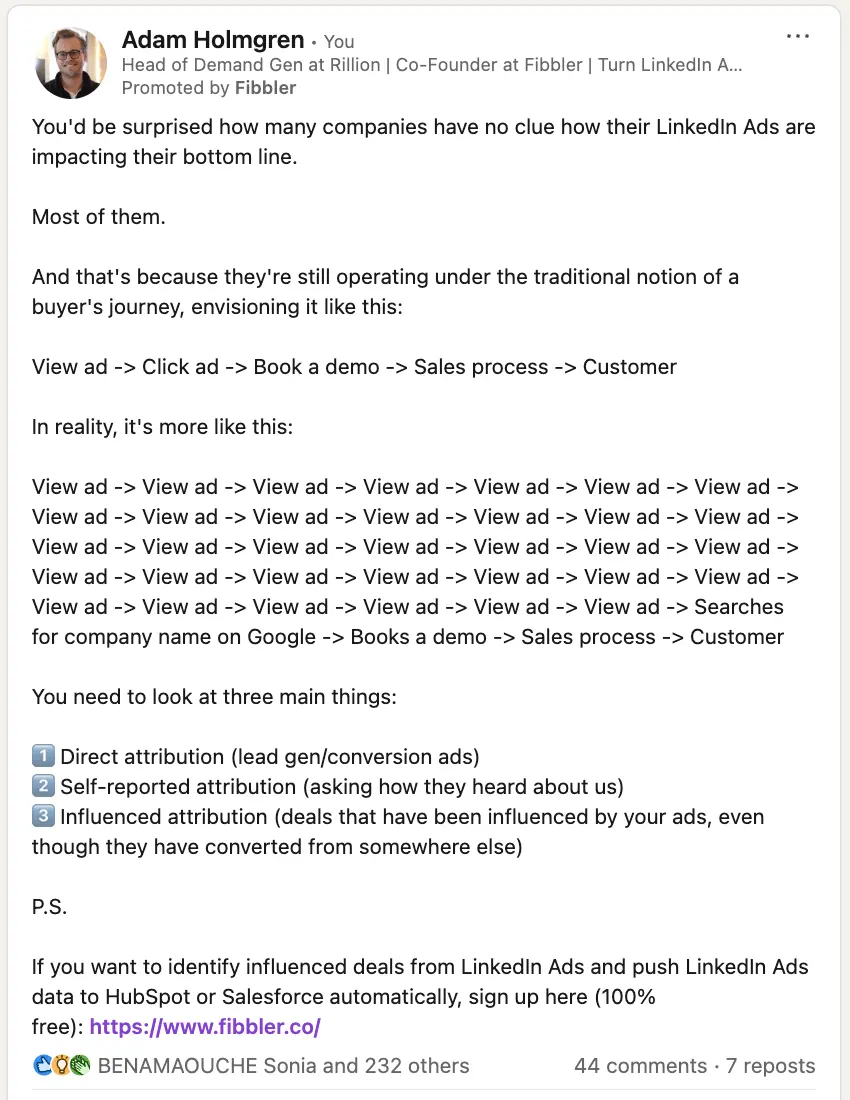
Fibbler published a static example that visibly reads “Promoted by Fibbler.” In the captured post, Adam Holmgren describes why a LinkedIn ad journey is rarely a neat view-click-demo path. The post moves from that attribution problem to a product that connects ad engagement with CRM and revenue context. The paid label and full visible caption can be inspected in Fibbler's captured ad image, with surrounding context on Fibbler's guide.
Why it is a plausible candidate: a demand-generation buyer can recognize a specific job: understanding influence that a last-click report misses. The product is not attached to an unrelated personal story; it is presented as an answer to the problem the post explains.
What not to claim: the drawn customer journey is an explanatory model, not evidence that every buyer behaves that way. Fibbler's broader customer claims are not results for this individual post, and a historical offer visible in a screenshot is not necessarily a current offer.
Selection decision: shortlist a post like this when the problem, audience, and product mechanism genuinely match. Do not select it merely because it looks polished or carries a paid label.
2. Lior Krolewicz and Yael Consulting: Teach One Diagnostic Task
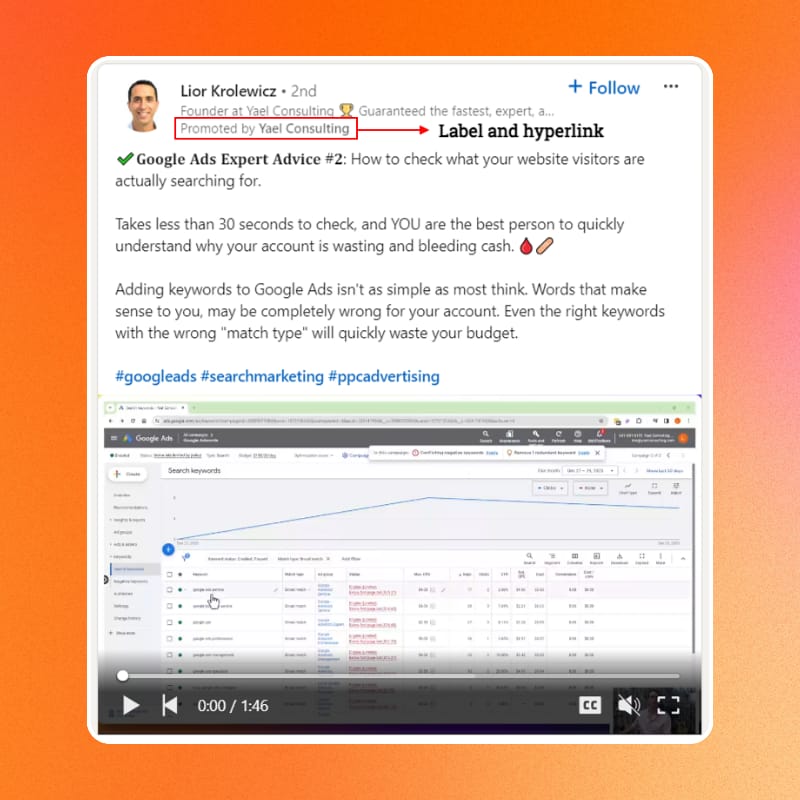
A captured video rendering visibly says “Promoted by Yael Consulting.” Its caption frames “Google Ads Expert Advice #2” around checking the search terms that generated website visits. The screenshot shows the player at 0:00 of 1:46 and a Google Ads interface. It is available in Sculpt's Thought Leader Ads guide and the guide's captured example image.
Why it is a plausible candidate: it gives a practitioner a concrete diagnostic task. “Check which searches produced visits” is more useful to that audience than a generic claim that paid search requires expertise.
What not to claim: only the caption and still were inspected here. The full video was not played, so its pacing, instructions, interface accuracy, audio, and final next step are not established.
Selection decision: treat it as a caption-level candidate until someone watches the complete native video. A useful hook cannot compensate for a confusing demonstration or an obsolete interface later in the clip.
3. Abi Wright and Smokeball: Address Adoption Risk, Not Just Product Features
LinkedIn's own two-page Smokeball Australia case study shows an Abi Wright video rendering labelled “Promoted · Partnership with Smokeball Australia.” The case says Smokeball chose Abi to discuss its Australia-based support and onboarding experience, while another customer covered AI capabilities. The three-minute customer video was cut into 30-second clips that the customers posted before Smokeball promoted them.
That is a useful selection lesson. A legal-software buyer may worry less about a feature checklist than about implementation, local support, and whether the vendor will be present after the contract is signed. A credible customer can address that adoption risk.
The case also reports that the Thought Leader Ad campaign, compared with an earlier campaign using the same videos, achieved twice the view rate, 8.7 times the completion rate, 50% lower cost per view, and a 186% increase in return on ad spend. Those are campaign-level, vendor-published results. The public case does not provide the exact flight, spend, audience, metric definitions, attribution window, or a randomized comparison. They cannot be assigned to Abi's post alone, and they do not prove that the format caused every difference.
Selection decision: shortlist a customer post when it addresses a material buying risk with evidence the customer can honestly own. Do not import Smokeball's percentages into another campaign forecast.
4. Hannah Jordan and LinkedIn: Give the Reader a Coherent Next Step
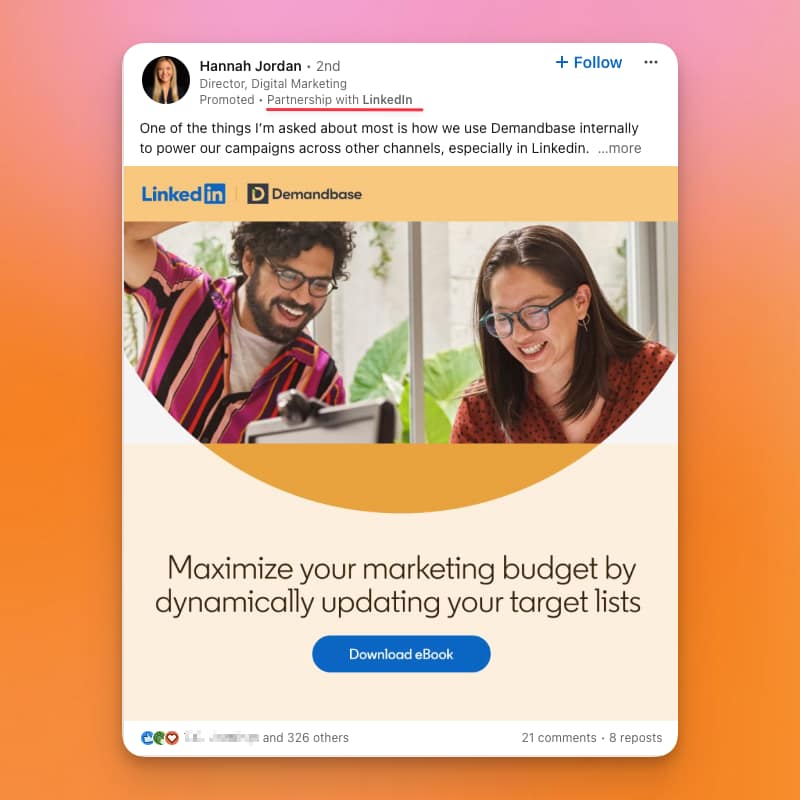
A captured rendering of Hannah Jordan's post visibly says “Promoted · Partnership with LinkedIn.” The source caption explains that people often ask how Demandbase is used internally to power cross-channel campaigns, especially on LinkedIn, then points readers to a new ebook. The paid rendering is preserved in Sculpt's captured image, while the original LinkedIn post supplies the full caption.
Why it is a plausible candidate: the next step follows from the first-person context. A marketer considering the Demandbase-LinkedIn combination is offered a resource about that combination, not a generic download detached from the post.
What not to claim: the ebook destination and lead quality were not verified here. The “Download eBook” treatment is drawn into the creative; it should not be confused with a configurable single-image Thought Leader Ad CTA button. The disclosure names LinkedIn, so the presence of Demandbase branding does not by itself establish who paid for the promotion.
Selection decision: shortlist a resource post when the resource resolves the same question the post raises. Define what happens after the click before calling it a lead-generation example.
5. Martin Nysted Grødem and Instantly.ai: Separate the Post's Result From the Ad's Result
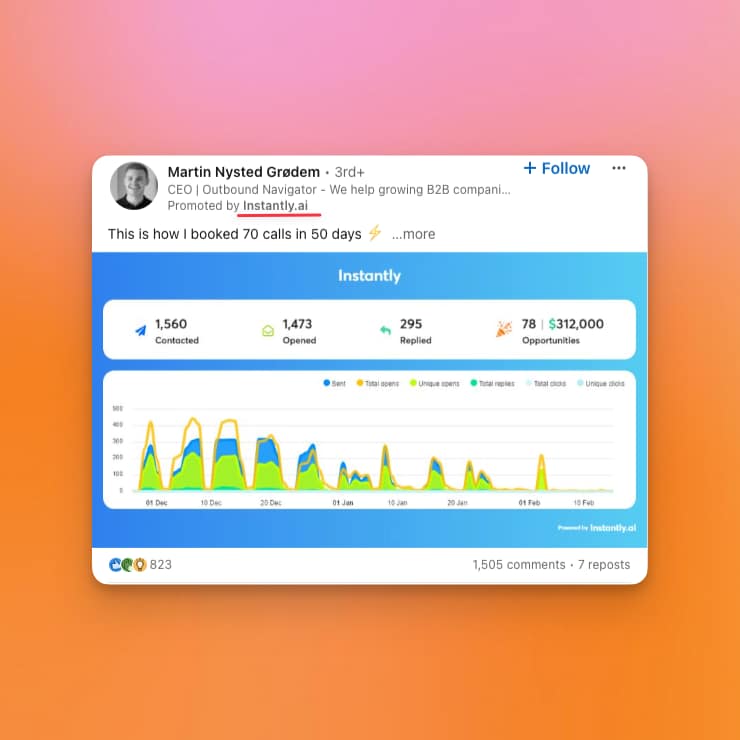
Sculpt's captured rendering says “Promoted by Instantly.ai.” The matching original LinkedIn post describes an outbound-email workflow and states that it produced 70 calls and 14 deals. It also names a multi-tool stack and includes affiliate links. The paid rendering can be inspected in the captured example image.
Why it is a plausible candidate: an agency or sales team building outbound operations can learn from a concrete workflow rather than a motivational slogan. The product context is visible.
What not to claim: the 70 calls and 14 deals describe the author's outreach process. They are not reported outcomes of the Thought Leader Ad. The source post is also marked “Edited,” so the currently visible caption should not automatically be treated as a perfect archive of the paid version.
Selection decision: record the distinction directly in the worksheet: post_claim = outbound results; paid_TLA_outcome = unknown. A genuine promoted rendering does not convert every number inside the post into advertising evidence.
Use a Gate-Based Worksheet, Not a Popularity Score
The following completed case is fictional. It is designed to show the decision, not to imply that these reaction counts or outcomes came from a real advertiser.
Advertiser: ExampleCo Workflow, a US B2B workflow SaaS company.
Buyer: an operations leader at a 50–500-employee services business.
Buyer task: evaluate a handoff-audit checklist that clarifies ownership, acceptance criteria, and deadlines.
Primary campaign intent: relevant resource visits, followed by separately qualified requests in the CRM.
| Candidate | Organic signal | Eligibility | Permission | Relevance and proof | Decision |
|---|---|---|---|---|---|
| A: founder perseverance story | 1,800 reactions | Public text post; eligible in the scenario | Author is willing, but no platform request yet | No handoff method, evidence, or connection to the buyer task | Reject for this task. It may suit employer branding, but popularity does not repair the mismatch. |
| B: three-check handoff post | 7 reactions | Public single-image post; eligible in the scenario | Pending | Strong buyer fit, but the caption overstates an internal log as a 75% reduction | Shortlist and hold. Repair the claim, then obtain approval and preview the exact source. |
| C: four-image customer story | 240 reactions | Multi-image; not eligible in this form | Declined | Potentially relevant customer context | Stop. Format and consent are separate blockers. Reformatting does not reverse a refusal. |
| D: native “Handoff Audit” article | 18 reactions | Standalone article, not a newsletter | Per-post approval assumed in this fictional case | Entire resource serves the task; no improvement percentage claimed | Conditional test alternative. Consider the documented Lead Generation route only when the unlock/form experience matches the intended action. |
Candidate A is not rejected because high-engagement posts are inherently bad. It is rejected because this particular post does not help this particular buyer. Candidate B is not selected because low-engagement posts are secretly better. It is held because relevance is strong while permission and substantiation remain unresolved.
Repair the Claim Where the Platform Allows It
Candidate B is based on a fictional four-week log of 30 handoffs. Twelve were late, and nine of those 12 lacked a named receiving owner. The original caption says:
“Our tool cut handoff delays by 75%.”
That statement is not supported. The actual arithmetic is:
9 ÷ 12 = 75%: the share of the late subgroup that lacked a named owner.9 ÷ 30 = 30%: those cases as a share of all observed handoffs.
Neither number measures a reduction. There is no before-and-after comparison, control, or causal test. A supportable replacement would be:
“In this team's four-week log, 9 of the 12 late handoffs had no named receiving owner. That is an observation, not proof of a 75% reduction. The checklist asks who accepts the work, what completion means, and when it is due.”
Because the fictional image contains only the neutral checklist, the author could edit the source caption. The advertiser could not insert alternate ad copy in Campaign Manager. Had the false percentage been baked into the image, the repair would require new media, a new author post, and a fresh permission decision.
Complete the Preparation Handoff Before Launch
For Candidate B, the handoff record should look like this:
| Field | Completed entry |
|---|---|
| Decision | Hold; not launch-authorized. |
| Author action | Edit the caption to the observational wording, confirm the relationship disclosure, and approve or decline this exact sponsorship request. |
| Evidence owner | Validate the 30-record denominator, the definition of “late,” and whether aggregate data may be published. |
| Allowed content handling | Caption-only source edit by the author; no media swap, advertiser-written intro, or separate destination URL. |
| Audience and job | US operations leaders evaluating the Handoff Audit Checklist. |
| Permission state | Pending; no brand-level auto-approval requested. |
| Operator checks | Confirm Page and ad-account roles, select the revised source post, verify format/objective, inspect the link and placement preview, and record the approved revision. |
| Measurement record | Paid impressions, objective-defined clicks, landing-page clicks, media and preparation cost, and deduplicated qualified requests in the CRM. |
| Stop rule | Pause for a material evidence error; the ad stops if the author revokes permission. |
The useful question is not merely whether a post looks native. It is whether this exact source, author, and claim can responsibly perform the buyer job being funded.
Measure the Job You Paid the Post to Do
LinkedIn's performance metrics guide defines clicks and CTR according to the selected objective. Its engagement metrics guide lists landing-page clicks separately. That means a high platform CTR can coexist with weak website or CRM performance.
Campaign Manager is the paid-reporting record. The author's source post can show aggregated organic and paid reach or impressions, and LinkedIn notes that those member-visible totals exclude LinkedIn Audience Network delivery. Do not use the source post's public totals as a substitute for the paid report.
Here is a completed synthetic comparison. Both tests are assumed to use the same period, audience, objective, and placement. A “qualified request” means one deduplicated US prospect in the target company range, in an operations role, who confirms the handoff problem and gives permission to be contacted.
| Metric | Test P | Test Q |
|---|---|---|
| Media spend | $600 | $600 |
| Impressions | 30,000 | 30,000 |
| Objective-defined chargeable clicks | 1,800 | 300 |
| Landing-page clicks | 30 | 90 |
| Qualified requests | 1 | 6 |
| Preparation, author, and operating cost | $200 | $400 |
| Total CTR | 6.00% | 1.00% |
| Media CPC | $0.33 | $2.00 |
| Landing-page CTR | 0.10% | 0.30% |
| Media cost per qualified request | $600.00 | $100.00 |
| Allocated total cost per qualified request | $800.00 | $166.67 |
If the team ranks posts by total CTR or media CPC, Test P wins. If the funded job is a qualified checklist request, Test Q is the better candidate for the next limited comparison despite its higher preparation cost and lower headline CTR.
Q is not a proven scalable winner. One versus six requests is small, and the table does not isolate audience, creative, author, placement, or timing. It demonstrates one principle: define the action before launch, then preserve the denominator and cost scope.
Also handle zero honestly. When a test produces zero qualified requests, its cost per qualified request is not zero. Report “no qualified requests at this spend,” then decide whether the evidence justifies another test.
The Post Worth Amplifying Is the One That Survives the Handoff
A strong Thought Leader Ad candidate does not need the most reactions or the smoothest personal brand. It needs to survive a traceable chain of decisions:
- The paid-example provenance is labelled honestly.
- The source post and author are currently eligible.
- The author has approved the exact sponsorship and understands the relationship.
- The post serves a defined buyer task with supportable evidence.
- Its next step matches the campaign objective.
- The team can measure paid delivery, site behavior, and qualified outcomes without merging them into one flattering number.
Use engagement to find posts worth inspecting, eligibility and permission as hard gates, and relevance and evidence to choose among the survivors. The process may reject the post with 1,800 reactions and hold the post with seven—not to favor low engagement, but to fund a specific, defensible job.
Use the filled candidate records, blank selection sheet, and measurement comparison to apply the examples.
Use the amplification decision workbench to record post evidence, eligibility, permission, and the paid-test decision.
Sources
- Thought Leader Ads, LinkedIn Marketing Solutions Help, last-updated label observed September 8, 2026.
- Create thought leader ads in Campaign Manager, LinkedIn Marketing Solutions Help, checked September 8, 2026.
- Manage requests to sponsor your LinkedIn profile posts as thought leader ads, LinkedIn Marketing Solutions Help, checked September 8, 2026.
- Manage auto-approval settings for your sponsored LinkedIn profile posts, LinkedIn Marketing Solutions Help, checked September 8, 2026.
- Disclosure of endorsement for sponsored posts, LinkedIn Marketing Solutions Help, checked September 8, 2026.
- Thought Leader Ads Specifications, LinkedIn Marketing Solutions, checked September 8, 2026.
- Create an article and newsletter ad using a thought leader ad, LinkedIn Marketing Solutions Help, checked September 8, 2026.
- Article and newsletter ads, LinkedIn Marketing Solutions Help, checked September 8, 2026.
- Create thought leader event ads in Campaign Manager and Event ads, LinkedIn Marketing Solutions Help, checked September 8, 2026.
- Edit a shared post, LinkedIn Help, checked September 8, 2026.
- Performance metrics in Campaign Manager and Engagement metrics in Campaign Manager, LinkedIn Marketing Solutions Help, checked September 8, 2026.
- Customer advocacy, captured on camera: Smokeball Australia, LinkedIn Marketing Solutions, publication date not stated; two-page case checked September 8, 2026.
- The LinkedIn Thought Leader Ads Framework That Acquired 600+ New Customers, Fibbler, page publication label May 2025; checked September 8, 2026.
- Adam Holmgren — Promoted by Fibbler captured rendering, Fibbler, capture date not stated; checked September 8, 2026.
- Our Guide to LinkedIn Thought Leader Ads, Sculpt, August 26, 2024; checked September 8, 2026.
- Lior Krolewicz — Promoted by Yael Consulting captured rendering, Sculpt image served through an Aelieve proxy, capture date not stated; checked September 8, 2026.
- Hannah Jordan — Promoted · Partnership with LinkedIn captured rendering, Sculpt image served through an Aelieve proxy, capture date not stated; checked September 8, 2026.
- Martin Nysted Grødem — Promoted by Instantly.ai captured rendering, Sculpt image served through an Aelieve proxy, capture date not stated; checked September 8, 2026.
- This is how I booked 70 calls in 50 days, Martin Nysted Grødem on LinkedIn, visible post marked edited; checked September 8, 2026.
- How we use Demandbase and LinkedIn together, Hannah Jordan on LinkedIn, publication date not stated; checked September 8, 2026.