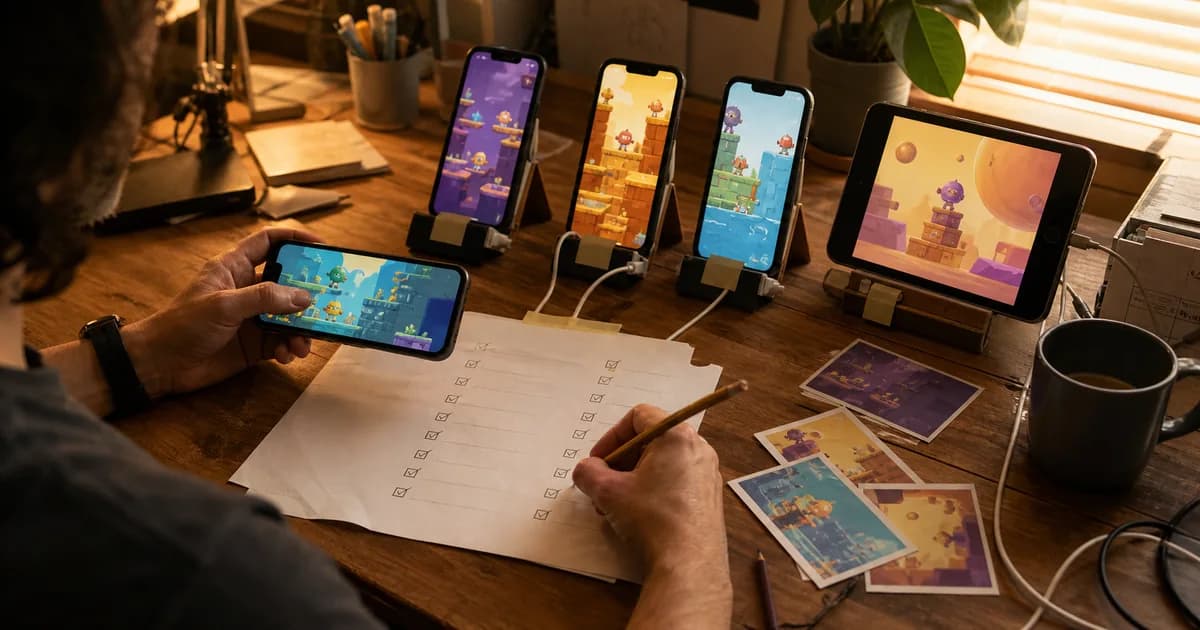
A user watches your video ad for two seconds, then taps "Skip." Another user scrolls past your banner without registering it exists. A third user sees a mini puzzle game inside an ad, plays it for twenty seconds, and voluntarily taps the install button when the end card appears.
Same campaign budget. Three very different outcomes.
That third experience, the one where a user actually chose to engage, is a playable ad. And it's quietly reshaping how the best-performing UA teams think about mobile advertising.
What Is a Playable Ad, Exactly?
A playable ad is an interactive HTML5 advertisement that lets users try a simplified version of an app or product directly inside the ad unit, before they ever visit the App Store or Google Play.
Think of it as a test drive. A car dealership doesn't sell vehicles by showing you a photo and asking for your credit card. They let you sit in the driver's seat, feel the steering, and take it around the block. A playable ad does the same thing for mobile apps: it gives users a hands-on experience that static images and video simply can't replicate.
The format runs on standard web technologies (HTML5, JavaScript, and Canvas or WebGL for rendering) packaged as a single file (usually under 5 MB) that loads inside a mobile ad SDK. No app install required. No redirect to a browser. The entire experience happens right where the user already is: inside another app.
The IAB defines playable ads as "premium, typically opt-in ad units predominantly built in HTML5, which allows quick loading, immediate consumer engagement, and enables consumers to take direct actions." Unlike static or video ads, playables deliver what the IAB calls "a complete sensory connection: sight, sound, motion and active touch."
Playable ads started in mobile gaming, where they let users play a few rounds of a game before deciding to install. But the format has expanded well beyond gaming, into e-commerce, fintech, food delivery, and other verticals where "try before you buy" makes sense.
Anatomy of a Playable Ad
Every effective playable ad follows a four-part structure. The specifics vary by product and network, but the rhythm is consistent: teach, engage, reward, convert.
The Tutorial (0–3 Seconds)
The first three seconds determine everything. A hand animation taps the screen, an arrow points to the first interactive element, or a short text prompt says "Tap to jump." The goal is to eliminate confusion instantly. Users who don't understand what to do in the first two seconds will close the ad.
This is harder than it sounds. You have zero onboarding context: no splash screen, no settings menu, no "Level 1." The tutorial has to be embedded in the ad's first frame. Apptica's 2025 data, reported by AppAgent, shows that tutorial prompts and logos appear in 85.4% of the highest-performing playable ads. It's not optional; it's table stakes. (For a deeper look at why those opening moments matter so much, see our guide on the first 3 seconds of a playable ad.)
The Gameplay (3–20 Seconds)
This is the core experience. The user swipes, taps, drags, or tilts to interact with a simplified version of the product. For a match-3 game, they might clear two boards. For an e-commerce app, they might swipe through product options to build an outfit. For a fintech app, they might drag sliders to see how different savings rates affect their balance.
The key word is "simplified." A playable ad is not a demo of the full app. It's a curated slice, usually one core mechanic, stripped of menus, settings, and progression systems. The best playables feel complete in 15–20 seconds. According to data cited by Digiday, ads exceeding 25 seconds see significantly higher drop-off rates, while shorter experiences around 20 seconds maintain stronger engagement and click-through rates.
If you're wondering which mechanics translate best to this format, we've put together a rundown of game types that work well in playable ads.
The End Card
When the gameplay ends, whether the user wins, loses, or time runs out, the end card appears. This is a branded screen showing the app's logo, name, a short value proposition, and a prominent call-to-action button. Think of it as the landing page inside the ad.
End card design matters more than most teams realize. It's the conversion moment. The user just had a positive experience and now faces a binary decision: install or close. The end card's job is to make that decision easy. Apptica's data shows that 42.2% of top-performing playable ads end with a clear completion state (win or loss), and of those, 85.9% end in a win, because a user who just "won" something is primed to take the next action.
The CTA
The CTA button, usually "Install Now," "Download Free," or "Play Full Game," links to the correct app store. On iOS, it opens the App Store. On Android, Google Play. This platform detection happens automatically through the ad SDK's bridge layer (typically MRAID), which routes the click to the right destination.
In some placements, a smaller CTA button persists during gameplay itself, giving users the option to install without waiting for the end card. This is especially useful for users who are already convinced after a few seconds of play.
Why Playable Ads Work
Playable ads outperform static formats not because they're flashy, but because they change the fundamental relationship between the user and the ad. Three mechanisms drive this.
Active Choice Instead of Passive Exposure
A video ad happens to you. You watch it, or more likely, wait for the skip button. A playable ad requires you to participate. When a user taps, swipes, or drags, they've made an active choice to engage. That choice creates a sense of ownership over the experience and higher intent downstream.
In a survey cited by the IAB, seven out of ten advertisers rated playable ads as the most effective format for in-app advertising. The primary reason was that user attention is earned through interaction, not rented through interruption.
Self-Selection Filters for Quality
Here's the counterintuitive part: playable ads can actually reduce installs while improving business outcomes. When a user plays a mini version of your game and doesn't like it, they won't install. That's a good thing. You just avoided paying for an install that would have churned within 24 hours.
The users who do install after a playable experience already know what they're getting. They've self-selected. This is why retention and ROAS data for playable-acquired users tends to be significantly better than for video-acquired users. The install base starts pre-qualified.
Emotional Engagement Through Interaction
There's a reason car dealerships push test drives. Touching something creates emotional attachment. In advertising psychology, this is the endowment effect. People value things more once they've interacted with them.
A playable ad creates a micro-moment of emotional investment. The user scores points, clears a level, builds something, or solves a puzzle. That tiny hit of achievement becomes associated with your brand. When the end card appears, the user isn't responding to a sales pitch. They're continuing an experience they already enjoyed.
What the Data Actually Says
Performance claims in advertising are easy to inflate. Here are the numbers we can trace to specific sources.
Install Rates
Liftoff's 2024 Mobile Ad Creative Index, based on more than 602 billion ad impressions, 49.4 million clicks, and 144 million installs, found that playable and video ads in gaming are 20 times more likely to result in an install than banner ads. That's not a marginal improvement. It's an order of magnitude.
According to adjoe, an ad tech platform, interactive playable ads deliver roughly three times higher conversion rates than conventional ad formats.
Retention
adjoe's data also indicates that playable ads in rewarded inventory boost Day 7 retention by 30–40% compared to non-playable formats. This aligns with the self-selection mechanism described above: users who engage with a playable ad enter the app with calibrated expectations, which reduces first-day churn.
ROAS
Bagelcode, a social casino game publisher, saw a 3.2x improvement in return on ad spend (ROAS) on Android after introducing playable ads, and a 1.4x improvement on iOS. This data was shared by Facebook as part of their 2018 playable ads launch, with adjoe and other ad tech sources subsequently citing the same figures. The difference between platforms reflects the different auction dynamics and user behavior on each.
Adoption Trends
In the first half of 2024, 7% of mobile gaming advertisers had adopted playable ads, up from 4% in the same period the year before, according to data tracked by Business of Apps. That's a 75% year-over-year growth rate. By November 2024, adoption had surged an additional 58%.
On the supply side, an average of 340 advertisers launched playable ads daily in 2024, producing roughly 30,000 unique playable creatives, about 8.3% of all mobile game ad creatives globally. More than half of the top 100 mobile game publishers worldwide have integrated playable ads into their user acquisition strategy.
For teams already running playable campaigns, the question shifts from "should we try this?" to "how do we test and iterate faster?", a topic we cover in our A/B testing guide for playable ads.
Who's Using Playable Ads, and How
Mobile Gaming: Where It Started
Gaming is where playable ads originated and where the data is richest. Studios use playable ads to showcase their core mechanic (a match-3 swap, a tower defense wave, an endless runner jump) and let users experience the gameplay loop before installing. The format is a natural fit because the product is gameplay.
Royal Match by Dream Games is one of the most-cited examples. The game has generated over 300 million total installs and is estimated to have exceeded $3 billion in lifetime revenue since its 2021 launch, with playable ads as a core component of its user acquisition strategy. These figures are widely cited across industry sources including Revx and EJaw, though Dream Games does not publicly disclose exact revenue figures.
Genres that translate best include casual puzzle, arcade, idle, and hyper-casual. Anything with a mechanic that's immediately understandable without context. If you're evaluating which type fits your app, see our breakdown of top game types for playable ads.
Retail and E-commerce: The New Balance Playbook
New Balance's "Cloud Jumper" campaign is the best-documented non-gaming case study available. The brand built a Doodle Jump-style playable ad promoting their Fresh Foam cushioned shoe line and distributed it programmatically across mobile ad exchanges plus paid social on Facebook, Instagram, and Snapchat.
According to Marketing Dive, the results were striking:
- 18.84% overall brand lift (28.9% in China, 14.6% in the U.S., 10.3% in Japan)
- 5% click-through rate, compared to the 0.5% retail advertising average, that's a 10x improvement
- 21 seconds of average play time
- 83% replay rate
An 83% replay rate means users weren't just trying the ad once. They were choosing to play it again. That kind of voluntary repeated engagement doesn't happen with video or banners.
For more on how e-commerce brands are applying this format, see our guide on playable ads for e-commerce.
Fintech: Making the Abstract Tangible
Financial products are inherently abstract. A savings rate, a loan term, a cashback percentage. These are hard to make tangible in a 15-second video. Playable ads solve this by turning numbers into something users can manipulate.
Lendi, an Australian mortgage platform, built a savings simulator as a playable ad on Facebook. Users adjusted loan terms and watched potential savings update in real time. According to data compiled by Business of Apps, the campaign achieved 66% lower cost per lead and a 20% increase in incremental leads. (Note: this data comes from a third-party case compilation, not an independent audit; interpret accordingly.)
The useful fintech question is narrower: can one honest interaction clarify the product without simulating returns or hiding risk?
Food and Delivery
McDonald's ran a playable maze game where users guided burger ingredients through a labyrinth to build a Big Mac. The campaign coincided with a major push for their mobile app, which became one of the most downloaded food applications globally in 2022. The creative worked because it turned a familiar product into a game mechanic. Low friction, high brand recognition.
For strategies specific to this vertical, see our post on playable ads for food and delivery apps.
Other Verticals
Playable ads are also being tested in dating, education, travel, and health apps, though public case study data for these verticals remains limited. The format works best when the product has a demonstrable, visual mechanic: swiping through profiles, navigating a map, completing a quick challenge. For verticals without an obvious interactive hook, the creative design challenge is significantly harder.
Three Ways to Create Playable Ads
1. Hire an Agency
The traditional route. You brief a creative agency, they design and build the playable, you review, iterate, and deploy.
According to AppAgent, a mobile growth consultancy, external playable ad production typically costs $3,000-$5,000 per creative with a 2-4 week turnaround. That's the starting range for a standard playable. Complex 3D creatives, multi-variant testing packages, or work from larger agencies can cost significantly more. Budgets of $15,000-$50,000+ per project are not uncommon at the top end of the market, though specific pricing data at that tier is not widely published.
What the per-creative price usually doesn't include: iterations after initial delivery, A/B testing variants, multi-network export and compliance testing, and the creative refresh cycle. Playable ads typically need fresh variations every 2-4 weeks to combat creative fatigue, more frequently than video ads. These ongoing costs can exceed the initial production cost over a campaign's lifetime.
Agencies are a good fit for teams with budget who want premium creative quality and don't have in-house HTML5 talent. For a full framework on when this path makes sense, see our agency vs. DIY decision guide.
2. Build In-House
If you have developers who know HTML5, Canvas, and ideally MRAID, you can build playable ads yourself. The upside is full control and lower per-unit cost over time. The downside is the technical overhead.
A playable ad isn't just a game. It's a game plus an end card, a CTA bridge, a loading screen, MRAID integration, audio unlock handling, pause/resume logic, orientation management, and network-specific export configurations, all in a single HTML file under 5 MB. Each ad network has different requirements for format, MRAID version, and file structure. (We detail these specs in our guides for Google Ads, Meta, Unity & ironSource, and AppLovin.)
According to AppAgent, teams that set up in-house playable production can achieve 60-80% cost savings after the initial investment. But "initial investment" means building the entire production pipeline, not just writing game code.
For the engine-level technical decision, our comparison of HTML Canvas vs. Phaser vs. Three.js breaks down which rendering approach fits which type of playable.
3. Use an AI-Powered Platform
The newest approach. You describe the game you want (in text, or by uploading a video of your app) and AI generates the playable ad complete with the full production pipeline.
Hookin takes a text prompt ("match-3 puzzle with candy theme") and generates a working playable ad with 8 end card templates, 8 game layout templates, configurable CTA buttons, a loading screen with your branding, and automatic MRAID integration. The chat-based editor lets you refine the game in natural language ("make it faster," "change the color scheme," "add a countdown timer") without regenerating from scratch. When you're ready, one-click export produces compliant builds for 10 ad networks including Google, Meta, TikTok & Pangle, AppLovin, Unity, ironSource, Mintegral, Vungle, AdMob, and Moloco.
Pricing is a fraction of agency cost: Hookin's Free tier lets you test the workflow, Pro runs $29/month, and Max is $99/month. The trade-off compared to a dedicated agency is less bespoke creative control. You're working within the platform's template and rendering system rather than building custom assets from scratch.
If you're currently running video ads and want to test playable, the video-to-playable conversion process is a low-friction starting point. And for a realistic look at what AI handles well and where it still falls short, see our analysis of AI-generated playable ads: what works and what doesn't. (For a direct comparison of the DIY AI approach versus using a production platform, we break that down in Why Use Hookin Instead of Building Playable Ads with AI Yourself.)
Ad Network Support: Where Playable Ads Run
Most major mobile ad networks support playable ads, but the technical requirements vary more than you'd expect. Here's a summary based on current network specifications:
| Network | Format | MRAID | Key Notes |
|---|---|---|---|
| Google Ads | ZIP | None | Requires ad.size meta tag |
| Meta | HTML | None | Viewport meta required, muted video |
| Unity | HTML | 3.0 | Must use mraid.open() for store links |
| AppLovin | HTML | 2.0 | mraid.open(url) required |
| ironSource | HTML | 2.0 | Inline HTML, no external requests |
| TikTok | ZIP | None | Strict size limits |
| Mintegral | ZIP | None | ZIP with assets folder |
| Vungle | ZIP | None | Main HTML must be named ad.html |
| AdMob | ZIP | None | Same spec as Google Ads |
| Moloco | HTML | None | FbPlayableAd.onCTAClick() callback |
Every network in this table enforces a maximum file size of 5 MB. Meta adds an extra constraint: while the total upload can be 5 MB, the index.html file itself must stay under 2 MB.
The "Format" column matters more than it looks. "HTML" means every asset (every image, sound, and font) must be base64-encoded and inlined into a single file. "ZIP" allows separate asset files within an archive, but adds packaging requirements. Some networks like Vungle require specific file naming conventions.
MRAID (Mobile Rich Media Ad Interface Definitions) is the IAB standard that lets ads communicate with the host app, handling events like viewability, expand/collapse, and store redirects. Unity requires MRAID 3.0 (the latest version, with pre-caching and richer event handling), while AppLovin and ironSource use MRAID 2.0. Networks without MRAID use their own bridge APIs.
This variation is one of the biggest operational challenges in playable advertising. A creative that runs perfectly on AppLovin may be rejected by Google Ads because of a missing meta tag, or fail on Unity because of an MRAID event listener that wasn't implemented. For details on staying within size limits, see our file size optimization guide. For network-specific walkthroughs, we've published dedicated guides for Google Ads, Meta, Unity & ironSource, AppLovin, and TikTok.
Where does most playable ad traffic actually flow? According to Apptica's 2025 data reported by AppAgent, AppLovin controls approximately 59% of playable ad traffic, with AdMob at 38%. That concentration means most testing and optimization starts on those two platforms.
The Honest Downsides
Playable ads are not a silver bullet. Here is what the format's advocates, ourselves included, often gloss over.
1. Production cost is high relative to other formats. Even at the low end, an agency-built playable costs $3,000-$5,000 per creative. Compare that to a video ad or a set of static banners. AI-powered platforms reduce this dramatically, but the format still demands more production investment than simpler alternatives. And one creative isn't enough. You need variants for testing and regular refreshes.
2. File size is a hard engineering constraint. Most networks cap at 5 MB. That's everything, code, images, audio, fonts, animations, in a single package. A video ad can be visually rich because it streams progressively. A playable ad must preload everything before the first frame renders. This limits visual fidelity and means asset optimization isn't optional. It's core production work.
3. Load time hurts on slow connections. A 4 MB HTML file on a 3G connection in an emerging market doesn't load instantly. Users may see a blank screen for several seconds, and some ad SDKs will time out and skip the ad entirely. This can bias your performance data toward users with fast connections and exclude the markets where mobile gaming growth is highest.
4. Creative fatigue sets in faster than with video. A video ad can run for months with minor thumbnail adjustments. A playable ad with limited gameplay variety gets predictable after repeated exposure. Industry practice is to refresh playable creatives every 2-4 weeks, which means you need a production pipeline that can sustain regular iteration, not just a one-off build.
5. Not every product fits. Playable ads shine when the product has a simple, demonstrable mechanic: tap to match, swipe to style, drag to build. They're harder to execute for narrative-heavy games (the story can't unfold in 15 seconds), complex B2B SaaS products (the value isn't in "trying" a dashboard), or sensitive verticals where gamification feels inappropriate. Public benchmark data for verticals like dating, education, and healthcare remains limited. The format is still finding its boundaries.
6. Measurement is more complex than video. A video ad has clean metrics: impressions, views, view-through rate, clicks. A playable ad adds interaction rate (percentage of users who engage beyond the first tap), completion rate (percentage who reach the end card), replay rate (how often users play again), and time-to-CTA (how quickly users tap install). Each ad network defines and reports these metrics differently, making cross-network comparison difficult. Standardize your measurement framework before launching. Our playable ad testing guide covers how.
7. Technical barriers are real without proper tooling. MRAID compliance across multiple versions, base64 encoding, audio context management, WebView quirk handling, cross-network export validation. The engineering surface area is large. Without a dedicated platform or an experienced HTML5 ad developer, the learning curve is steep. This is one of the main reasons industry adoption sits at 7% despite consistently strong performance data.
Frequently Asked Questions
How much does it cost to create a playable ad?
It depends on the method. Agency production typically starts at $3,000-$5,000 per creative according to AppAgent, with complex 3D playables costing significantly more. In-house teams reduce per-unit cost after initial setup, but require HTML5 and ad tech expertise. AI-powered platforms like Hookin offer plans from free to $99/month, making the format accessible at a fraction of traditional cost. Whichever route you choose, factor in iteration and creative refresh costs. A single creative isn't enough for a sustained campaign.
Do playable ads only work for mobile games?
No. Gaming is the most established use case, but playable ads have delivered strong results in retail (New Balance saw a 10x CTR improvement over the industry average), fintech (Lendi achieved significantly lower cost per lead with an interactive mortgage simulator), and food delivery (McDonald's ran playable campaigns during a period when their app became one of the most downloaded globally). Any product with a visual, demonstrable mechanic can benefit. That said, some verticals have limited public performance data; see the downsides section above.
What's the ideal length for a playable ad?
Industry consensus points to 15-20 seconds of interactive gameplay as the sweet spot. According to data cited by Digiday, playable ads around 20 seconds experience roughly 30% less churn and 15% higher click-through rates than longer ones, while ads exceeding 25 seconds see substantially higher drop-off. Add 2-3 seconds for the tutorial and a few seconds for the end card, and the total experience runs about 20-25 seconds.
Do I need coding skills to create a playable ad?
Not anymore. With Hookin, you describe a game in plain text ("match-3 puzzle with fruit theme"), and the AI generates a complete playable ad: end cards, CTA buttons, MRAID integration, loading screen, and multi-network export included. The chat-based editor handles refinements in natural language. For teams that do prefer coding, building from scratch provides more control but requires HTML5 Canvas, JavaScript, MRAID, and ad network spec expertise. Our build-versus-buy breakdown explains where generation ends and packaging, validation, and refinement begin.
Which ad networks support playable ads?
All major mobile ad networks: Google Ads, Meta, TikTok & Pangle, AppLovin, Unity, ironSource, Mintegral, Vungle, AdMob, and Moloco. Each has different technical requirements; see the network support table above. AppLovin and AdMob account for the majority of playable ad traffic according to Apptica, making them the typical starting point for testing.
How do I measure playable ad performance?
Start with standard UA metrics: cost per install (CPI), install rate, and Day 7 retention. Then layer in playable-specific metrics. Interaction rate measures what percentage of users engage beyond the first tap. Completion rate tracks how many reach the end card. Replay rate shows how often users voluntarily play again. Time-to-CTA reveals how quickly users decide to install. Define these consistently across networks before launch. Each platform reports them differently, and inconsistent definitions will make your cross-network data unreliable.
Where This Is Heading
A decade ago, building a website meant hiring a developer, writing HTML by hand, and deploying to a server you managed yourself. Today, you type content into a CMS and hit publish. Playable ads are going through that same transition right now, from custom engineering projects that take weeks and cost thousands, to products that anyone on a marketing team can ship in an afternoon.
The data makes the case. The production barriers are falling. The question isn't whether playable ads work. It's whether your team can produce them fast enough to test, iterate, and find the creative that scales.
Hookin handles the pipeline: describe a game, customize the end card, export to 10 ad networks. Text-to-game AI, chat-based editing, MRAID auto-detection, and one-click multi-network export. The infrastructure that used to take months to build now takes minutes to use.