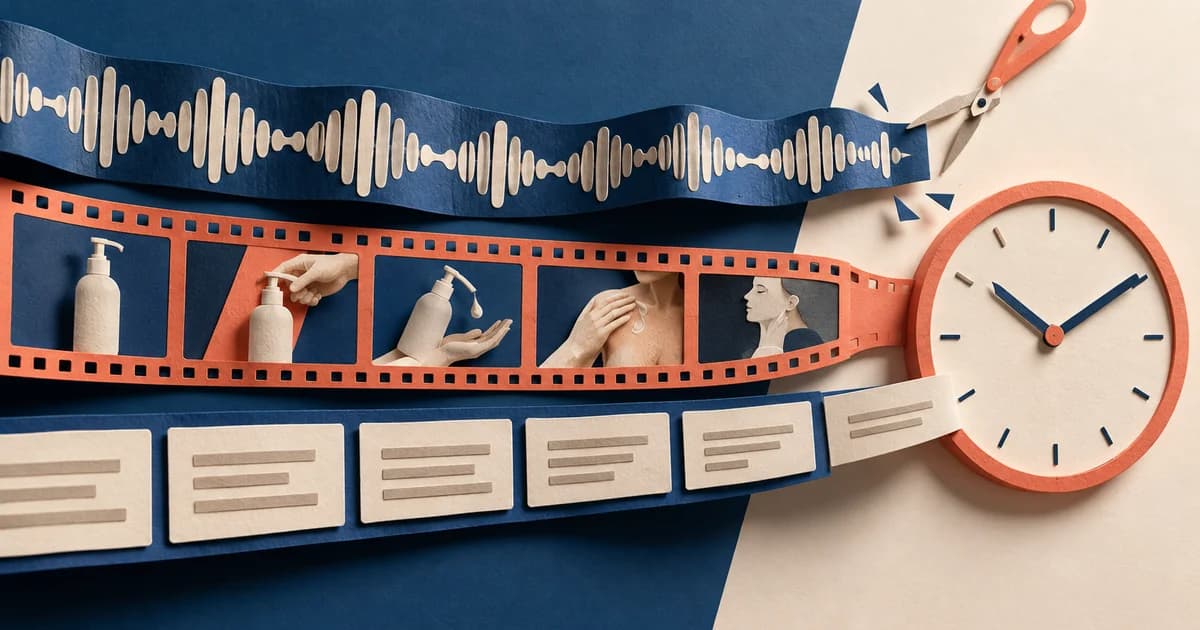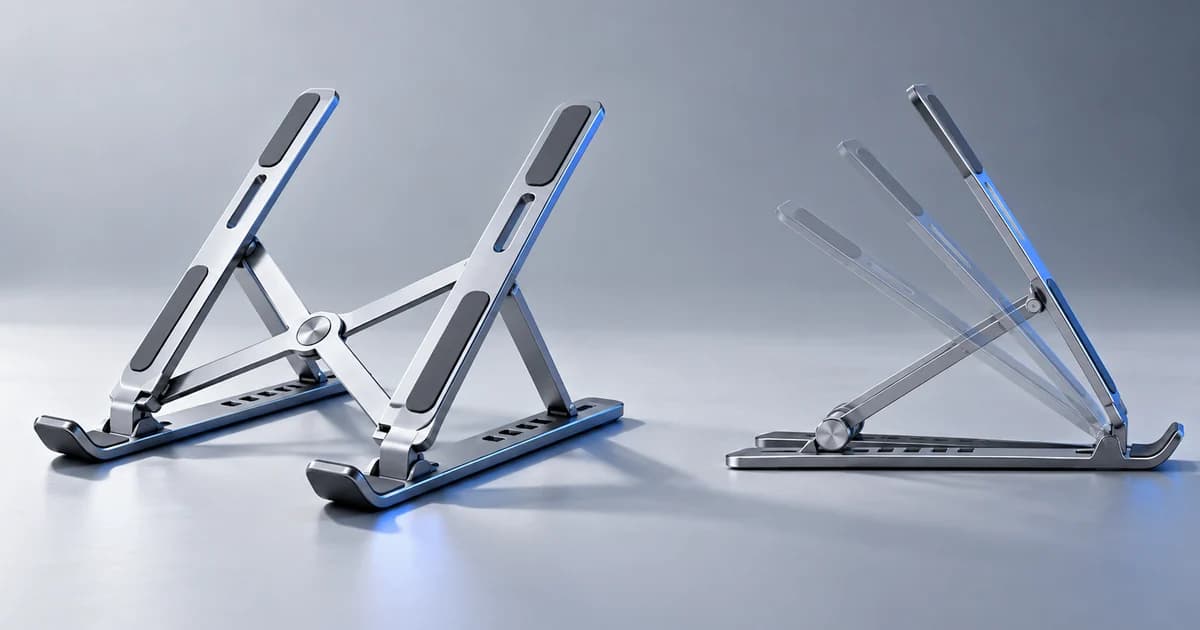
A folding laptop stand gives you a creative choice. A still image can show the stand folded, open, and ready for a laptop. A video can show the hand movement and hinge path between those states. Which format is better?
That question is premature. First ask what the buyer still needs to understand.
A static ad is often enough when the message can be inspected in one view: the offer, the product, the contents of a bundle, or two end states. Motion becomes materially useful when time carries part of the evidence: order, duration, continuity, an intermediate state, or a change that appears only as conditions change. Sometimes both formats deserve a role because they answer different useful questions.
The six pairs below are fictional teaching examples, not a performance ranking or observed campaign winners. Explore the six briefs in the interactive comparison. Each holds the product, offer, call to action, and communication job constant so the role of time is easier to see.

Start With the Missing Information, Not the Format
Write one sentence before opening a design tool:
The buyer is missing this information: ________.
Then build the strongest reasonable single-image answer. Do not compare a polished video with a random frozen frame. A good static can use labels, arrows, insets, or multiple states on one canvas. That remains a single static image; a carousel is a different, multi-card format and should be evaluated separately.
Now remove time from the idea. What product fact disappears?
If the answer is “none,” the static may already carry the communication job. Motion can still direct attention or create a mood, but that is an execution choice rather than new product evidence. If a transition, duration, sequence, or condition-dependent change disappears, motion has a clearer reason to exist. When the still preserves a useful endpoint and video adds a different useful change, produce both.
A 2021 laboratory study of 88 university students sharpened this distinction. Participants learned the same mechanical linkage from one picture, four pictures, or an animation. Animation helped more with movement-specific changes; the single picture helped more with spatial arrangements. Two-minute learning presentations are not ads or purchases, so the study cannot predict CPA. It does support asking “what must be learned?” before “does video win?” (Ploetzner, Berney, and Bétrancourt, 2021).
Roost’s laptop-stand instructions provide a useful counterexample: the product page supplies opening and closing diagrams. They do not reveal speed or force and were not tested as ads, but they show that a sequence can sometimes be encoded clearly in a still (Roost, “How To Use The Roost Laptop Stand”).

Six Products, Six Matched Creative Decisions
1. Downloadable Planner: Static First When the Job Is Offer Recognition
Communication job: “What am I downloading?”
The fictional product is a one-page “Weekly Focus” planner with three visible areas: Top 3 priorities, Monday–Friday, and Notes. The offer is one free sample page. Both formats use the same copy: “One page for the week. Free sample.” The CTA is “View the sample.”
The static concept shows the full page, with the three section labels large enough to recognize. The viewer can see the object and the free-offer scope at once.
The eight-second video opens on exactly that same view. From 0–2 seconds it shows the full page and offer; from 2–4 seconds it emphasizes Top 3 priorities; from 4–6 seconds it emphasizes the weekday area; from 6–8 seconds it returns to the full page. The headline and CTA stay visible throughout.
What disappears without time? Only the order of emphasis. The product and offer do not.
Decision: Static-first candidate. Motion has not yet earned its production cost by adding product information. If the real question is “How do I complete the planner on Monday morning?”, write a new tutorial brief; adding that lesson only to video would break the match.
2. Folding Laptop Stand: Use Motion When the Transition Is the Question
Communication job: “How does the folded product become ready?”
The fictional “Stand A” has one product page, no discount claim, and no promised opening time. Both formats say “From folded to ready.” The CTA is “See Stand A.”
The static uses one canvas with three numbered states: 1 Folded → 2 Open the support → 3 Ready for your laptop. An arrow shows direction, and any real lock or grip point must remain visible. This is not a carousel; all three states appear together.
The ten-second video shows the folded state from 0–2 seconds, the uninterrupted opening action from 2–7 seconds, and the open state from 7–10 seconds. The hand and every necessary contact point stay in frame. Ten seconds is a storyboard duration, not a claim that a real stand opens that quickly. If the honest movement takes longer, the edit should take longer rather than speeding it up to manufacture “ease.”
What disappears without time? The endpoints and order survive in the static. The continuous hand–part path and intermediate states disappear.
Decision: Motion candidate when that path resolves genuine uncertainty. If shoppers only need the folded dimensions, a measured still is the better brief. The Roost instructions are a useful counterexample to “mechanical product equals mandatory video”: a well-designed static can explain more than a hero shot, while video can carry the remaining transition evidence.
3. Lip Gloss: Use Both for a Fixed View and an Angle-Dependent Finish
Communication job: “What does the Rose A finish look like?”
The fictional shade, model, application amount, camera settings, and light remain the same. Both executions use “Rose A. See the glossy finish.” The CTA is “Explore Rose A.” No plumping, wear-time, or universal color claim is added.
The static is a controlled close-up of the completed look with a small product identifier. It gives the viewer time to inspect the finish at one known angle.
The eight-second video starts on that identical view for two seconds, makes a small head or camera-angle change from 2–6 seconds, and returns to the original view from 6–8 seconds. Lighting and exposure do not change.
What disappears without time? The finish at the chosen angle remains. The way the reflection changes with angle disappears.
Decision: Paired candidate. The still is useful for inspection; motion is useful if the changing reflection answers a product question. A tutorial showing the applicator touching the lips would be a different communication job. Changing light, model, shade, or application between formats would also make the comparison dishonest.
4. Task Software: Use Motion to Connect an Action to Its Output
Communication job: “What does this button create?”
The interface is completely fictional. A button labeled “Create weekly check-in” creates a record titled “Weekly check-in” with Owner: Alex and Status: Not started. Both formats say “Create the same check-in structure.” The CTA is “See the workflow.”
The static places the button on the left and the completed record on the right, connected by one arrow and the label “Button → prefilled record.” This is efficient when the buyer mainly needs to inspect the promised output.
The ten-second video shows the button from 0–2 seconds, one cursor click from 2–3 seconds, the record appearing with the same fields from 3–6 seconds, and a readable hold from 6–10 seconds.
What disappears without time? The output content survives. The visible continuity between the action and result disappears.
Decision: Motion candidate when the action–result relationship is the proof. Do not cut out setup, permissions, or a waiting state and then claim “instant” or “one click.” Freeze the UI version, sample data, plan requirements, and permissions before production. Official product documentation can verify a real feature, but it cannot make this fictional workflow true for another tool. For example, Notion’s current button documentation says buttons can add pages to databases and edit properties, with permissions and some plan-dependent actions; it does not validate this invented screen (Notion Help, “Buttons”).
5. Linen Trousers: Use Both to Compare Endpoints and Show the Transition
Communication job: “How does the same garment look standing and seated?”
The same fictional trousers, model, size, styling, and lens appear in both versions. The copy is “See the fit, standing and seated.” The CTA is “View the fit details.”
The static places the standing and seated views side by side. It makes comparison easy because neither state disappears while the viewer studies the other.
The ten-second video holds the standing view from 0–2 seconds, shows the same model sitting from 2–6 seconds, and holds the seated view from 6–10 seconds.
What disappears without time? Both endpoint looks remain in the static. The path of the fabric during the position change disappears.
Decision: Paired candidate. The static may be better for direct endpoint comparison; motion may reveal how the fabric shifts during one specific movement. Neither format proves comfort, fit across different bodies, or performance after hours of wear. Keep the shown model and size context visible, and do not let a flattering moving shot replace the size chart.
6. Coffee Sampler: Static First When the Job Is Countable Inventory
Communication job: “What is inside the box?”
The fictional sampler contains A, B, and C, each 100 grams, for a total of 300 grams. Both executions say “Three samples. 100 g each.” The CTA is “See the sampler.”
The static shows the open box, all three labeled bags, and 3 × 100 g = 300 g together. Nothing needs to be remembered from an earlier frame.
The eight-second video begins with the complete box and quantity label, then emphasizes A from 2–4 seconds, B from 4–5 seconds, C from 5–6 seconds, and the complete set again from 6–8 seconds.
What disappears without time? No inventory fact. Only the reveal order disappears.
Decision: Static-first candidate for the inventory job. An unboxing video may still be valuable when anticipation, gifting, or the opening ritual is the message—but that is a different brief. Product maintenance matters here: Rounton Coffee’s sample-pack page explicitly notes that its bags may differ from the product images because of a new bag design. That is not performance evidence; it is a reminder that both stills and videos become stale when the source product changes (Rounton Coffee, “Coffee Sample Pack”).
Placement Can Override a Good Creative Idea
A format decision is only useful if the intended placement can actually serve it.
As checked on September 8, 2026, Google’s Demand Gen documentation lists 4:5 and 9:16 image and video assets, recommends 9:16 for YouTube Shorts, requires video to be at least five seconds, and says videos under ten seconds are not eligible for YouTube in-stream. Its placement table allows image-only ads on YouTube Shorts but not YouTube in-stream. The same campaign family therefore does not give every format the same inventory (Google Ads Help, “Demand Gen campaign creative: Asset specifications and guidelines”).
TikTok’s Search Ads documentation creates another boundary. The current availability page lists video, Carousel Image Ads, and limited catalog formats; that is not proof that a standalone single-image ad is available everywhere. Its behavior page also says an autoplaying search video can count as both a view and an impression, while a still image receives an impression. A raw “views” comparison would not even measure the same event (TikTok for Business, “Search Ads Campaign Availability”; “About Search Ads Campaign”).
Before production, record the actual campaign type, placement, aspect ratio, safe zones, crop behavior, duration rules, autoplay behavior, and account preview. Platform documentation can change, and an account-level preview may expose a restriction that a general help page does not.
Budget the Shared Work, Not Just the File Extension
“Static is cheap; video is expensive” is too crude to plan a real package. Product preparation, claim review, styling, casting, location, lighting, and rights may be shared. A simple video can be made from existing photos; a premium static can require a full shoot.
Here is a completed illustrative labor model for the six fictional briefs. It assumes one English version, a 4:5 master plus a 9:16 adaptation, one revision, permissioned existing assets, simple tabletop/screen/model capture, and no purchased narration or music. It excludes media spend, talent fees, products, travel, studio, licensing, tax, and margin.
| Work block | Hours | What it covers |
|---|---|---|
| Shared preparation and capture | 14 | Product, UI, model, and common source work used by both formats |
| Static masters | 10 | Six single-canvas compositions |
| Static adaptation, accessibility, and QA | 4 | Second ratio, text alternatives, export checks |
| Video masters and incremental capture | 16 | Six timelines plus movement-specific capture/editing |
| Video adaptation, accessibility, and QA | 8 | Second ratio, timed copy, descriptive text, export checks |
| Total | 52 | 14 shared + 14 static-specific + 24 video-specific |
At a purely illustrative labor rate of $50 per hour, the package is 52 × $50 = $2,600. Allocate the 14 shared hours equally and the static side accounts for 21 hours while video accounts for 31. The ratio, 31 ÷ 21 ≈ 1.48, is a result of these assumptions—not a market rule that “video costs 1.48 times more.”
The more useful marginal questions are different. After the shared work and static set exist, adding the six videos requires 24 hours, or $1,200 in this scenario. After the shared work and videos exist, adding the six statics requires 14 hours, or $700. Six products × two formats × two aspect ratios also means 24 media files, before source files, rights records, captions, or text alternatives.
Maintenance belongs in the same calculation. Suppose only Sample B’s label changes and no reshoot is needed. Updating the static master plus two exports takes an assumed one hour. Updating the video edit plus two renders takes two. At the same illustrative rate, that is 3 hours × $50 = $150. If a reshoot, renewed talent right, or new offer is required, this estimate no longer applies.
Design for Sound-Off Use and Accessibility Separately
A video can make sense without sound and still be inaccessible. A static can be readable to a sighted viewer and still lack a useful text alternative.
W3C guidance separates captions for meaningful speech and non-speech audio from descriptions or descriptive transcripts that communicate important visual information. It also recommends planning accessibility during scripting and storyboarding, not attaching it at the end (W3C WAI, “Making Audio and Video Media Accessible”). Its non-text-content guidance applies to informative images and animations too (W3C WAI, “Understanding Success Criterion 1.1.1”). These pages are general web guidance, not a platform-specific legal verdict for every ad placement.
For the fictional software example, “software screenshot” is a poor text alternative. A useful equivalent is: “The Create weekly check-in button creates a record titled Weekly check-in with Owner set to Alex and Status set to Not started.” For the coffee sampler: “The box contains three 100-gram samples labeled A, B, and C, totaling 300 grams.”
Accessibility work can also reveal a weak brief. If the important video information cannot be described without introducing claims that are absent from the still, the two versions may not be communicating the same job.
A Performance Test Does Not Automatically Isolate “Format”
Public static-versus-video tests point in opposite directions. In a 2019 AdEspresso Facebook lead experiment, the single-image arm had the lowest reported cost per lead, ahead of a silent slideshow video. But the static was an older successful creative, the video assembled information from four cards, and the report did not establish user-level randomization or comparable exposure. It is a scoped counterexample to “video always wins,” not a pure format effect (AdEspresso, 2019).
A 2021 Biteable report favored video: it listed a $225 budget per arm and image-versus-video CPLs of $14.22 and $2.75. Yet it did not report the campaign period, placement, lead counts, actual spend, attribution window, or assignment method, and some headline percentages do not reconcile with its own figures. It is a scoped counterexample to “static always wins,” not a benchmark (Biteable, 2021).
Both results can be real for their executions; they do not combine into a universal average.
A further problem is delivery. Randomly assigning people to be eligible for two ads does not guarantee that the people who actually receive impressions are comparable. Auction delivery, inventory eligibility, and optimization can produce different exposed audiences. Recent methodological work distinguishes assignment from exposure and warns against treating the response of delivered audiences as a clean content-only effect (Braun and Schwartz, 2024; Boegershausen et al., 2025). A platform-affiliated counteranalysis argues that many tests remain useful for business decisions and presents ways to reduce divergent delivery, but its narrowest matched example was static-only, not a guarantee for mixed-format tests (Burtch et al., 2025).
This synthetic example shows why an aggregate result can reverse even when one format has the higher rate inside both audience groups.
| Audience group | Static exposures / clicks | Static rate | Video exposures / clicks | Video rate |
|---|---|---|---|---|
| Higher response propensity | 100 / 10 | 10% | 900 / 81 | 9% |
| Lower response propensity | 900 / 18 | 2% | 100 / 1 | 1% |
| Total | 1,000 / 28 | 2.8% | 1,000 / 82 | 8.2% |
Static has the higher rate inside each row, but video has the higher total because it received far more impressions in the high-response group. This is arithmetic, not a claim about any real platform or audience.
Before publishing a winner, decide which question you are testing:
- Creative-plus-delivery package: Under this campaign, audience, budget, placement, and platform optimization, which implemented package produced the better business result?
- Representation effect: Under comparable actual exposure, did presenting the same information as a still or through time change the response?
- Incremental campaign effect: Compared with a no-ad holdout, what result did the campaign cause among the eligible population?
For any of them, predefine the product, offer, communication job, candidate-selection rule, primary metric, attribution window, minimum meaningful difference, and stopping rule. Record planned and actual spend, eligible audience, unique reach, impressions, frequency, placement, autoplay/audio conditions, landing visits, and conversions. Keep carousel as a separate format. One static versus one video tests those two executions; it does not automatically estimate the average effect of all statics versus all videos.
The honest result may be: “In this setup, the video package produced a lower CPL.” It is not automatically: “People prefer video because motion is inherently more persuasive.”
The Practical Rule
Choose static when the buyer can receive the complete, readable answer at once. Choose motion when sequence, duration, continuity, an intermediate state, or a condition-dependent change is part of the answer. Produce both when the still supports inspection and motion adds a different useful fact. Then check placement, accessibility, maintenance, and delivery before calling either format a winner.
A still does not fail because it does not move. A video does not earn its budget merely by moving. The format has done its job only when it carries information the buyer actually needs.
Sources
- “Image vs. Video vs. Carousel: Which Is the Best Facebook Ad Format?” — AdEspresso, 2019.
- “Facebook Ads: The Video vs. Image Experiment” — Biteable, 2021.
- “When Learning From Animations Is More Successful Than Learning From Static Pictures” — Ploetzner, Berney, and Bétrancourt, 2021.
- “How To Use The Roost Laptop Stand” — Roost.
- “Demand Gen Campaign Creative: Asset Specifications and Guidelines” — Google Ads Help; checked September 8, 2026.
- “Search Ads Campaign Availability” and “About Search Ads Campaign” — TikTok for Business; pages updated April 2026 and July 2025.
- “Making Audio and Video Media Accessible” and “Understanding Success Criterion 1.1.1: Non-text Content” — W3C Web Accessibility Initiative.
- “Where A-B Testing Goes Wrong” — Braun and Schwartz, Marketing Science Institute report, 2024.
- “On the Persistent Mischaracterization of Google and Facebook A/B Tests” — Boegershausen et al., 2025.
- “Characterizing and Minimizing Divergent Delivery in Meta Advertising Experiments” — Burtch et al., arXiv v1, 2025.
- “Coffee Sample Pack” — Rounton Coffee; checked September 8, 2026.
- “Buttons” — Notion Help; checked September 8, 2026.