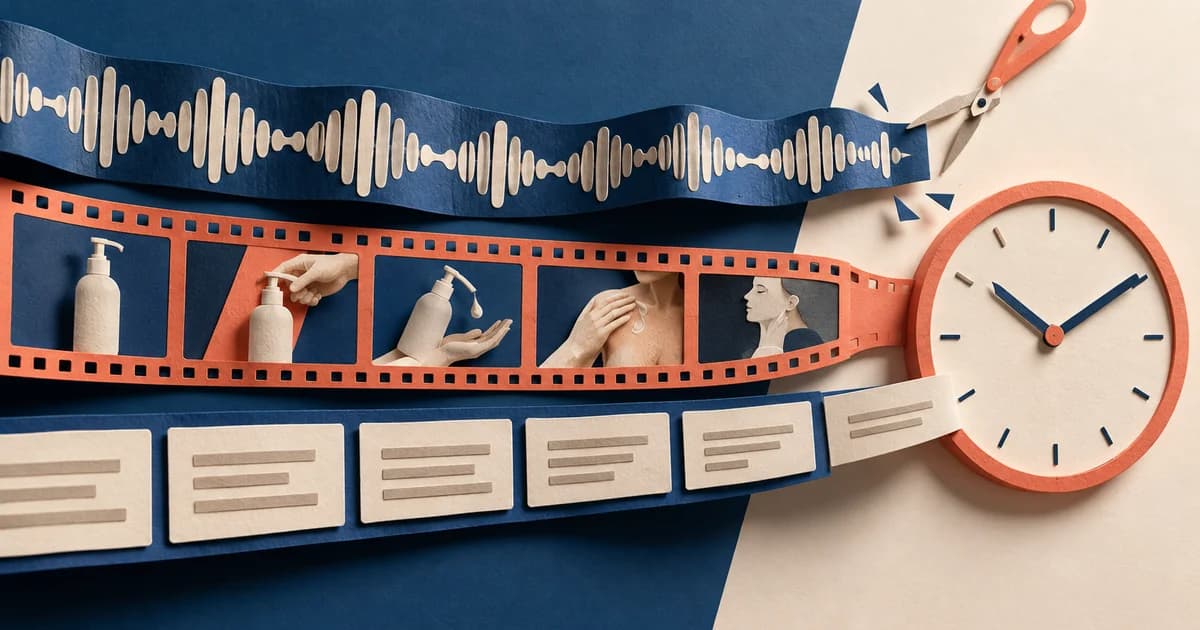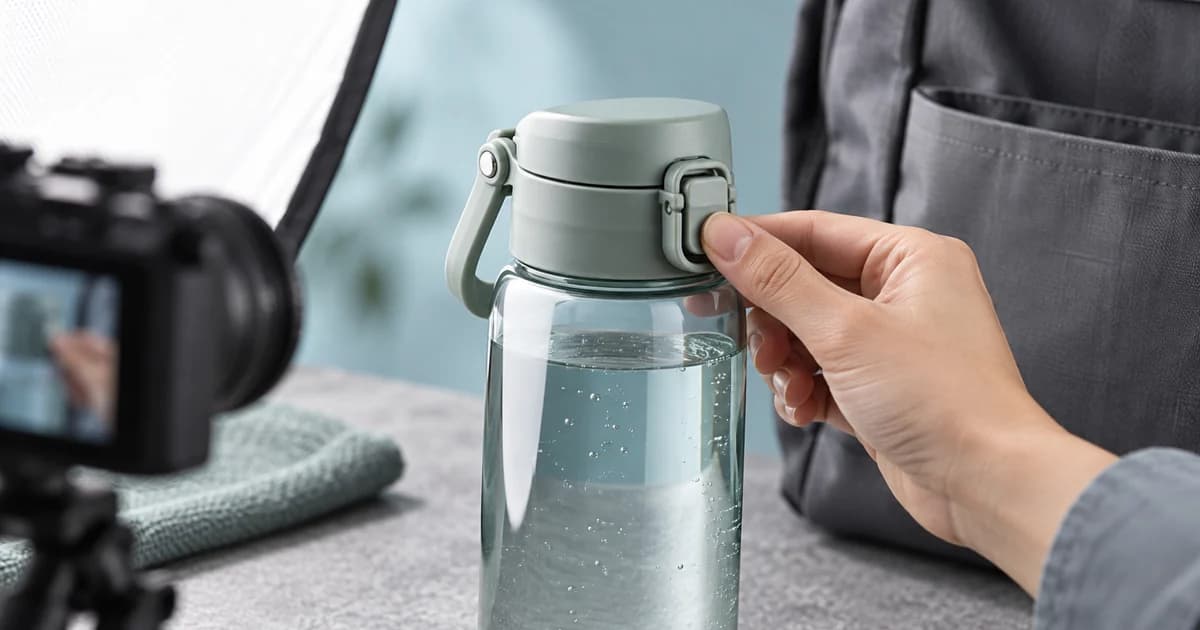
A shot list can look complete and still leave an editor with a hole. Imagine a product video that has a polished hero shot, three attractive close-ups, and a clean image of a closed lid—but no usable footage of the lid actually closing. The list contains plenty of shots. The edit is still uncovered.
The practical fix is to build a commercial shot list backward from the intended edit. Each required edit beat should point to the information the viewer must receive, the shot that can provide it, the product state and people needed to capture it, the time reserved for it, and the accepted file that will eventually enter the timeline. A row is not “done” merely because the camera rolled.
This guide works through a complete synthetic example: a 20-second product commercial for a generic latch bottle. It includes 12 shot-list decisions, 11 shots active in the baseline day, 28 planned visual takes, 11 named audio files, and a 480-minute setup-based schedule. The example is original teaching material, not a completed shoot or a measured production result.
A Commercial Shot List Is Three Linked Views
Public templates show why a single universal field list is the wrong goal. StudioBinder’s March 2026 guide covers scene and shot numbers, description, framing, movement, camera, lens, frame rate, sound, lighting, location, status, prep time, shoot time, and setup timing. Vimeo’s guide, updated in August 2026, emphasizes shot IDs, camera details, lighting, audio, duration, props, and location. Scriptease’s one-page form uses a smaller set—scene, shot, size, angle, movement, lens, description, cast, estimated time, and notes—then leaves a separate area for pickups, inserts, and coverage priorities.
Those are useful examples, not an industry law. The better question is whether your fields support the decisions your crew and editor must make. For a compact product shoot, one dataset can provide three views:
| Working view | The question it answers | Minimum useful fields |
|---|---|---|
| Edit coverage | Can the planned cut communicate every required piece of information? | Beat ID, timeline range, required information, primary shot, valid alternate, invalid substitute, audio need |
| Setup schedule | In what order can the crew capture that coverage? | Stable shot ID, shoot order, lighting group, camera framing, product start/end state, talent/prop window, reset, time allowance, priority |
| Capture log | What actually exists and is safe to use? | Shot ID, take, card and file path, full-action interval, issue/select note, technical QC, edit coverage, brief approval, media verification |
This also keeps the shot list within its proper boundary. An approved storyboard or reference frame may explain composition, but the shot list should translate that approval into executable coverage. It should not become a second storyboard development exercise.
Use stable shot IDs across all three views. Edit order can change. Shoot order can change. A lighting group can contain several camera positions. A take can be rejected. The identifier P06, however, should still mean the same closing action in the edit map, schedule, take log, and pickup decision.
Start With the 20-Second Edit Contract
Before choosing angles, write what the audience must see and for how long. Our example runs at exact 24.000 fps, so 20.000 seconds equals 480 frames. Source and timeline ranges below use an inclusive start and exclusive end: [in, out).
| Timeline | Frames | Required editorial information | Planned source |
|---|---|---|---|
| 00:00–00:02 | 0–48 | Establish the complete bottle and silhouette | P01 T02, source 2.0–4.0 s |
| 00:02–00:05 | 48–120 | Show the latch opening completely | P02 T02, source 2.0–5.0 s |
| 00:05–00:07.5 | 120–180 | Begin the pour in a readable master | P04 T02, source 2.0–4.5 s |
| 00:07.5–00:09 | 180–216 | Finish the pour on a stream detail | P05 T02, source 4.5–6.0 s |
| 00:09–00:11 | 216–264 | Show the bottle closing and latching | P06 T02, source 2.0–4.0 s |
| 00:11–00:14 | 264–336 | Place it upright in the specific BAG01 pocket | P07 T02, source 2.0–5.0 s |
| 00:14–00:16 | 336–384 | Read the closed-lid design detail | P09 T02, source 2.0–4.0 s |
| 00:16–00:20 | 384–480 | End on the hero frame and CTA-safe area | P08 T02, source 2.0–6.0 s |
The arithmetic is explicit: 48 + 72 + 60 + 36 + 48 + 72 + 48 + 96 = 480 frames. More importantly, the table exposes dependencies. P04 and P05 are not just two attractive pour angles. They are expected to represent one continuous four-second event at a compatible phase and water state. P06 must show the closing action; a static image of the closed result cannot replace it.
A public JOBY production breakdown provides a useful real-world mechanism without giving us a full shot log. For one pull-out transition, the filmmakers describe capturing two shots under the same lighting from two camera positions and aligning them in post. The same article explains that device screens were planned as post-production replacements while retaining real reflections in camera. That is the relevant lesson: a transition or composite creates specific capture inputs, not a generic request for “more coverage.” See “Learn How We Shot the Joby Commercial in 6 Colours All in Camera”.
The edit contract must also distinguish the action you need from the extra media around it. Adobe’s January 2026 Premiere documentation defines clip handles as footage before the in-point and after the out-point; it warns that insufficient source media can force repeated frames in a transition. It does not prescribe a universal number of seconds. In this example, two seconds before and after an action is a planning assumption to test, not a standard.
The Filled 12-Decision Product Shot List
The fictional production uses one controlled interior from 09:00 to 17:00; four crew members; hands-only talent available from 10:40 to 16:40; a tripod camera at normal 4K/24; a close-focus zoom; two LEDs with diffusion, bounce, and negative fill; an external audio recorder; and three visually matched bottle samples. The demonstration uses measured water and one specific bag, BAG01. The plan proves only that product-and-bag combination—not universal fit.
Four codes define physical continuity: D0 is dry, empty, and closed; D1 is empty and open; W150 is open with 150 ml of water; W150C is the same fill, closed and latched. BAG-END is the final upright pocket state.
| ID | Editorial job | Lighting / framing | Action and state | Record plan | Priority and acceptance test |
|---|---|---|---|---|---|
| P01 | Establish complete product | U01 / U01-A | Static D0 | 6 s × 2 | Required; whole bottle plus 2 s stable hold |
| P02 | Show complete opening | U02 / U02-A | D0 → D1 | 7 s × 3 | Required; latch never hidden at the decisive moment |
| P03 | Wider opening backup | U02 / U02-B | D0 → D1 | 9 s × 3 | Required backup; full action must remain readable |
| P04 | Master the entire pour | U03 / U03-A | D1 → W150 | 10 s × 3 | Required; water entry, stream, and finish in one take |
| P05 | Insert the stream detail | U03 / U03-B | D1 → W150 | 10 s × 3 | Required insert with P04 fallback; phase and level must match |
| P06 | Show closing and latch contact | U03 / U03-C | W150 → W150C | 6 s × 3 | Required; movement and contact visible; no static substitute |
| P07 | Place bottle in BAG01 | U04 / U04-A | W150C → BAG-END | 9 s × 3 | Required; entry and upright end state visible |
| P08 | Closing hero with CTA space | U01 / U01-B | Static D0 | 8 s × 2 | Required; product and text-safe area readable for 4 s |
| P09 | Closed-lid design detail | U02 / U02-C | Static D0 | 6 s × 2 | Required; detail legible, but does not prove closing action |
| P10 | Conditional clean plate | U01 / P08-matched | Product removed | 10 s × 0 baseline | Inactive; activate only for a named cleanup/composite task |
| P11 | Optional hand bridge | U02 / U02-D | Static D0 continuity | 5 s × 2 | Optional; clean hand path without hiding product |
| P12 | Optional hero variant | U01 / U01-C | Static D0 | 8 s × 2 | Optional; distinct, brief-compatible 4 s hold |
P10 is deliberately inactive, leaving 11 initial active shots. If post defines a real cleanup task before U01 is released, two plate takes add an estimated four minutes. That estimate is not a measured result. A producer could replace an unshot P12 with P10 and keep the baseline time, but cannot recover P12’s four minutes after it has already been filmed.
The plan has four lighting groups but 11 active camera framings: U01 contains three framings, U02 four, U03 three, and U04 one. Calling these “four setups” would hide most reframing work. The exact unit matters whenever someone asks whether the day is feasible.
The baseline creates 28 planned visual take names and 11 audio filenames. Rather than burying every path in the article, the complete records are available in the interactive shot-list workbook, filled shot-list CSV, 28-take manifest, 11-file audio manifest, and edit-to-source map.
Schedule States and Dependencies Before Camera Convenience
Grouping by equipment and lighting can reduce repeated changes, but it does not outrank product state. P06 was initially tempting to place with the dry latch close-ups in U02. That would make the camera list neat and the edit false: the bottle in P06 must already contain the water introduced by P04/P05. The corrected order keeps P04, P05, and P06 together in the wet U03 group, then sends the closed bottle to P07.
Public production accounts show the same class of dependency in different contexts. In a small spec-product breakdown, Chriss Stergiopoulos recommends leaving haze work until the end in a small space; the account also describes fishing-line removal and wet product treatment as planned post and continuity considerations. This example draws on his written account. See “How to film a product commercial at home”. In a larger commercial day account, cinematographer Patrick O’Sullivan describes choosing one early exterior over a hallway shot because both depended on a limited sun window, then pushing the hallway later. That is a reported scheduling decision from that production—not a benchmark for this bottle shoot. See “Commercial Cinematography Series: Day 1 – Side Light”.
Here is the complete one-day scenario:
| Time | Minutes | Work | Dependency or gate |
|---|---|---|---|
| 09:00–09:25 | 25 | Load-in and space check | Location access begins; R01–R04 present |
| 09:25–09:55 | 30 | Prelight, on-set camera/codec confirmation, test offload, room tone | Full workflow preflight already passed; confirm on set; A03 room tone |
| 09:55–10:40 | 45 | U01: P01 → P08 → P12 | Dry B01; P10 inactive |
| 10:40–11:50 | 70 | U02: P02 → P03 → P09 → P11 | T01 present; opening sound; latch orientation |
| 11:50–12:05 | 15 | Early verified offload | A001 and S001 to D1/D2 |
| 12:05–12:20 | 15 | Break | Protected in this scenario |
| 12:20–13:30 | 70 | U03: P04 → P05 → P06 | D1 → W150 → W150C; pour/close sound |
| 13:30–14:15 | 45 | Meal | Protected in this scenario |
| 14:15–14:50 | 35 | U04: P07 | Closed wet bottle; fixed BAG01 orientation |
| 14:50–15:15 | 25 | Remaining verified offload | B001 and S002 to D1/D2 |
| 15:15–15:35 | 20 | Edit-coverage gate | Playback, action intervals, continuity, alternates |
| 15:35–16:10 | 35 | Contingency or pickup | Not silently allocated to another task |
| 16:10–16:30 | 20 | Pickup offload and reconciliation | Used only if new media is created |
| 16:30–16:40 | 10 | Final acceptance and talent release | Coverage, authority, and media state checked |
| 16:40–17:00 | 20 | Strike and exit | Hard 17:00 access end |
The total is 55 load/test + 220 lighting-group work + 60 breaks + 60 data + 20 coverage gate + 35 contingency + 10 final acceptance + 20 strike = 480 minutes.
Every number depends on the stated crew, space, product, reset, take count, codec, and approval arrangement. Pre-approved creative, sourcing, safety planning, reservation, product prep, the full codec/ingest workflow preflight, final post-production, and delivery are outside the day. The 30-minute morning block only confirms the already-tested workflow on location. Add a second location, a hard daylight window, one irreplaceable product, complex liquid resets, a performer with a shorter window, or more elaborate moves, and the one-day premise may fail. Narrow the concept before pretending the spreadsheet can manufacture time.
Capture Complete Actions, Sound, and Only the Plates You Need
A useful shot is an editorial unit, not merely a good-looking moment. P04 is deliberately captured as a full four-second pour master. P05 supplies a closer insert, but the plan survives if P05 is soft or out of phase: the editor can use P04 source 2.0–6.0 seconds across the full timeline interval. P03 can replace P02 only because both are required to contain the complete opening. P09 cannot replace P06 because a closed lid is a result, not the closing action.
Sound receives the same identity discipline. The plan names three opening files, three pour files, three closing files, and two room-tone files. The selected pour recording, A02_POUR_T02.WAV, contributes source 2.0–6.0 seconds to timeline 5.0–9.0 seconds. The selected open and close recordings each provide a short event interval. These are proposed placements; actual sync and listening still decide the edit.
Frame.io’s room-tone workflow guide explains why matching ambience matters and notes that microphone position and time can change the sound of a space. It does not give this shoot a magic fixed duration. The two 30-second room-tone takes are therefore a transparent production assumption. A historical Sound Devices Wave Agent guide is also useful as a field example: its report options separate filenames, scene/take data, duration, notes, wild tracks, and circled takes. The example is a software demonstration, not evidence that a real campaign followed this exact workflow.
Clean plates deserve similar restraint. “Always get a clean plate” sounds safe until it fills the day with unassigned footage. P10 remains off unless someone can name the composite or cleanup task, lock the matching frame, and reserve the marginal time. A plate without a post job is inventory, not coverage.
A Checked Box Is Not an Accepted Edit Beat
A single completion checkbox collapses several different questions. Keep at least these statuses separate:
- Captured: Did the camera or recorder create the expected file?
- Technical QC: Is focus, exposure, motion, sound, and duration acceptable?
- Edit coverage: Does the source contain the information and full action required by the beat?
- Brief approval: Did the designated authority accept the product presentation and claim boundary?
- Media verified: Do the intended copies exist under the chosen verification procedure?
Scriptease’s separate media/card log and circle-take/editor-notes form illustrate why those records need not live in one overloaded box. Current OffShoot verification documentation further distinguishes size checks, source verification, and source-and-destination read-back. Those are product-specific modes, not a universal prescription; the transferable lesson is to name what “verified” means in your plan.
Consider three gate decisions:
| On-set condition | Correct record | Release decision |
|---|---|---|
| P05 insert is unusable, but P04 contains the full pour | P05 stays failed; E03 passes through the documented P04 fallback | U03 may release only after P04’s useful interval and continuity are checked |
| P06 files exist, but the hand hides latch contact | Captured may be yes; edit coverage is no | Use the pickup window or change the brief; file presence is not coverage |
| P08 is creatively accepted, but one destination is not verified | Picture approval passes; media verification stays open | Do not describe data delivery as complete |
Before dismantling a setup, play the required interval—not only a thumbnail or a favorite frame. Compare the start and end state with the continuity reference. Record the selected take and exact file path. Confirm valid alternates and invalid substitutes. Have the named brief authority sign off, and have the media owner report the copy/verification state. Only then release the product state, talent, or location that would be expensive to reconstruct.
Stress-Test the Day Before Calling It Feasible
A schedule that sums to eight hours can still fail under a plausible disturbance. Suppose lunch ends 30 minutes late and P06 needs the modeled 27-minute pickup: 12 minutes to restore the light and reference, five for the wet reset, five for takes, and five for QC. The day has 35 minutes of contingency.
30-minute delay + 27-minute pickup − 35-minute contingency = 22-minute deficit.
With a hard 17:00 exit, the theoretical finish becomes 17:22. That is a no-go, not a reason to compress the coverage gate or pretend the data work is optional. If P11 and P12 are still unshot, dropping their seven- and four-minute marginal allowances recovers at most 11 minutes—still 11 short. If they were already captured, deleting the rows recovers nothing.
Data assumptions need the same test. At a planning ceiling of 150 Mb/s, 40 minutes of recorded video would be 150,000,000 bits/s × 2,400 s ÷ 8 = 45 GB in decimal units. Rounding the main payload to 46 GB, if a preflight measures an end-to-end two-destination copy-and-verification rate of 30 MB/s, adding ten minutes of overhead would produce about 35:33, inside the combined 40-minute allowance. At 10 MB/s, the same model needs about 86:40. The schedule is therefore conditional on a preflighted workflow; a storage device’s advertised interface speed is not the input.
Finally, stress-test the edit itself. If the real pour needs six seconds, the original four-second beat cannot contain it. One honest 20-second alternative is 1 + 3 + 6 + 2 + 3 + 1 + 4 = 20 seconds: shorten the establish and detail beats to one second each. If those details become unreadable, extend the deliverable or remove a feature. Do not tell the operator to “pour faster” after the physical action has already disproved the edit.
The resulting commercial shot list template is not proof that the shoot will work. It is a decision model that exposes what must be true for the shoot and edit to work. Keep the edit job, product state, time budget, accepted file, and fallback linked. Then the list can tell you what to film, what to check, what to drop, and when the honest answer is that one day is not enough.
Sources
- “The Only Shot List Template You Need — with Free Download”, StudioBinder, March 9, 2026.
- “How to make a shot list to simplify the video production process”, Vimeo, published October 1, 2024; updated August 10, 2026.
- “Shot List — On-Set Template”, Scriptease, date not stated.
- “Media / Card Log — On-Set Template”, Scriptease, date not stated.
- “Circle Take / Editor Notes Sheet — On-Set Template”, Scriptease, date not stated.
- “Clip handles settings”, Adobe, updated January 7, 2026.
- “Roomtone”, Frame.io, date not stated.
- “Learn How We Shot the Joby Commercial in 6 Colours All in Camera”, Syrp Lab, October 4, 2022.
- “How to film a product commercial at home (Backstage Breakdown)”, Chriss Stergiopoulos, May 18, 2021.
- “Commercial Cinematography Series (Part 6): Day 1 – Side Light”, Wandering DP, date not stated.
- “Verification”, Hedge / OffShoot, date not stated.
- “Wave Agent User Guide and Technical Information — Beta 1.2”, Sound Devices, date not stated; historical software documentation.