A media buyer asks for “the Performance Max assets,” and production sends three headlines, one square image, and a landscape video. The campaign may be publishable, but the handoff is not complete. Google still has to stretch a narrow set of ideas across Search, Display, Discover, Gmail, Maps, YouTube, and Shorts—and may create or reshape assets to fill the gaps.
For one focused product, a stronger production target is 15 short headlines, five long headlines, five descriptions, four horizontal images, four square images, two vertical images, a square logo, a horizontal logo, and one custom video in each of 16:9, 1:1, and 9:16. That goes beyond the launch minimum, but it matches Google’s current recommended image coverage, fills every text slot, and supplies all three recommended video orientations instead of depending on automatic video creation. Google’s current specification table is the source of truth for these counts and limits: Performance Max campaigns specs and format requirements.
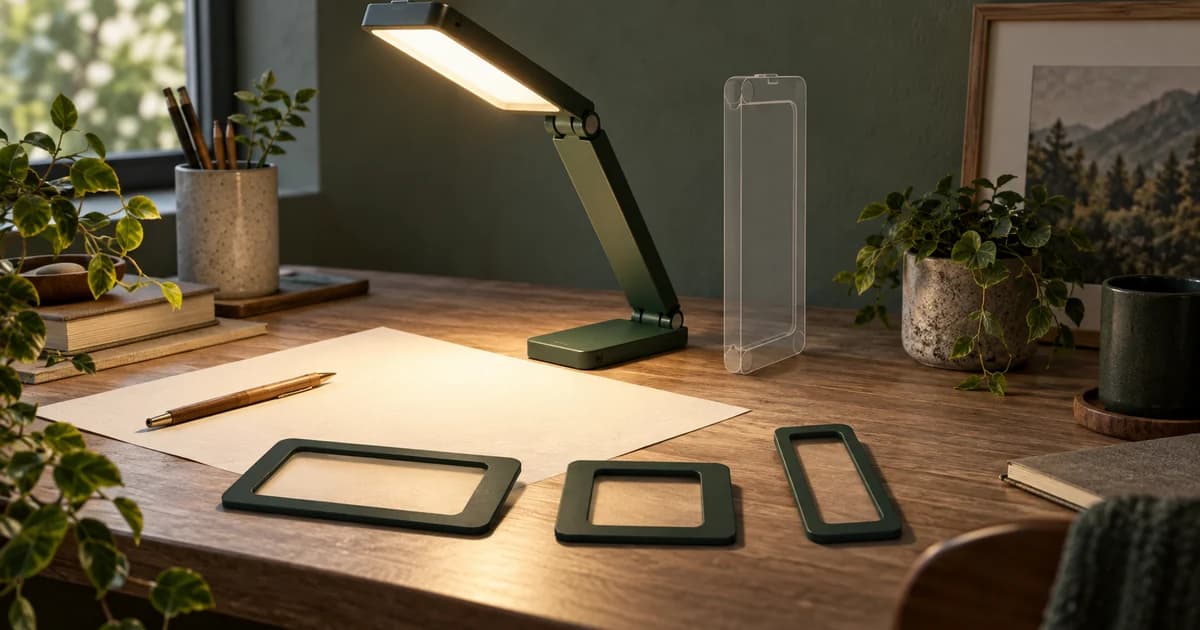
This article turns that list into a finished example for LumaFold One, a fictional fold-flat task light for small desks. The downloadable files are original teaching assets, not a live campaign, a policy approval, or performance evidence. The point is to show what a coherent delivery looks like before the media buyer opens Google Ads.
Separate the publishing minimum from the production brief
The smallest valid non-retail asset group is not the same thing as a useful creative pack. Google’s API documentation lists the hard minimum as three headlines, one long headline, two descriptions, one landscape marketing image, and one square marketing image. Business name and logo placement depends on whether campaign-level brand guidelines are enabled. Video is optional for publication. Google Ads API: Asset requirements
Google’s advertiser-facing specification page then recommends a broader set: 11 or more headlines, two or more long headlines, four or more descriptions, four or more horizontal images, four or more square images, and two or more vertical images. It also recommends a horizontal, square, and vertical video, each at least 10 seconds. If no video is supplied, Google may generate one; the page says custom videos in all three formats are needed to prevent that automatic video generation and reach “Excellent” Ad Strength. Performance Max campaigns specs and format requirements
| Asset type | Publishable non-retail minimum | Current recommended coverage | LumaFold pack |
|---|---|---|---|
| Headlines, 30 characters max | 3 | 11+; up to 15 | 15 |
| Long headlines, 90 characters max | 1 | 2+; up to 5 | 5 |
| Descriptions, 90 characters max | 2 | 4+; up to 5 | 5 |
| Horizontal images, 1.91:1 | 1 | 4+ | 4 |
| Square images, 1:1 | 1 | 4+ | 4 |
| Vertical images, 4:5 | 0 | 2+ | 2 |
| Square logo, 1:1 | 1 when required at the relevant level | 1; up to 5 logos in brand guidelines | 1 |
| Horizontal logo, 4:1 | 0 | 1 | 1 |
| Custom video, 16:9 | 0 | 1 | 1 |
| Custom video, 1:1 | 0 | 1 | 1 |
| Custom video, 9:16 | 0 | 1 | 1 |
Retail campaigns have one important exception: when a Merchant Center feed is linked, Google’s API documentation says the minimum necessary asset set can be generated automatically. The same documentation still recommends uploading additional assets to expand inventory coverage. The LumaFold pack treats feed data and product imagery as inputs to coordinate with—not substitutes for—the creative handoff. Google Ads API: Asset requirements
That table is a production decision, not a universal promise that every asset will serve. Performance Max mixes and matches assets from the same group across applicable formats. Google therefore advises building an asset group around one theme or audience. Build an asset group The practical consequence is stricter: every headline should make sense beside every image in the group, and every image should support the same landing-page promise.
Start with one product truth, not 25 disconnected lines
The fictional brief for LumaFold One is deliberately narrow:
- Product: a rechargeable task light that folds flat.
- Primary job: give a compact workspace focused light without permanently occupying the desk.
- Supportable features: adjustable hinge, three brightness levels, USB-C charging, cord-free use after charging, and flat storage.
- Primary audience: people using small, shared, temporary, or travel workspaces.
- Final URL placeholder:
https://lumafold.example/products/one. - Call to action: Shop now.
- Display paths:
fold-lightandsmall-desks.
The .example domain is intentionally non-live. A real upload needs the advertiser’s verified domain, a landing page that substantiates every claim, and a business name that exactly matches the domain or verified legal name. Google caps the business name at 25 characters and manages business name and logos through campaign-level brand guidelines in the current workflow. About brand guidelines
The creative spine is one sentence: focused light when you need it, desk space when you do not. Features earn their place only when they prove that sentence. “Three brightness levels” shows control. “Adjustable hinge” shows direction. “Folds flat” resolves the space problem. By contrast, generic phrases such as “Upgrade your workspace today” consume a headline slot without identifying the product, problem, or mechanism.
The complete text pack
Filling all text slots is useful only when the lines do different jobs. This set distributes product identity, problem recognition, mechanism, use case, and action. Character counts include spaces and punctuation.
| # | Short headline | Characters | Job |
|---|---|---|---|
| 1 | Light Your Desk | 15 | Ultra-short product outcome |
| 2 | Meet LumaFold One | 17 | Product identity |
| 3 | A Desk Light That Folds | 23 | Category plus difference |
| 4 | Clear Light, Less Clutter | 25 | Benefit contrast |
| 5 | Packs Flat After Work | 21 | Storage behavior |
| 6 | Three Brightness Levels | 23 | Feature proof |
| 7 | Aim Light Where You Need It | 27 | Hinge benefit |
| 8 | Recharge With USB-C | 19 | Charging feature |
| 9 | Made for Small Desks | 20 | Audience and use case |
| 10 | Open. Aim. Get to Work. | 23 | Product sequence |
| 11 | A Travel-Ready Task Light | 25 | Portable use case |
| 12 | Cord-Free After Charging | 24 | Use condition |
| 13 | Fold It Flat Between Tasks | 26 | Repeated-use behavior |
| 14 | Light for Shared Desks | 22 | Shared-space use case |
| 15 | Shop the Fold-Flat Light | 24 | Product-specific action |
Google asks for at least one headline of 15 characters or fewer; “Light Your Desk” satisfies that requirement without collapsing into a vague fragment. The set also avoids a common combinatorial problem: none of the lines introduces a sale, price, warranty, battery runtime, or performance claim that the images and landing page do not support.
The five long headlines carry a complete proposition when a format gives them more room:
- A fold-flat task light that keeps small desks clear and ready for work — 70 characters.
- Open the LumaFold One, aim the light, and get to work without desk clutter — 74 characters.
- Three brightness levels and an adjustable hinge in one travel-ready desk light — 78 characters.
- Give a small workspace focused light, then fold it flat when the work is done — 77 characters.
- A rechargeable desk light designed for flexible workspaces and compact storage — 78 characters.
The five descriptions add explanation rather than repeating the same slogan:
- Open it for focused light. Fold it flat when your desk needs the space back. — 76 characters.
- Choose from three brightness levels and aim the hinge where you need light. — 75 characters.
- Recharge by USB-C, work cord-free, and pack the lamp flat between sessions. — 75 characters.
- Built for small desks, shared tables, dorm rooms, and flexible work setups. — 75 characters.
- See the LumaFold One in every position and choose the setup that fits your desk. — 80 characters.
The pack includes these fields in HB63_copy_deck_v1.csv, so production and media teams can check the exact approved strings rather than copying from a slide or chat thread.
The image pack: ten compositions, not ten crops
Google currently recommends 1200 × 628 for horizontal images, 1200 × 1200 for square images, and 960 × 1200 for vertical images. JPG and PNG are accepted in the advertiser-facing image guidance, with a 5 MB maximum. Keep essential content inside the center 80% safe area because different placements can crop the edges. The supplied compositions still need a placement-specific crop review; the manifest does not certify safe-area compliance. Google also recommends at least one image without text or graphic overlays in every supplied aspect ratio. About image assets for Performance Max campaigns

The pack uses four repeatable creative jobs rather than making arbitrary visual variations:
| File | Dimensions | Creative job | Requirement or gap it covers |
|---|---|---|---|
| lumafold_h01_clean_product_1200x628.png | 1200 × 628 | Clean product identity | Horizontal image without overlay |
| lumafold_h02_small_desk_scene_1200x628.png | 1200 × 628 | Product in context | Horizontal small-workspace use case |
| lumafold_h03_three_positions_1200x628.png | 1200 × 628 | Mechanism demonstration | Horizontal feature explanation |
| lumafold_h04_packs_flat_message_1200x628.png | 1200 × 628 | Benefit-led message | Fourth horizontal concept |
| lumafold_s01_clean_product_1200x1200.png | 1200 × 1200 | Clean product identity | Square image without overlay |
| lumafold_s02_travel_flat_1200x1200.png | 1200 × 1200 | Portability context | Square use-case variation |
| lumafold_s03_brightness_levels_1200x1200.png | 1200 × 1200 | Feature demonstration | Square product-control story |
| lumafold_s04_small_desk_benefit_1200x1200.png | 1200 × 1200 | Benefit-led message | Fourth square concept |
| lumafold_p01_clean_desk_scene_960x1200.png | 960 × 1200 | Clean mobile composition | Vertical image without overlay |
| lumafold_p02_open_aim_pack_960x1200.png | 960 × 1200 | Two-step product story | Second vertical concept |
The horizontal, square, and vertical files are separately composed. That matters because “make the landscape image vertical” is not a crop instruction; it is a new layout problem. The horizontal scene can place copy on the left and the lamp on the right. The vertical scene needs a top-to-bottom reading order and more space around the product. Blind cropping would either remove the lamp head, shrink the product into irrelevance, or cut the message.
Two additional files carry brand identity: lumafold_logo_square_1200x1200.png and lumafold_logo_horizontal_1200x300.png. They are included as handoff assets, but their upload level is a campaign configuration question. With brand guidelines enabled, current Google documentation places business name and logo assets at campaign level rather than treating them as ordinary asset-group images. Google Ads API: Asset requirements
The video pack: three native orientations with one message order
A single landscape master is not a complete PMax video delivery. Google recommends Full HD source dimensions of 1920 × 1080, 1080 × 1080, and 1080 × 1920 for horizontal, square, and vertical video. Each orientation must be at least 10 seconds; a vertical video between 10 and 60 seconds is recommended for Shorts eligibility. Google may resize or transform uploaded videos, but that automation is not the same as an intentionally composed vertical edit. About video assets for Performance Max campaigns
The LumaFold pack contains three original 12-second H.264/AAC MP4s:

| Time | Message | Visual responsibility |
|---|---|---|
| 0.0–2.4 seconds | “Small desk?” | Establish the folded product and space problem immediately |
| 2.4–5.4 seconds | “Open. Aim. Work.” | Show the product category and adjustable form |
| 5.4–8.2 seconds | “3 light levels” | Turn a feature into visible controls and light output |
| 8.2–10.2 seconds | “Packs flat” | Resolve the clutter problem with the storage behavior |
| 10.2–12.0 seconds | LumaFold and product-specific CTA | Close with brand and action, not a new claim |
These are production examples, not observed ads. Each packaged video independently decoded as 288 video frames at 24 fps over 12 seconds, with an audio stream. This verifies file integrity; it does not establish Google approval, serving behavior, or campaign results.
Decide what automation is allowed to change
A complete pack does not switch off every automated feature by default. It makes the decision visible.
Text customization is on by default. Google may create dynamic headlines, descriptions, and additional text grounded in landing-page content, and says those assets are refreshed at least every 48 hours. The setting can be controlled under Campaign settings → Asset Optimization → Text Customization. About text customization in Performance Max campaigns Controlling text customization in Performance Max campaigns
Final URL expansion can replace the supplied final URL with another relevant page on the same domain. For a one-product asset group, that can be useful only when the rest of the eligible site supports the same promise. If a category page, support article, or different product would break the relationship between copy, video, and destination, use URL exclusions or turn the setting off after reviewing the account’s structure.
Automatic video creation is the clearest avoidable gap. Supplying all three custom orientations gives Google less reason to construct a video from stills and text. It also lets the producer control product scale, reading order, and end-card timing instead of discovering an automatic version after launch.
Video enhancements remain a separate choice. Google can create other orientations, shorter edits, and—in eligible English assets—voice-over versions. For Performance Max, the enhancement control is available during campaign creation under Asset optimization → Video. About video enhancements Even with three native videos, review that setting; “we supplied every ratio” and “Google may generate additional versions” can both be true.
Brand guidelines are also campaign-level controls. Review the inferred business name, logos, font, and colors rather than assuming the landing page was interpreted correctly. The supplied LumaFold logo files are production-ready examples, but a live campaign still needs verified identity, landing-page visibility, and policy review.
Package the work so someone else can audit it
A folder full of final images is not enough. The buyer needs to know which files are upload assets, which are article references, which claims were approved, and which platform settings remain decisions.
This package includes:
HB63_copy_deck_v1.csvwith every text field, count, character limit, and creative job.- HB63_product_brief_v1.md with the fictional product truth, exclusions, destination fields, and asset-group theme.
- HB63_asset_manifest_v1.csv with dimensions, ratios, formats, byte sizes, roles, overlay status, and upload status.
HB63_media_probe_v1.jsonwith machine-read video stream and duration data.- HB63_upload_checklist_v1.md with the replacement and account checks required before a real upload.
- Original PNG, MP4, WAV, storyboard, contact-sheet, and source-generation files.
The filename pattern is intentionally plain: brand, orientation or role, dimensions, and duration where relevant. A producer can identify lumafold_v03_vertical_1080x1920_12s.mp4 without opening it, and the manifest tells the buyer why it exists.
A pre-upload check for one-product asset groups
Before handing the pack to the account operator, verify the following in order:
- Replace the fictional URL with the exact live product page and confirm that every feature in the copy appears on that page.
- Replace the fictional business name only if the advertiser’s domain or verified legal name differs; keep it within 25 characters.
- Run the text deck through a character-count check after any edit. A one-word change can push a valid line over 30 or 90 characters.
- Confirm four horizontal, four square, and two vertical marketing images are present, and that each ratio includes a clean image without overlays.
- Confirm every image is the intended ratio, under 5 MB, legible, rights-cleared, and composed with essential content inside the center 80%.
- Confirm the square and horizontal logos are legible at small sizes and upload them through the correct brand-guideline workflow.
- Play all three videos from beginning to end with sound. Check 16:9, 1:1, and 9:16 as independent edits, not thumbnails of one master.
- Decide explicitly whether text customization, Final URL expansion, and video enhancements should remain on. Record URL exclusions where needed.
- Preview combinations. Look for a headline that becomes redundant, misleading, or nonsensical beside any supplied image.
- After upload, review policy status, asset sources, automatically created assets, and the asset report. A complete production pack reduces uncontrolled gaps; it does not remove the platform review step.
The best PMax asset pack is not the largest folder. It is the smallest coherent set that covers every important format without forcing the platform to invent the product story.
For LumaFold One, that coherent set is now concrete: 25 text variations, ten marketing images, two logo treatments, and three native-orientation videos, all centered on one product truth. The reusable method is equally concrete: separate minimums from recommendations, assign each asset a job, recompose rather than crop, supply the video formats you care about, and document the automation decisions that remain.
Sources
- Performance Max campaigns specs and format requirements — Google Ads Help.
- About image assets for Performance Max campaigns — Google Ads Help.
- About video assets for Performance Max campaigns — Google Ads Help.
- Build an asset group — Google Ads Help.
- About text customization in Performance Max campaigns — Google Ads Help.
- Controlling text customization in Performance Max campaigns — Google Ads Help.
- About brand guidelines — Google Ads Help.
- About video enhancements — Google Ads Help.
- Asset requirements for Performance Max — Google Ads API documentation; last updated August 19, 2026.